
R910920969 AA10VS0100DFR/31R-VPA12N00 German Rexroth hydraulic piston pump
| Parameter | Specifiion |
|---|---|
| Order Number | R910920969 |
| Model | AA10VSO100DFR/31R-VPA12N00 |
| Type | Variable displacement axial piston pump (swashplate design, open circuit) |
| Nominal Displacement | 100 cm³/rev |
| Control Type | DFR (Pressure Cut-off + Flow Control / Load Sensing) |
| Pressure Rating | 280 bar (Continuous) 350 bar (Peak, intermittent) |
| Speed Range | 1500 - 1800 rpm (Recommended) Max. speed 2000 - 2400 rpm (limited by inlet conditions) |
| Rotation Direction | Right-hand (R) (viewed from shaft end) |
| Shaft Type | Splined shaft (SAE standard) |
| Port Connection | VPA12N (SAE flange, side ports, no through-drive) |
| Mounting Flange | ISO 3019-2 (Series 31) |
| Seal Material | NBR (Standard for mineral oil) |
| Suitable Media | Mineral oils (HL, HLP), HLP-D, HVLP |
| Media Temperature | -20 °C to +80°C (Start-up viscosity < 1000 mm²/s) |
| Recommended Viscosity | 16 - 68 mm²/s (ISO VG 32-68) |
| Cleanliness Requirement | ISO 4406 20/18/15 or better |
| Weight | Approx. 45 - 50 kg |
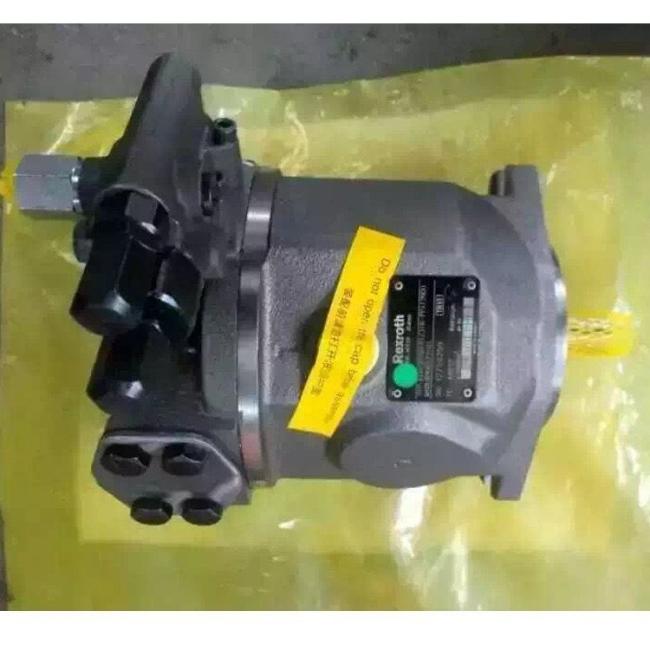
DFR is a combined pressure-flow control with load sensing (LS).
- Pressure Control: Limits system pressure to a set maximum (like a relief valve).
- Flow Control (LS): The pump automatically adjusts its swashplate angle to deliver only the flow required by the actuators, maintaining a constant pressure differential (Δp) across the control orifice. This results in significant energy savings compared to constant flow pumps.
No. The code N00 in VPA12N00 explicitly indies no through-drive. The shaft does not extend through the rear cover, so you cannot mount a second pump (gear or piston) on the back of this unit. If you need a tandem pump configuration, you must order a variant with a through-drive code (e.g., ending in K...).
- Case Drain (L ports): This pump has two case drain ports. They must be connected separately to tank with minimal backpressure (max 2-3 bar). Do not tee them into the main return line. This is critical for flushing heat and preventing seal/bearing failure.
- Suction Conditions: Ensure inlet pressure at port S is ≥ -0.8 bar (absolute) to avoid cavitation. Use short, large-diameter suction lines.
- Rotation: Confirm motor rotation matches the pump's "R" (clockwise) designation. Running backwards can destroy the pump.
- Noise: Usually caused by cavitation. Check suction filter, inlet line for leaks, or oil viscosity being too high at startup.
- Overheating: Often due to excessive case pressure (blocked or undersized case drain line) or operating for long periods at high pressure with small displacement (high power loss).
The DFR control has two adjustment screws (usually under caps on the control housing):
- Pressure Limiter: Sets the maximum system pressure (clockwise to increase).
- Flow Controller (LS Δp): Sets the pressure differential for load sensing (typically set to 10-20 bar).
Always adjust under controlled conditions with a pressure gauge.
Yes. While the DFR control limits pressure, it is not a safety valve. You must install a separate system relief valve (e.g., a DB/DBW type) in the main line as a safety backup against control failure.
- DFR: Typically used in industrial appliions with explicit pressure/flow control.
- DRS: Often used in mobile appliions with a stronger emphasis on load sensing. The functional principle is very similar, but the control response and internal pilot circuitry may differ.
Get in Touch
Have questions about our products or want to discuss a custom order? Our team is ready to help you.