
100g Car Clay Bar For Removing Overspray And Fallout Automotive Clay Bar
A clay bar (also called "auto clay bar" or "detail clay") is a specialized, soft, and malleable cleaning tool designed for deep decontamination of a car’s paintwork (and sometimes other smooth surfaces like glass or chrome). Unlike regular car washes that only remove surface dirt (e.g., dust, mud), a clay bar targets embedded contaminants that stick to the paint’s clear coat—substances that can’t be wiped away with soap and water alone.
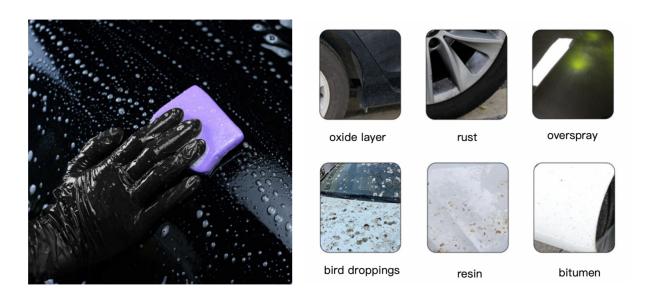
Its key job is to "lift" and trap stubborn, invisible (or barely visible) pollutants that build up on a vehicle over time, including:
- Iron particles: From brake dust, industrial fallout, or rail dust (often appear as tiny orange/brown spots).
- Tree sap, bird droppings residues: Sticky substances that harden and bond to the paint.
- Road grime, tar: Tiny bits of asphalt or road debris that embed in the clear coat.
- Industrial pollutants: Dust, smog particles, or pollen that cling to the surface.
For most car owners (sedan/SUV drivers who detail 2–4 times a year), the 100g bar hits the sweet spot:
- Full-body coverage, no hassle: One 100g bar handles a complete decontamination (from roof to trunk) without being too heavy to maneuver. It’s easy to shape into a flat pad for large areas or a small ball for tight spots (like around headlights).
- Freshness that lasts: It’s small enough to use up in 1–2 sessions, so the clay never sits unused long enough to dry out or collect dust. You’ll always get smooth, effective cleaning.
- Budget-friendly balance: It costs less than larger bars but doesn’t skimp on usability—great for anyone who wants reliable results without overspending.
| Grade | Color choice | Size choice | Advantage |
|---|---|---|---|
| A+ | Blue, grey, orange | 50g, 100g, 150g, 200g | ✅ Cost-Effective ✅ Strong Friction & Fast Action ✅ Deep Cleaning |
| A++ | blue, grey | 50g, 100g, 150g, 200g | ✅ Non-Sticky & Residue-Free ✅ Rapid Contaminant Removal ✅ Waterless Storage |
| A+++ | blue, purple, white | 50g, 100g, 150g, 200g | ✅ Exceptional Stretch & Durability ✅ Scratch-Free Guarantee ✅ No Residue or Shedding |
| Feature | Our clay bar | Poor quality clay bar |
|---|---|---|
| Material | High-purity polymer, no impurities. Soft and smooth to the touch with no noticeable grit, minimizing the risk of scratching car paint during use. | Contains fillers/recycled material. Contains hard abrasive particles that easily cause swirl marks or micro-scratches after use. |
| Tackiness | Optimal Tackiness: balanced adhesion—effectively removes stubborn contaminants like iron particles, tar, and bug residue without excessive sticking to paint. | Improper Tackiness:either too weak (fails to pick up dirt) or too strong (excessive resistance, sticks aggressively to paint, and leaves residue) |
| Durability | Resuable multiple times, maitaining flexibility even after cleaning an entire vehicle. | Clay quickly becomes saturated with contaminants, loses cleaning effectiveness after just a few folds, and requires frequent replacement. |
| Flexibility | Excellent flexibility,can be repeatedly kneaded and reshaped. | Poor Flexibility: Either too stiff or too soft, making it difficult to shape. |
| Efficiency | Fast & efficient cleaning: Cleans quickly while protecting paint | Poor efficiency: reuires 3-5 passes for equivalent cleaning. |

- Restores smoothness: After using a clay bar, the paint will feel noticeably smoother to the touch (often described as "glass - like")—a key sign that contaminants are gone.
- Protects the paint & clear coat: Embedded contaminants (like metal particles) can scratch the paint over time or react with moisture to cause rust spots. Removing them prevents long - term damage.
- Improves wax/sealant performance: Waxes, sealants, or ceramic coatings adhere best to a clean, smooth surface. A clay bar creates a "pristine base," helping these protective products last longer and deliver better shine.
- Lubrication first: To avoid scratching the paint, you must spray a clay lubricant (or a mild, pH - neutral car shampoo diluted with water) on the surface and the clay bar itself. This creates a slippery barrier so the clay glides smoothly.
- Gentle gliding: Mold the clay bar into a flat, palm - sized shape, then glide it over the lubricated surface using light, back - and - forth motions (like ironing). The clay’s sticky, malleable texture traps contaminants as it moves.
- Refresh as needed: As the clay picks up dirt, it will feel gritty. Fold it over to expose a clean, unused layer—repeat until the clay feels smooth again or you’ve finished the section.
- Keep the surface thoroughly lubricated at all times during clay use.
- Don't be alarmed if you feel resistance initially when gliding the clay; it will move more easily as you continue, leading to a smoother finish.
Get in Touch
Have questions about our products or want to discuss a custom order? Our team is ready to help you.