
Stainless Steel 904L Hex metal Bolts Available in Various Sizes 5/8”-11 Anodized Finish Corrosive Environments
| Attribute | Value |
|---|---|
| Usage | Fastening |
| Size | Various sizes available |
| Style | Steel hex head with washer nut |
| Head Style | Hexagon head |
| Strength | High |
| Finish | Polished/Zinc/Anodizing |
| Manufacturer | JIA SHAN Hardware Company |
| Length | As customisation |
| Package | Small Packing+Carton Packing+Pallet |
| Standard | DIN |
| Package Quantity | 100 pieces |
| Shape | Bolt |
| Measurement System | INCH, Metric |
| Port | Shenzhen |
| Quality | Inspection before shipment |
| Color | As customisation |
| Material | Steel:304/316/301/310/201 |
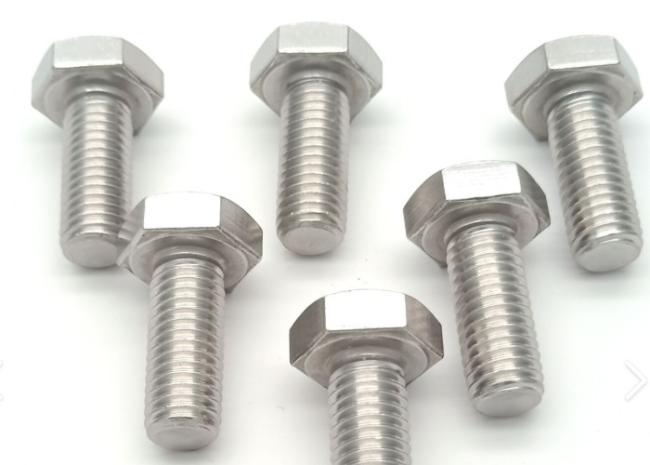
Hex bolts are widely used across various industries and products due to their simple design, high strength, and ease of installation. Hexagonal bolts' anti-loosening method, first: friction anti-loosening method; second: mechanical anti-loosening method; third: permanent anti-loosening method; fourth: riveting and punching anti-loosening method; fifth: structure anti-loosening method.
Friction anti-loosening
This is one of the most widely used anti-loosening methods, this method between the threaded vice to produce a positive pressure that does not change with the external force to produce a friction that can restrain the relative rotation of the threaded vice. This positive pressure can be achieved by axial or simultaneous two-way compression of the threaded sub. Such as taking elastic washers, double nuts, self-locking nuts and nylon inserts lock nuts. This method of anti-loosening against the disassembly of the nut is relatively convenient, but in the blow, vibration and variable load environment, the beginning of the bolt will lead to preload due to relaxation of the landing, with the growth of the number of vibration, the loss of preload demented increase, will eventually lead to nut loosening, threaded joint failure.
Mechanical anti-loosening
The use of cotter pins, stop shims and string wire rope. Mechanical anti-loosening method is more reliable, against the important connection to use mechanical anti-loosening method.
Permanent anti-loosening
Spot welding, riveting, bonding and so on. This method in the disassembly of most of the threaded fasteners to be crushed, can not be reused.
Rivet punch anti-loosening
Accepted after tightening the punch point, welding, bonding and other methods, so that the threaded vice to lose the activity of the vice characteristics of the connection does not demolition connection. The disadvantage of this method is that the bolt can only be used once, and disassembly is very difficult, must be crushed bolt side can be disassembled.
Structural anti-loosening
The structure of the anti-loosening does not rely on the force of outsiders, relying only on its own structure. Structural anti-loosening method that is Tang's thread anti-loosening method, but also the beginning of the best anti-loosening method into and results, but not for most people know.
- Construction Industry - Hex bolts are commonly used in structural steel connections, such as bridges, building frameworks, and scaffolding. Their ability to handle heavy loads and external forces like wind ensures stability and durability in construction projects.
- Machinery Manufacturing - In machinery and equipment assembly, hex bolts are essential for fastening mechanical parts in machinery such as lathes, heavy-duty equipment, and assembly lines. Their high strength and durability make them suitable for machines operating under vibration and heavy loads.
- Automotive and Transportation - Hex bolts are widely used in the automotive industry for securing critical parts like chassis, engines, and transmission systems. Their strength and reliability help maintain the vehicle's integrity under high-speed and heavy-duty conditions.
- Home Appliances and Electronics - Hex bolts are used to assemble and secure parts in appliances such as air conditioners, washing machines, and televisions. They provide reliable connections and ensure the overall stability of the products.
- Energy and Petrochemical Industry - Hex bolts are crucial in wind turbines, nuclear power plants, and petrochemical plants, where they are used in securing large equipment and pipeline systems. Their corrosion resistance and strength allow them to perform in harsh environments.
- Marine and Offshore Engineering - In shipbuilding and offshore platforms, hex bolts are used to secure deck fittings, hulls, and equipment. Stainless steel hex bolts, in particular, resist corrosion from seawater, ensuring the longevity of marine structures.
- Furniture Manufacturing - Hex bolts are frequently used in the assembly of furniture such as beds, tables, chairs, and cabinets. Their easy installation and firm fastening provide stability and long-term durability to household and office furniture.
Anodizing is a process that enhances the corrosion resistance and surface properties of metals, particularly aluminum. Here's a detailed look at how anodizing improves corrosion resistance and other key properties:
Corrosion Resistance
Anodizing significantly enhances the corrosion resistance of aluminum by forming a thick, protective oxide layer on its surface. This layer acts as a barrier against environmental factors such as moisture, chemicals, and UV exposure. The anodized layer is integral to the metal, meaning it won't chip or peel like traditional coatings. This makes anodized aluminum ideal for harsh environments, including marine and aerospace applications.
Surface Hardness and Durability
The anodizing process creates a hard, wear-resistant surface that protects against scratches and abrasion. This is particularly beneficial for components that experience frequent handling or mechanical stress. Hard anodizing (Type III) further increases this hardness and durability, making it suitable for high-stress environments.
Aesthetic Enhancements
Anodizing not only improves functionality but also enhances the visual appeal of metal parts. The process allows for a variety of finishes, including matte, glossy, and textured surfaces. Additionally, the porous nature of the anodized layer enables it to absorb dyes, resulting in vibrant and long-lasting colors.
Electrical Properties
The anodized layer acts as an electrical insulator, which can be advantageous in electronic applications where components need to be isolated from electrical currents. This property ensures that the underlying metal remains conductive while the surface provides insulation.
- Type I (Chromic Acid Anodizing): Forms a thin, protective layer suitable for decorative purposes.
- Type II (Sulfuric Acid Anodizing): Creates a thicker layer that offers better corrosion resistance and can be dyed for aesthetic purposes.
- Type III (Hard Anodizing): Produces the thickest and most durable oxide layer, ideal for applications requiring high durability.
| No. | C% | Cr% | Ni% | Mo% |
|---|---|---|---|---|
| 304 | 0.07 | 17.5-19.5 | 8.0-10.5 | / |
| 316 | 0.08 | 16.0-18.0 | 10.0-14.0 | 2.00-3.00 |
| 301 | 0.15 | 16.0-18.1 | 6-8 | / |
| 310 | 0.08 | 24-26 | 19-22 | / |


Get in Touch
Have questions about our products or want to discuss a custom order? Our team is ready to help you.