
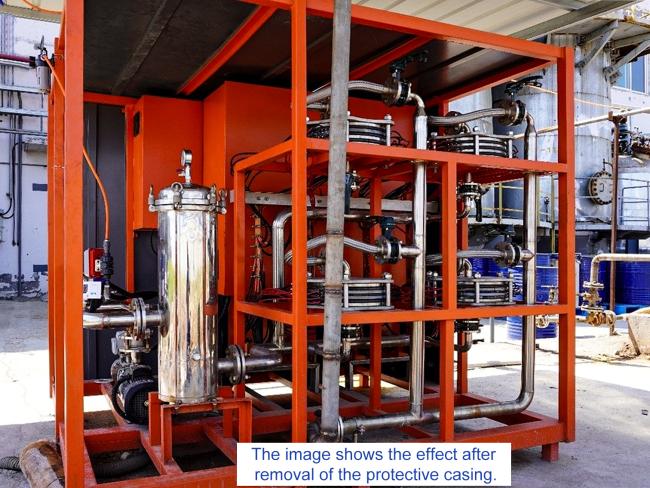
Electrochemical wastewater treatment equipment for coking wastewater treatment
I. Product Overview
Coking wastewater is one of the most difficult wastewaters to treat in the coal chemical industry. It originates from the high-temperature carbonization (coking), gas purification, and chemical product recovery processes of coal, and mainly includes residual ammonia water, final cooling wastewater from coal gas, crude benzene separation water, and tar processing wastewater. Its typical water quality characteristics are: high COD concentration, high ammonia nitrogen concentration, high content of recalcitrant toxic substances (phenols, benzene series compounds, polycyclic aromatic hydrocarbons, heterocyclic compounds such as pyridine, quinoline, carbazole, etc.), extremely poor biodegradability (BOD₅/COD typically 0.10~0.20), high cyanide and sulfide content, oil content (tar), and large fluctuations in water quality and quantity.
The treatment of coking wastewater has long been a core environmental challenge for coking enterprises. Traditional process routes typically follow the pattern of "pretreatment (oil removal, phenol removal, ammonia stripping) → biological treatment (A/O, A²/O, SBR, etc.) → advanced treatment," but face numerous challenges in actual operation: ① Phenolic compounds, cyanides, and heterocyclic compounds strongly inhibit or even kill microorganisms in the biological system, leading to frequent poisoning and bulking of activated sludge, and unstable operation of the biological system; ② Extremely poor biodegradability (B/C < 0.20), limited COD removal rate in the biological stage, and effluent COD far below current discharge standards; ③ Low winter temperatures cause a sharp drop or even halt in the nitrification efficiency of biological systems, leading to significant ammonia nitrogen exceedances. This system employs electrochemical oxidation technology and can be flexibly integrated into multiple stages of the coking wastewater treatment process, undertaking the following core functions:
For phenol removal effluent after ammonia stripping:Direct oxidation and decomposition of toxic substances such as phenols, cyanides, and heterocyclic compounds in the wastewater, completely eliminating biotoxicity within 1-2 hours. The B/C ratio is increased from 0.10-0.20 to over 0.35, creating safe and stable influent conditions for subsequent biological systems and effectively preventing system collapse due to shock.
For advanced treatment of biological effluent:Deep removal of residual COD (recalcitrant humic substances, aromatic polymers, etc.) and color from the biological effluent, completely eliminating COD and color to meet the most stringent emission standards.
For quenching wastewater treatment: After COD and color removal, the wastewater is reused in the quenching system, achieving closed-loop circulation of quenching water and reducing the risk of fresh water intake and external pollution.
The entire process consumes only electricity, without adding any chemical agents, and does not produce hazardous waste such as iron sludge or adsorbed saturated carbon. The electrodes are resistant to scaling and pollution, and can adapt to complex water qualities such as high hardness, high salinity, and oil content in coking wastewater. It operates at normal temperature and pressure (0~40℃) and is not affected by seasonal and temperature changes. It is a key core technology for achieving stable compliance and upgrading of coking wastewater.
II. Difficulties in coking wastewater treatment and solutions with this equipment
|
Address the difficulties |
Electrochemical solutions |
|
Phenols (phenol, cresol, naphthol, etc.), cyanides, and heterocyclic compounds are highly toxic to microorganisms, causing frequent poisoning, expansion, and even collapse of biochemical systems. |
Electrochemical pre-detoxification, oxidatively decomposes phenols, cyanides, heterocyclic compounds and other toxic substances in 1 to 2 hours, completely eliminating biological toxicity and ensuring long-term stable operation of the biochemical system |
|
Its biodegradability is extremely poor (B/C 0.10~0.20), and simple biochemical methods cannot effectively degrade most COD. |
Electrochemical processes disrupt aromatic and heterocyclic structures, increasing the B/C ratio to over 0.35 and improving COD removal rate in the biochemical stage by 40%–60%. |
|
Pretreatment processes such as ammonia stripping and phenol removal are energy-intensive—requiring the addition of large amounts of alkali and steam, resulting in high operating costs. |
Electrochemical processes can directly oxidize and remove phenols and ammonia nitrogen, reducing the required depth of ammonia stripping and phenol removal, lessening the pretreatment load, and decreasing overall energy consumption. |
|
In winter, when temperatures are low (<10℃), the activity of biochemical nitrifying bacteria decreases significantly, and the ammonia nitrogen removal rate drops sharply or even stops. |
Electrochemical deep treatment is unaffected by temperature (stable operation from 0 to 40℃), and can guarantee compliance with ammonia nitrogen and COD standards in winter. |
|
Conventional electrodes are prone to scaling (calcium and magnesium hardness) and contamination (tar, polymers) in coking wastewater, and frequent cleaning leads to their failure. |
Special titanium-based composite coated electrodes and anti-scaling operation mode are suitable for high-hardness, oily coking wastewater, and can operate for a long time without scaling or clogging. |
|
After the quenching wastewater is recycled, COD and color accumulate continuously, and harmful gases are generated during quenching, polluting the atmosphere. |
Electrochemical treatment of quenching wastewater removes COD and color before reuse, thus cutting off the accumulation and circulation of pollutants in the quenching system. |
III. Working Principle
After pretreatment such as oil removal, precipitation, and ammonia stripping, coking wastewater enters the electrochemical reactor, where the following reactions occur under the action of electrodes:
(1) Direct electro-oxidation The characteristic toxic pollutants in coking wastewater are directly oxidized on the anode surface: Phenols (phenol, cresol, naphthol, etc.): After the benzene ring is hydroxylated on the anode surface, it is further oxidized and ring-opened, transforming into small molecule organic acids, and finally mineralized into CO₂ and H₂O. The oxidative ring-opening process of phenol completely eliminates its cell membrane penetration toxicity to microorganisms. Cyanide (CN⁻): It is directly oxidized to cyanate (CN⁻→CNO⁻) at the anode. The cyanate is further hydrolyzed into ammonia and carbonate, and its high toxicity is completely eliminated. Heterocyclic compounds (pyridine, quinoline, carbazole, indole, etc.): The nitrogen-containing heterocycle is directly ring-opened on the anode surface. N is released from the ring and converted into NH₃ or N₂. The ring system structure is destroyed, and the biotoxicity is greatly reduced. Polycyclic aromatic hydrocarbons (naphthalene, anthracene, phenanthrene, etc.): The aromatic ring system is gradually oxidized and ring-opened on the anode surface. The macromolecular condensation structure is decomposed into small molecule degradable substances.
(2) Indirect electro-oxidation Anode electrolysis of water produces hydroxyl radicals (·OH). At the same time, active chlorine (Cl₂, H₂O) is generated by electrolysis of naturally occurring chloride ions in coking wastewater. OCl, OCl⁻): Hydroxyl radicals perform non-selective oxidative attacks on various recalcitrant organic compounds, especially showing significant ring-opening effects on polycyclic aromatic hydrocarbons and heterocyclic compounds. Activated chlorine further diffuses into the solution, rapidly oxidizing ammonia nitrogen, while simultaneously supplementing the oxidation of organic compounds that have not directly contacted the anode.
(3) Ammonia nitrogen oxidation removal: The concentration of ammonia nitrogen in coking wastewater is high, and electrochemical removal is achieved through an indirect oxidation pathway: Chloride ions are electrolyzed at the anode to generate activated chlorine. Activated chlorine rapidly oxidizes ammonia nitrogen into nitrogen gas. Chloride ions are regenerated and circulated in the reaction, continuously participating in ammonia nitrogen oxidation. The ammonia nitrogen removal rate can reach 80%~99%.
(4) Co-removal of COD and improvement of biodegradability: After direct and indirect oxidation, macromolecular aromatic and heterocyclic organic compounds in coking wastewater undergo: ring opening of aromatic rings/heterocyclic rings → chain breaking of macromolecules → conversion into small molecule organic acids, alcohols, aldehydes, etc. These small organic molecules can be utilized by microorganisms in BOD₅ detection, thus increasing BOD₅; at the same time, some organic matter is completely mineralized into CO₂, causing COD to decrease. The B/C ratio increases from 0.10~0.20 to over 0.35, providing a high-quality biodegradable carbon source for subsequent biochemical systems.
IV. Core Advantages (Targeting Coking Wastewater)
|
Advantages |
illustrate |
|
Rapid elimination of biotoxicity |
Within 1-2 hours, it oxidizes and decomposes highly toxic substances such as phenols, cyanides, and heterocyclic compounds, reducing the inhibition rate of luminescent bacteria in the effluent from >90% to <20%, effectively preventing poisoning and collapse of the biochemical system. |
|
Significantly improve biochemical properties |
The B/C ratio increased from 0.10-0.20 to over 0.35, improving the COD removal rate in the biochemical stage by 40%-60%, and achieving an overall COD removal rate of over 95% for the entire system. |
|
Simultaneous removal of COD, ammonia nitrogen, cyanide and color |
A single unit simultaneously oxidizes phenols, heterocycles, ammonia nitrogen, cyanides, and chromophores, replacing some of the functions of the traditional "phenol removal + ammonia stripping + biochemical treatment + deep oxidation" process. |
|
Unaffected by seasons and temperature |
The treatment efficiency is stable within the range of 0~40℃. When biochemical nitrification stops in northern winters, electrochemical treatment can guarantee that ammonia nitrogen and COD meet the standards. |
|
Adaptable to complex water quality |
The high hardness, high salinity, and small amount of tar in coking wastewater do not pose a limitation—the electrodes are resistant to scaling and fouling, and the high-salt environment promotes active chlorination. |
|
Zero chemical dosage |
No alkali, oxidant, or flocculant needs to be added; it only consumes electricity. |
|
Long-term stable operation of electrodes |
The titanium-based composite coating and special anti-scaling design adapt to the complex water quality of coking wastewater, ensuring long-term operation without scaling, clogging, or failure. |
|
Fully automatic PLC control |
The current is automatically adjusted based on online detection of influent COD and ammonia nitrogen, enabling rapid response to large fluctuations in coking wastewater quality without the need for manual monitoring. |
V. Technical Parameters (Customizable)
|
parameter |
scope |
|
Processing volume |
1 ~ 2000 m³/day (modular parallel operation) |
|
Installed power |
5 ~ 500 kW (depending on water quality and treatment objectives) |
|
Operating voltage |
3 ~ 15 V (DC, safe voltage) |
|
effluent COD |
Removal rate 30%~90%, B/C ratio ≥ 0.35 |
|
Effluent COD (Deep Treatment Mode) |
Removal rate 50%~95% |
|
Total phenols in effluent |
Removal rate ≥80% |
|
Cyanide in effluent |
Removal rate ≥90% |
|
Water color |
Removal rate ≥90%, effluent colorless or slightly yellow and transparent |
|
Equipment Material |
PP / Stainless Steel / Titanium |
|
Inlet water requirements (pre-treatment recommended) |
Tar/Oil ≤ 50 mg/L, SS ≤ 100 mg/L, pH 5~9 |
VI. Process Location
Option 1: Pre-treatment and Detoxification Before Biochemical Processing
Coking Wastewater → Oil Removal and Sedimentation (Removal of Tar and SS) → Electrochemical Treatment Equipment (Removal of Phenolics, Cyanides, Heterocyclic Compounds, and Improvement of B/C Ratio) → Intermediate Tank/Equalization Tank → Biochemical System → Secondary Sedimentation Tank → Discharge Meeting Standards
Explanation: This is the most critical and core application configuration in coking wastewater treatment. The electrochemical detoxification unit is placed before the biochemical system, undertaking the core functions of "oxidative decomposition of phenols/cyanides/heterocyclic compounds + improvement of the B/C ratio." If coking wastewater without electrochemical detoxification directly enters the biochemical system, microorganisms will be in a state of long-term toxicity inhibition, leading to extremely unstable system operation. After detoxification, the COD removal rate of the biochemical stage is significantly improved, and the system operates stably throughout the year, unaffected by fluctuations in influent toxicity.
Option 2: Advanced Biochemical Treatment of Effluent
Coking Wastewater → Pretreatment → Biochemical System → Secondary Sedimentation Tank → Electrochemical Treatment System (Removal of Residual COD and Color) → Discharge Meeting Standards
Option 3: Pre-Biochemical Detoxification + Post-Biochemical Advanced Treatment
Coking Wastewater → Pretreatment → Electrochemical Treatment System (Pre-Biochemical) → Biochemical System → Electrochemical Advanced Treatment Unit (Post-Biochemical) → Discharge Meeting Standards/Reuse
Note: For newly built coking wastewater treatment plants or comprehensive upgrading projects, one electrochemical unit is set up before and after the biochemical treatment. The front end is responsible for detoxification and improving biodegradability, ensuring stable and efficient biochemical treatment; the back end is responsible for advanced removal of residual COD and color, ensuring stable effluent compliance. The two electrochemical units work together, making the coking wastewater treatment system most resilient to shocks, with the most stable effluent and optimal operating costs. Although the equipment investment is slightly higher than a single-unit configuration, the reliability of the biochemical system and the certainty of final effluent compliance are significantly improved, resulting in the best overall cost-effectiveness.
Get in Touch
Have questions about our products or want to discuss a custom order? Our team is ready to help you.