
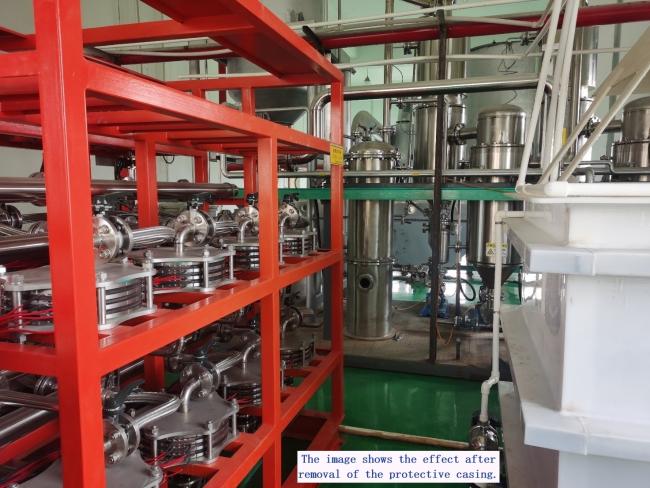
Electrochemical wastewater treatment equipment, used for semiconductor wastewater treatment.
I. Product Overview
Semiconductor wastewater originates from processes such as chip manufacturing (wafer fabrication, packaging and testing), liquid crystal panels (TFT-LCD, OLED), photovoltaic cells, and electronic component production. It is one of the types of wastewater with the highest water quality requirements and the greatest difficulty in treatment within the electronics industry. Semiconductor manufacturing processes are complex and involve numerous steps, resulting in significant differences in wastewater quality across different processes. These can be mainly categorized as follows: Ammonia-nitrogen-containing wastewater: Primarily originates from developing solutions, stripping solutions, and cleaning solutions, with ammonia nitrogen concentrations typically ranging from 100 to 1000 mg/L. Total nitrogen in some quaternary‑ammonium pollutants wastewater can reach thousands of mg/L. Organic wastewater originates from photoresist, stripping solution, developer, cleaning agents, etc., and contains various recalcitrant organic solvents and polymers. Acidic and alkaline wastewater originates from cleaning and etching processes and contains H₂SO₄, HCl, HNO₃, H₃PO₄, NaOH, etc. Chemical mechanical polishing wastewater contains nano-sized abrasive particles, oxidants, and surfactants. Semiconductor wastewater treatment has distinct industry-specific requirements: chip manufacturing demands extremely high water purity; any chemical residue can affect wastewater reuse and discharge; wastewater contains various characteristic pollutants that inhibit or toxicize microorganisms, making direct treatment by conventional biological systems difficult; discharge standards are extremely stringent; and companies generally face water scarcity and stringent wastewater reuse targets.
This system employs electrochemical oxidation technology, which can be flexibly applied to various semiconductor wastewater treatment scenarios: For wastewater containing quaternary‑ammonium pollutants/high ammonia nitrogen—it efficiently electrochemically oxidizes and degrades quaternary‑ammonium pollutants ((CH₃)₄NOH) into low-toxicity intermediates such as small-molecule amine by‑products, ultimately converting them into N₂, CO₂, and H₂O. The total nitrogen removal rate can reach over 90%, and the effluent ammonia nitrogen can be reduced to 5-10 mg/L, completely solving the problems of quaternary‑ammonium pollutants's poor biodegradability and biotoxicity.
For organic wastewater (photoresist/stripping solution/developer solution, etc.)—it directly oxidizes and decomposes photoresist resins, polymers, and organic solvents, opening rings and breaking chains. The COD removal rate is 70%-90%, and the effluent can safely enter subsequent biological treatment systems or directly meet discharge standards.
For comprehensive wastewater deep treatment and reuse—deeply removing residual COD, ammonia nitrogen, and TOC, with effluent COD ≤30~50 mg/L and ammonia nitrogen ≤5 mg/L, meeting the requirements for ultrapure water pretreatment or direct reuse in cleaning processes.
The entire process consumes only electricity, without adding chemical agents (quaternary‑ammonium pollutants treatment requires no external carbon source or acid/alkali adjustment), and does not produce large amounts of chemical sludge (fluoride-containing sludge is reduced by 50%~80%). The electrodes can still operate efficiently in wastewater with low conductivity, operating at normal temperature and pressure, ensuring safety and stability. It is an ideal technology choice for upgrading semiconductor industry wastewater treatment from "meeting discharge standards" to "resource reuse".
II. Difficulties in semiconductor wastewater treatment and solutions with this equipment
|
Address the difficulties |
Electrochemical solutions |
|
quaternary‑ammonium pollutants (tetramethylammonium hydroxide) is highly toxic to organisms and is almost impossible to degrade using conventional aerobic biochemical methods. Anaerobic degradation is time-consuming (lasting days to weeks) and produces the toxic intermediate volatile amine intermediates. |
quaternary‑ammonium pollutants is directly oxidized on the anode surface—tetramethylammonium ions are demethylated and progressively degraded into amine intermediates → ammonia → NH₃ → N₂, with a total nitrogen removal rate of ≥90% and an HRT of only 30~90 minutes. |
|
Photoresist, stripping solution, and developer contain large amounts of recalcitrant organic matter (resins, polymers, aromatic solvents), have extremely low biochemical/carbon ratios, and are inefficient for biochemical treatment. |
Electrochemical direct oxidation ring-opening and bond breaking—chain scission of macromolecular polymers and ring opening of aromatic rings—results in COD removal rates of 70%–90% and increases the B/C ratio from 0.05–0.10 to over 0.30. |
|
High-concentration organic wastewater (detergent wastewater, stripping wastewater) has a COD as high as tens of thousands of mg/L, and conventional dilution methods require several times more water to treat. |
Electrochemical methods can directly treat high-concentration organic waste liquids without the need for large-scale dilution, significantly reducing the amount of water to be treated and the scale of equipment required. |
|
Multiple wastewater streams (containing ammonia nitrogen, organic matter, acids, and alkalis) are treated independently, resulting in a lengthy, large-scale, and complex management system. |
Electrochemical treatment can simultaneously process COD and ammonia nitrogen, with one unit completing the purification function of multiple traditional systems. |
|
Wastewater contains various organic solvents that are both soluble and toxic to microorganisms, making biological systems susceptible to impact. |
Electrochemical direct oxidation decomposition of organic solvents eliminates biotoxicity, ensuring that effluent can safely enter a biological treatment system or be discharged directly in compliance with standards. |
III. Working Principle
Depending on the water quality and treatment objectives, semiconductor wastewater undergoes the following purification reactions in an electrochemical reactor:
(1) High-efficiency oxidative degradation of quaternary‑ammonium pollutants (tetramethylammonium hydroxide) (a core function unique to semiconductors)
quaternary‑ammonium pollutants ((CH₃)₄NOH) is the most representative nitrogen-containing organic pollutant in the semiconductor industry, possessing biotoxicity and being difficult to biodegrade. In the electrochemical reactor:
quaternary‑ammonium pollutants is directly oxidized by losing electrons on the anode surface—tetramethylammonium ions (quaternary‑ammonium ions) are gradually demethylated.
Total nitrogen removal rate ≥90%, and total nitrogen in the effluent can be reduced to 10~20. (2) Oxidative degradation of organic wastewater (photoresist/stripping solution/developer, etc.) Semiconductor organic wastewater contains photoresist resin, stripping solution, surfactants in developer, etc.: Macromolecular polymers are oxidized and broken on the anode surface, and long carbon chains and aromatic rings are gradually decomposed into small molecule organic acids. Organic solvents (IPA, PGMEA, NMP, etc.) are directly oxidized to CO₂ and H₂O at the anode. Hydroxyl radicals (·OH) indiscriminately oxidize various organic substances, ensuring thorough COD removal. Naturally present chloride ions (introduced during semiconductor cleaning) generate active chlorine, which supplements the oxidation of organic matter in the solution that cannot directly contact the anode.
(3) Removal of ammonia nitrogen and total nitrogen
Besides quaternary‑ammonium pollutants, semiconductor wastewater also contains other forms of ammonia nitrogen (developer, cleaning solution, etc.):
Chloride ions are electrolyzed at the anode to generate active chlorine (Cl₂, HOCl, OCl⁻).
Active chlorine rapidly oxidizes ammonia nitrogen into nitrogen gas, and organic nitrogen (NH₄⁺ in quaternary‑ammonium pollutants degradation intermediates) is also converted into N₂.
Total nitrogen in the effluent can be reduced to below 10~20 mg/L.
IV. Core Advantages (Targeting Semiconductor Wastewater)
|
Advantages |
illustrate |
|
Highly efficient degradation of quaternary‑ammonium pollutants (a core Key difficulties in the semiconductor industry) |
quaternary‑ammonium pollutants achieves a total nitrogen removal rate of ≥90%, with an HRT of only 30-90 minutes (compared to several days to weeks for anaerobic digestion), completely resolving the issues of quaternary‑ammonium pollutants's poor biodegradability and biotoxicity. |
|
Direct treatment of high-concentration organic waste liquid |
No need for large-scale dilution; process directly, avoiding the ineffective cycle of "dilution-processing". |
|
COD and ammonia nitrogen are removed simultaneously. |
One unit performs the purification function of multiple traditional independent treatment systems, greatly simplifying the process and reducing the footprint. |
|
Zero chemical dosage |
No chemical reagents are added—quaternary‑ammonium pollutants treatment requires no external carbon source, introduces no foreign ions, and does not increase TDS. |
|
Unaffected by high salt/high ammonia nitrogen |
When quaternary‑ammonium pollutants and ammonia nitrogen concentrations are high, the electrochemical treatment efficiency does not decrease; on the contrary, the increase in ammonia nitrogen promotes the indirect oxidation pathway. |
|
Safe operation at normal temperature and pressure |
Operating voltage 3~15V DC, no high temperature or high pressure, no risk of chemical leakage, meets the stringent EHS (Environmental, Health and Safety) requirements of the semiconductor industry. |
|
Fully automatic PLC control |
The current can be automatically adjusted based on the online detection of incoming water quaternary‑ammonium pollutants/COD/ammonia nitrogen, responding to water quality fluctuations, and operating unattended. |
V. Technical Parameters (Customizable)
|
parameter |
scope |
|
Processing volume |
1 ~ 1000 m³/day (modular parallel operation) |
|
Installed power |
5 ~ 600 kW (depending on water quality and treatment objectives) |
|
Operating voltage |
3 ~ 15 V (DC, safe voltage) |
|
effluent COD |
Removal rate 70%~95% |
|
Ammonia nitrogen in effluent |
Removal rate ≥90% |
|
Equipment Material |
PP / PVDF / Stainless Steel / Titanium |
|
Inlet water requirements (pre-treatment recommended) |
SS ≤ 100 mg/L, pH 3~11 (wide adaptability range, can tolerate strongly acidic wastewater containing fluoride) |
VI. Process Location
Option 1: Specialized Wastewater Treatment
quaternary‑ammonium pollutants/Developer Wastewater → Collection and Equalization Tank → Electrochemical Treatment Equipment → Effluent (B/C ≥ 0.30) → Enters Integrated Wastewater Equalization Tank → Conventional Biological System → Discharge Meets Standards/Reuse
Option 2: Advanced Biological Effluent Treatment
Integrated Wastewater → Pretreatment → Biological System → Secondary Sedimentation Tank → Advanced Electrochemical Treatment Equipment (Removal of Residual COD/TOC/Ammonia Nitrogen/Total Nitrogen) → Effluent → Reuse/Discharge Meets Standards
Option 3: High-Concentration Wastewater Reduction (Alternative to Hazardous Waste Transportation)
High-concentration organic wastewater (detergent wastewater, stripping wastewater, developer wastewater, etc.) → Collection Tank → Electrochemical Treatment Equipment → Treated Wastewater (significantly reduced COD) → Continued Biological Treatment
Get in Touch
Have questions about our products or want to discuss a custom order? Our team is ready to help you.