
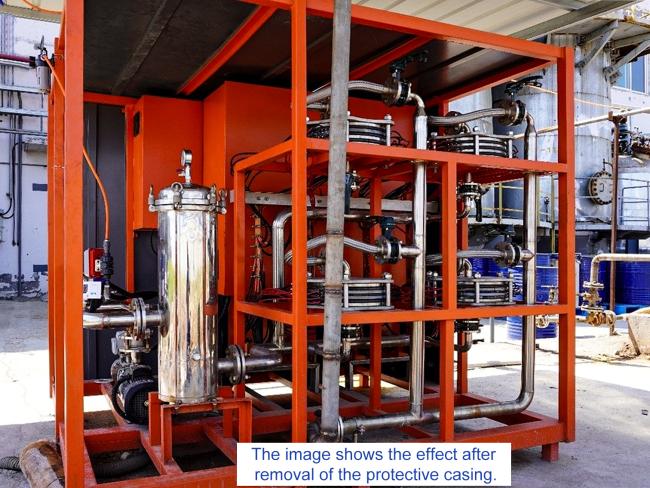
Electrochemical wastewater treatment equipment for laboratory wastewater.
I. Product Overview
Laboratory wastewater primarily originates from experimental activities in universities, research institutes, testing and inspection agencies, pharmaceutical R&D centers, disease control centers, and environmental monitoring stations, covering multiple fields including chemistry, biomedicine, environmental testing, materials science, and food testing. Typical characteristics of laboratory wastewater include: a wide variety of wastewater types (organic waste liquid, inorganic waste liquid, biological waste liquid, acid and alkali waste liquid, etc.); extremely complex composition (including thousands of chemical reagents, solvents, intermediate products, and reaction byproducts); extremely wide COD concentration range (from hundreds of mg/L to tens of thousands of mg/L); the presence of recalcitrant organic matter (aromatics, halogenated hydrocarbons, polycyclic aromatic hydrocarbons, etc.) and biotoxic substances (pathogenic microorganisms, antibiotics, genetically engineered products, etc.); drastic fluctuations in water quality and quantity (significant differences between different experimental projects and time periods); and relatively small production volume but extremely high hazard.
Laboratory wastewater treatment has long faced a series of unique challenges:
1. Diverse wastewater types and extremely complex compositions after mixing: Wastewater from different laboratories and different experimental projects exhibits vastly different properties, resulting in hundreds of pollutants in the mixed wastewater, which traditional single-process treatment methods struggle to comprehensively address.
2. Contains high concentrations of toxic and harmful substances: The coexistence of organic solvents, strong acids and alkalis, and pathogenic microorganisms poses a serious threat to the environment and human health.
3. Significant biosafety issues: Biological/medical laboratory wastewater may contain pathogens, viruses, genetically engineered organisms, etc., requiring complete inactivation before discharge.
4. Extremely poor biodegradability: Large amounts of organic solvents and aromatic compounds... The compounds have stable structures, with a B/C ratio often below 0.10, making them virtually ineffective for conventional biological treatment. Water quality and quantity fluctuate wildly – experiments are discontinuous, wastewater discharge is intermittent, and COD can jump from hundreds of mg/L to tens of thousands of mg/L within hours, making traditional biological systems unsuitable. Treatment facilities are limited by space constraints – laboratories are typically located in urban built-up areas or on campuses, with extremely limited available space, making large-scale treatment facilities impossible. Strict management requirements – wastewater containing Class I pollutants must be collected and treated separately, and direct discharge or diluted discharge is prohibited.
This system employs electrochemical oxidation technology, specifically optimized for the characteristics of laboratory wastewater: small volume (1~50 m³/d), complex composition, high toxicity, and large fluctuations. Through the synergistic effect of direct anodic oxidation and electrocatalytic generation of hydroxyl radicals (·OH) and active chlorine, it can simultaneously treat various organic pollutants, ammonia nitrogen, and pathogenic microorganisms (electrochemical disinfection) in laboratory wastewater, stabilizing the effluent COD to meet discharge standards, completely eliminating color, and ensuring biosafety.
The entire process consumes only electricity, without adding any chemical reagents. The equipment has a small footprint (it can be placed inside or next to the laboratory building), a high degree of automation, and is easy to operate and maintain. It is an ideal technical solution to solve the four core Key difficulties of laboratory wastewater: "complex composition, high toxicity, large fluctuations, and small footprint".
II. Difficulties in laboratory wastewater treatment and solutions with this equipment
|
Address the difficulties |
Electrochemical solutions |
|
Wastewater is diverse (a mixture of organic, inorganic, and biological wastewater) and extremely complex in composition, making it difficult to treat comprehensively using traditional single-process technologies. |
Electrochemical oxidation has a broad spectrum of activity—hydroxyl radicals (·OH, 2.80 V) can indiscriminately oxidize various organic pollutants while simultaneously inactivating pathogenic microorganisms; one set of equipment can cover multiple types of pollutants. |
|
It contains a large amount of recalcitrant organic matter such as organic solvents, aromatic compounds, and halogenated hydrocarbons, and has an extremely low B/C ratio (<0.10), making biochemical treatment essentially ineffective. |
Electrochemical direct oxidation ring-opening and bond breaking—aromatic ring opening, halogen removal, and long carbon chain breaking—converts recalcitrant macromolecules into smaller, biodegradable substances or directly mineralizes them into CO₂ and H₂O. |
|
Wastewater from biological/medical laboratories contains pathogenic microorganisms, pathogenic bacteria, viruses, etc., and must be thoroughly inactivated before discharge. |
Electrochemical simultaneous disinfection—the anode generates active chlorine and hydroxyl radicals, which effectively kill various pathogenic microorganisms, ensuring that the effluent meets the standards for fecal coliform count, and eliminating the risk of chemical storage. |
|
Wastewater discharge is intermittent, and water quality and quantity fluctuate greatly, making traditional biological systems (which require continuous operation and have long acclimatization periods) unsuitable. |
Electrochemical systems can operate intermittently and are ready to use immediately—requiring no microbial acclimatization, they achieve treatment effects instantly upon startup, and shutdown has no impact, making them perfectly suited for intermittent drainage modes in laboratories. |
|
The available space in the laboratory is extremely limited, making it impossible to install large-scale processing facilities. |
The equipment adopts an integrated modular design, occupying only 2-10 m² (depending on the processing capacity), and can be placed in the laboratory building, basement, or open space next to the building. |
|
Laboratory wastewater treatment facilities need to meet strict safety and environmental management requirements |
Operating voltage 3~15V DC, no high voltage, no high temperature, no chemical storage, operates at normal temperature and pressure, intrinsically safe. |
III. Working Principle
After large particulate matter is removed by a screen or filter, the laboratory wastewater enters an electrochemical reactor, where multiple pollutants are synergistically removed under the action of electrodes:
(1) Oxidative Degradation of Organic Matter
A large amount of organic solvents (ketone‑based components, ethanol, diethyl special organic components, dichloromethane, benzene series compounds, etc.), aromatic compounds, and halogenated hydrocarbons in the laboratory wastewater are directly oxidized on the anode surface:
Aromatic Compounds: The benzene ring is hydroxylated on the anode surface, opening the ring and transforming into small molecule organic acids, which are eventually mineralized into CO₂ and H₂O
Halogenated Hydrocarbons (chloroform, dichloromethane, carbon tetrachloride, etc.) : The C-X bond breaks at the anode surface, halogens are removed in ionic form, and the organic skeleton is oxidized and decomposed.
Organic solvents (alcohols, ketones, esters, special organic components, etc.): are directly oxidized to CO₂ and H₂O at the anode surface.
Macromolecules (polymers, surfactants, etc.): long carbon chains and special organic components are oxidized and broken.
Anode electrolysis of water generates hydroxyl radicals (·OH), and simultaneously utilizes chloride ions present in the wastewater to generate active chlorine (Cl₂, HOCl, OCl⁻), supplementing the oxidation of pollutants that did not directly contact the anode.
(2) Ammonia nitrogen removal
Ammonia nitrogen in laboratory wastewater (from nitrogen-containing reagents, cleaning solutions, etc.) is removed through an indirect oxidation pathway—chloride ions are electrolyzed at the anode to generate active chlorine, which rapidly oxidizes ammonia nitrogen into nitrogen gas. (3) Disinfection and Sterilization: The active chlorine and hydroxyl radicals generated during the electrochemical oxidation process have a highly effective killing effect on pathogenic microorganisms in the wastewater—penetrating cell walls, oxidizing cell membrane proteins and intracellular enzyme systems, and destroying DNA/RNA structures, causing irreversible inactivation of microorganisms. The fecal coliform count in the effluent meets the corresponding discharge standards.
(2) Color Elimination: Dyes, colored reagents, and chromophores (azo bonds, quinone groups, conjugated double bonds, etc.) that may be present in the laboratory wastewater are oxidized and broken, resulting in colorless and transparent effluent.
IV. Core Advantages (Targeting Laboratory Wastewater)
|
Advantages |
illustrate |
|
Broad spectrum processing capability |
Simultaneously removes organic matter (COD), ammonia nitrogen, and color while disinfecting and sterilizing; one set of equipment covers the vast majority of pollutant types in laboratory wastewater. |
|
Highly efficient degradation of recalcitrant organic matter |
The hydroxyl radical (·OH) has an oxidation potential of 2.80 V and can indiscriminately attack various organic pollutants—opening aromatic rings, removing halogens, breaking long carbon chains, significantly increasing the B/C ratio, or directly mineralizing them. |
|
Simultaneous disinfection and sterilization |
Electrochemical generation of active chlorine and hydroxyl radicals effectively kills pathogenic microorganisms, eliminating the need for a separate disinfection unit and the risk of chemical storage. |
|
Ready to use immediately, suitable for intermittent drainage |
No microbial acclimatization is required; treatment effects are achieved immediately upon startup; shutdown has no impact; perfectly suited for the discontinuous and intermittent drainage modes of laboratories. |
|
Zero chemical dosage |
It does not add any chemical agents (flocculators, oxidants, disinfectants, etc.), consumes only electricity, and has no risks associated with the procurement, storage, and handling of chemicals. |
|
Zero solid waste/hazardous waste generation |
Organic matter is mineralized into CO₂ and escapes, without producing hazardous wastes such as saturated carbon and iron sludge. |
|
Extremely small footprint |
With its integrated modular design, it occupies only 2-10 m² (depending on processing capacity) and can be placed inside, in basements, or next to laboratories, making it suitable for laboratories with limited space. |
|
Intrinsic safety |
Operating voltage is 3~15V DC. There is no risk of high voltage, high temperature, flammability, or explosion. It operates at normal temperature and pressure. |
|
Fully automatic PLC control |
Automatic start and stop based on incoming water flow, requiring no dedicated personnel, operating parameters can be monitored remotely, and operation and maintenance are extremely simple. |
|
Adapt to extreme pH |
Laboratory wastewater often contains strong acids and bases (pH 1~13), and electrochemical equipment can tolerate a wide pH range, so large amounts of neutralizing agents are not required. |
V. Technical Parameters (Customizable)
|
parameter |
scope |
|
Processing volume |
0.5 ~ 50 m³/day (modular parallel connection, customizable) |
|
Installed power |
1 ~ 30 kW (depending on water quality and treatment objectives) |
|
Operating voltage |
3 ~ 15 V (DC, safe voltage) |
|
Inlet water pH |
1 ~ 13 (Wide range of adaptability, no need for extensive neutralization) |
|
Fecal coliforms |
It meets the corresponding emission standards (disinfection compliance). |
|
COD removal rate |
60%~95% |
|
ammonia nitrogen removal rate |
70%~95% |
|
Color removal rate |
≥90% |
|
Equipment Material |
PP / Stainless Steel / Titanium |
|
Equipment footprint |
2 ~ 10 m² (integrated skid-mounted, depending on processing capacity) |
|
Water intake requirements |
SS ≤ 100 mg/L (simple pre-filtration) |
VI. Process Location
Option 1: Integrated Wastewater Treatment
Laboratory wastewater (organic waste liquid, inorganic waste liquid, biological waste liquid, etc.) → Sorted collection → Mixing and equalization tank → Integrated electrochemical treatment equipment (COD degradation + ammonia nitrogen removal + disinfection and sterilization + decolorization) → Effluent meets discharge standards/is discharged into the municipal sewer system
Description: After sorting and collecting (meeting regulatory requirements), various types of laboratory wastewater enter the mixing and equalization tank for homogenization, and then enter the integrated electrochemical equipment for comprehensive treatment. One set of equipment simultaneously completes four major functions: organic matter oxidation, ammonia nitrogen removal, disinfection and sterilization, and decolorization, ensuring the effluent meets the corresponding standards. This option has the shortest process flow, the smallest footprint, and the simplest operation, making it the preferred configuration for most laboratory wastewater treatment systems.
Option 2: High-Concentration Waste Liquid Reduction (Alternative to Hazardous Waste Transportation)
Laboratory high-concentration waste liquid (expired reagents, reaction residues, chromatographic waste liquid, etc.) → Collection tank → Electrochemical treatment equipment (COD removal rate 60%~85%) → Effluent discharged into integrated wastewater system → Integrated treatment equipment → Discharge meeting standards
Explanation: Traditionally, high-concentration organic waste liquid generated in laboratories (such as expired organic solvents, chromatographic waste liquid, etc.) is disposed of as hazardous waste through transportation, which is extremely costly. Electrochemical treatment allows for on-site batch processing of this type of high-concentration waste liquid, significantly reducing COD before smoothly discharging it into the integrated wastewater treatment system. This reduces the amount of hazardous waste transported by 70%~90%, resulting in considerable annual savings in disposal costs.
Option 3: Disinfection Treatment of Biological Laboratory Wastewater
Biological/Medical Laboratory Wastewater → Separate Collection → Electrochemical Disinfection Unit (Active Chlorine + Hydroxyl Radical Synergistic Sterilization) → Effluent (Pathogenic Microorganism Inactivation) → Discharge into Integrated Wastewater System/Compliant Discharge
Note: Pathogenic microorganisms in biological laboratory wastewater must be completely inactivated before discharge. The electrochemical disinfection unit efficiently kills various pathogenic microorganisms through on-site electrolytic active chlorine and hydroxyl radicals, eliminating the need for storing and using chemical disinfectants (such as sodium hypochlorite), eliminating the risk of chemical leakage, and providing stable and reliable disinfection results.
Get in Touch
Have questions about our products or want to discuss a custom order? Our team is ready to help you.