
10t/H-13t/H Coal Dryer Machine Energy Saving Coal Rotary Dryer
Coal Dryer
1.Product Introduction
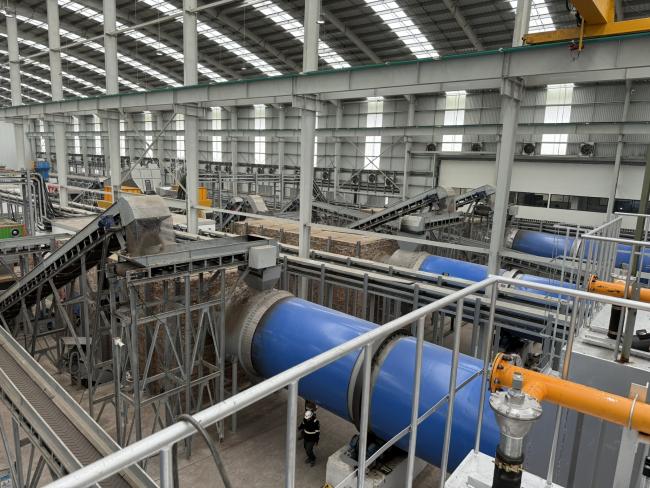
A coal dryer is an industrial device designed to reduce the moisture content of coal. Through the drying process, the heating value of the coal is enhanced and its combustion efficiency is improved. Furthermore, this treatment reduces transportation costs, lowers pollutant emissions, and optimizes the performance of downstream industrial processes.
2.Application
-
Thermal Power Generation and Energy Production:Directly burning high-moisture coal (such as lignite) results in low thermal efficiency and increased emissions. By drying the coal to reduce moisture from 20%–40% to below 10%, the heating value of the fuel is significantly enhanced. This reduces coal consumption per unit of power generated, thereby lowering CO₂ and pollutant emissions.
- Coking Coal Pretreatment:In the metallurgical industry, oven-charged coal must be pre-dried to a moisture content of less than 6%. This stabilizes coke oven operations, shortens coking cycles, reduces energy consumption during the coking process, and improves both the strength and yield of the resulting coke. This process is a critical technical link in coking coal preparation.
- Coal Washing and Processing:After the washing process, materials like coal slime, flotation concentrates, or blended concentrates typically have a moisture content of 15%–28%. Once dried and dehydrated, these can be sold as commercial coal or blended with raw coal to prevent resource waste. Equipment in this sector is usually equipped with cyclone separators and baghouse filters to achieve dust recovery and ensure compliance with environmental standards.
- Coal Transportation and Storage:High-moisture coal is prone to freezing in cold regions, making unloading difficult, and is susceptible to spontaneous combustion in stockpiles. Dried coal exhibits better flowability and is less likely to clump, significantly reducing transportation and storage risks—making it particularly suitable for long-distance rail and maritime transport.
- Industrial Feedstock Pretreatment:Moisture control is a vital prerequisite in coal chemical processing, briquette production, and gasification. Drying improves the molding rate of briquettes, ensures the stability of gasification reactions, and extends the operational lifespan of the equipment.
3.Working Principle
The working principle of a Coal Dryer involves the application of thermal energy to evaporate the moisture within coal (primarily surface water and a portion of capillary water). Once vaporized, this moisture is carried away by a drying medium, typically hot air or flue gas. The core objective of the system is to achieve highly efficient heat and mass transfer by maximizing the contact surface area and retention time between the material and the thermal medium.
4.Advantages
1. Significant Improvement in Thermal Efficiency and Energy Savings
Modern coal dryers utilize enclosed designs, advanced insulation materials, and waste heat recovery systems, achieving thermal utilization rates of over 90%. Compared to traditional single-drum dryers, thermal efficiency is improved by more than 40%, significantly reducing energy consumption.
2. Efficient Dehydration to Enhance Combustion and Coking Efficiency
Drying can reduce coal moisture from over 30% to below 10% (e.g., reducing coal moisture from 30.06% to 12.05%), drastically reducing heat loss from ineffective evaporation.
3. Excellent Environmental Performance for Green Production
Through multi-stage dust collection systems (gravity settling + cyclone + baghouse filters), dust emission concentrations can be controlled at <30mg/Nm³, far below national standards.
4. Process Stability, Product Quality, and Automation
Advanced drying technologies—including fluidized bed, belt, and paddle dryers—ensure uniform heating. Moisture content fluctuations are controlled within 0.5%–3%, far superior to the 5%–8% range of traditional processes.
5. Reduction in Comprehensive Operating Costs
Operating costs are significantly lowered through energy savings, extended equipment lifespans (e.g., refractory life increased by 50%), and reduced manual intervention.
5.Technical Specifications
| Product Specs (m) | Capacity (T/H) | Main Motor Power (kW) | Main Motor Model | Main Gearbox Model | Ratio | Weight (T) |
| φ1.2×10m | 2.5 | 7.5 | Y160M-R3 | ZL50-16-1 | - | 13.5 |
| φ1.5×12m | 3.3 - 4.9 | 10 | Y160L-6B3 | JZQ500-III-2F | - | 18.9 |
| φ1.5×15m | 4 - 6 | 18.5 | Y200L-6 | JZQ500-III-2F | - | 21 |
| φ1.8×12m | 4 - 6 | 11 | Y200L-6 | ZQ50-16II-2 | 16.46 | 22.33 |
| φ2.2×12m | 7 - 12 | 18.5 | Y160L-6 | JZQ650-III | 31.5 | 37.6 |
| φ2.2×14m | 7 - 12 | 18.5 | Y160L-6 | JZQ750-III | 31.5 | 40 |
| φ2.2×16m | 12 | 30 | Y225M-6 | JZQ750-III | 31.5 | 45 |
| φ2.4×14m | 12 | 30 | Y250M-6 | JZQ750-III | 31.5 | 51 |
| φ2.4×18m | 10 - 13 | 37 | Y250M-6 | ZL85-13-1 | 27.16 | 54 |
| φ2.4×20m | 10 - 14 | 37 | Y250M-6 | ZL85-13-1 | 27.16 | 54.14 |
| φ3×20m | 25 | 55 | Y250M-4 | ZL100-16-1 | 41.52 | 78 |
| φ3×25m | 32 - 36 | 75 | YR280M-4 | ZL100-16-1 | 41.52 | 104.9 |
6.Our Solutions
Get in Touch
Have questions about our products or want to discuss a custom order? Our team is ready to help you.