
Nylon Carpet Tiles – 50×50cm Peel-and-Stick Modular Carpet Squares for Office, Retail & Home
This is a 50×50 cm modular nylon carpet square made for interiors that need a floor to look after itself. The face is a tufted loop pile jacquard in durable nylon with an anti-fouling treatment, and the tile is built with a thin, tidy 7.0 mm ± 0.2 mm body and a peel-and-stick format so it can be laid quickly and replaced one square at a time. It is designed for offices, hotels, retail floors and homes where a clean appearance, low-maintenance upkeep and predictable long-term costs matter more than novelty.
If you are comparing this tile with other carpet floorcoverings, the difference is in the details rather than the headline. The loop-pile construction keeps the surface tight and even, so it resists the flattening and shading that softer carpets show after weeks of use. The peel-and-stick format removes a whole step from the installation process, cutting labour time and the mess associated with loose adhesives. And the modular 50×50 cm square means a single marked or worn tile becomes a five-minute repair rather than a re-covering project. Those three ideas — tighter weave, simpler laying, smarter repairs — underpin everything below.
Many modular carpets look similar in a photograph, so it is worth spelling out what makes this one different in practice:
| Feature | Why It Matters |
|---|---|
| Tight tufted loop pile jacquard | A dense, even surface that resists flattening and shading and stays neat under regular traffic. |
| Anti-fouling surface treatment | Helps keep spills and everyday marks near the surface so they can be cleaned quickly. |
| Antibacterial finish | Supports a more hygienic floor, useful in shared and health-sensitive spaces. |
| Peel-and-stick backing | Simplifies installation and reduces reliance on separately applied adhesive. |
| 50×50 cm modular squares | Enables single-tile replacement and flexible, compatible layouts. |
| Solution-dyed / computer-printed options | Offers strong colour stability and the freedom to match specific designs. |
| 7.0 mm thin profile | Keeps door clearances and transitions easy to manage. |
The figures below describe the standard build of this modular carpet square. Colours, patterns, dye methods and backing options can be confirmed against a specific project brief.
| Specification | Detail |
|---|---|
| Product Name | Nylon Carpet Tiles |
| Product Type | Modular Carpet Squares |
| Face Construction | Tufted loop pile jacquard |
| Tile Size | 50 × 50 cm |
| Total Thickness | 7.0 mm ± 0.2 mm |
| Installation Method | Peel-and-stick (self-adhesive) |
| Pattern | Various patterns available |
| Dye Method | Solution dyed / computer printing |
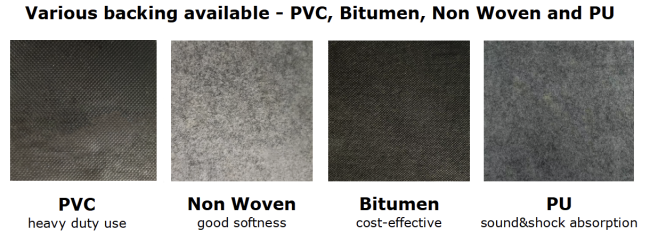
| Backing Options | PVC, PU, bitumen or non-woven |
| Standard Applications | Offices, Hotels, Retail Stores, Homes |
| Property | Value / Standard |
|---|---|
| Surface Treatment | Anti-fouling treatment |
| Antibacterial Treatment | Antibacterial & anti-fouling finish |
| Colour Fastness | Grade 4.5 and above (AATCC 165) |
| Flame Retardancy | GB8624-2012 Class B1 |
| Backing Material | PVC, PU, bitumen or non-woven |
| Colour / Logo | Custom colours, computer printing and logo options |
| Item | Detail |
|---|---|
| Brand Name | Flooring Source |
| Place of Origin | China |
| Certification | SGS |
| Model Number | Nylon Carpet Tiles |
| Item | Detail |
|---|---|
| Payment Terms | T/T |
| Packaging | Standard export carton |
| Minimum Order Quantity | 1 square metre |
| Delivery Time | 25–30 days |
| Price Range | USD 7–10 per square metre |
| Supply Ability | 3,000 square metres per day |
Loop-pile nylon tufted into a jacquard pattern produces a surface with a dense, uniform character rather than an open, fluffy one. That density is what keeps a floor looking tidy: there are fewer loose fibres to mat down, fewer shadows to exaggerate traffic lanes, and less opportunity for the surface to look worn even after months of daily use. The jacquard construction also allows patterns and tonal effects to be woven into the face rather than printed on top, so the appearance is part of the structure rather than a coating that can rub away. For busy commercial interiors this translates into a floor that keeps a consistent, professional look between cleanings and across the whole area, not just where people walk least.
The anti-fouling treatment applied during production helps reduce the penetration of common stains — coffee, tea, soft drinks, food grease and everyday dust — into the fibres, keeping spills closer to the surface where they can be blotted or vacuumed away. Combined with prompt spot treatment, this supports a cleaning regime built around routine care rather than heavy intervention, which is easier on the floor and on the people maintaining it. Because the tile is available with an antibacterial finish as well, floors in shared and health-sensitive spaces can stay fresh and hygienic with a straightforward schedule.
The nylon face is chosen for abrasion resistance and resilience, so it can take the steady pressure of feet, chairs and trolleys without collapsing. Nylon recovers its shape well after being compressed, which is why the loop surface bounces back rather than flattening where people stand or turn. In practical terms, this suits circulation routes, desks, counters and aisles that see continuous use — the floor keeps its texture and stays comfortable underfoot instead of developing the flattened, tired patches that softer surfaces acquire.
With a colour fastness of Grade 4.5 and above (AATCC 165), the surface resists fading even where daylight falls strongly through glazing. The available solution-dyed option gives further colour stability, because the pigment is carried through the fibre rather than sitting only on the surface. The result is a floor that keeps a uniform, coordinated appearance over the long term, avoiding the patchy, washed-out look that fading and uneven wear can create. A broad choice of patterns, colours and printed effects makes it straightforward to match a brand palette or a particular interior scheme.
At 7.0 mm ± 0.2 mm total thickness, the tile is slim enough to keep door clearances, skirting and threshold transitions simple to manage. It sits neatly against hard flooring, tiling or other surfaces without creating a pronounced step, and its modular square edges allow precise, repeatable layouts. For renovation projects where existing doors, frames and services must stay unchanged, a thin modular carpet is often the most practical choice.
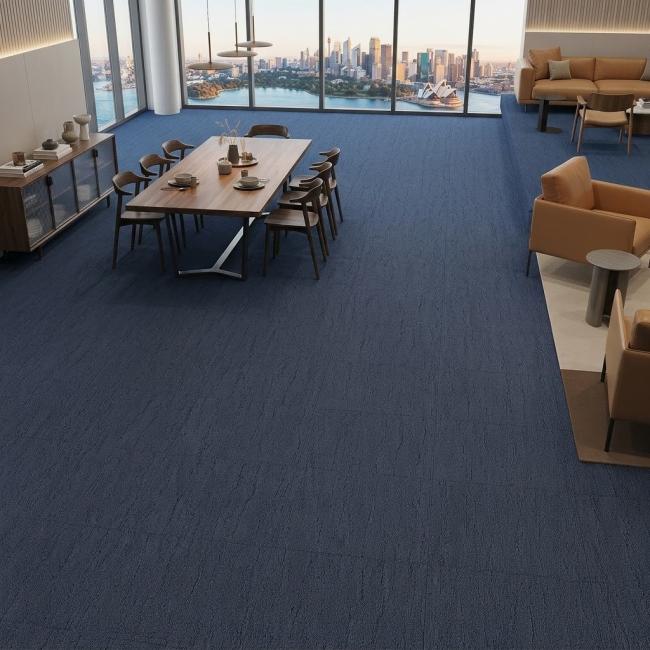
Because the tile combines a neat appearance, easy cleaning and modular repairs, it suits a wide range of commercial and residential interiors. The table below sets out the common applications; the scenarios that follow show how the product behaves in each setting.
| Application Area | Why It Fits |
|---|---|
| Offices & meeting rooms | A tidy, professional finish that handles daily footfall and rolling chairs; easy single-tile repair |
| Hotels & corridors | Softens noise in circulation areas and stays presentable with routine housekeeping |
| Retail stores & showrooms | Comfortable underfoot for long trading hours; holds appearance under visitor traffic |
| Reception & waiting areas | Easy-clean surface for constant public use; modular layout for zoning |
| Schools & healthcare | Antibacterial, easy-clean finish for hygienic, shared environments |
| Homes & residential rooms | Comfortable, quiet and simple to maintain; peel-and-stick convenience |
In practice, the benefits of the modular square show up in specific, everyday ways:
- Open offices and workspaces. The tight loop face keeps the floor looking uniform across large areas, and a marked tile under a desk or chair can be swapped in minutes without an installer.
- Hotel corridors and guest floors. Routine vacuuming keeps the surface neat, while modular replacement avoids having to close a whole corridor for a single damaged square.
- Retail stores and showrooms. Peel-and-stick installation shortens downtime during fit-outs, and a comfortable, stable surface supports staff and visitors through long opening hours.
- Reception and waiting areas. The anti-fouling, antibacterial surface handles constant public use and stays presentable between cleanings.
- Schools, clinics and shared facilities. Easy cleaning and a hygienic finish suit environments where cleanliness and quick turnaround matter.
- Homes and residential rooms. The peel-and-stick format makes small DIY jobs practical, and the modular square allows a single worn area to be refreshed.
| Benefit | What It Means in Practice |
|---|---|
| Neat, long-lasting appearance | A dense loop-pile jacquard resists flattening and shading, keeping a consistent look under daily traffic. |
| Easy stain control | The anti-fouling treatment keeps spills near the surface so routine vacuuming and prompt blotting do most of the work. |
| Hygienic surfaces | An antibacterial finish supports cleaner shared spaces such as schools, clinics and hospitality venues. |
| Economical repairs | Modular 50×50 cm tiles mean a localised repair, not a whole-floor replacement. |
| Quick installation | The peel-and-stick format simplifies laying and reduces reliance on separately applied adhesive. |
| Colour stability | Grade 4.5+ colour fastness (AATCC 165) and a solution-dyed option keep the floor looking uniform as it ages. |
| Safe and compliant | GB8624-2012 Class B1 flame retardancy supports common commercial safety expectations. |
| Flexible design | Multiple patterns plus computer-printing and custom-logo options allow the floor to match a brand or scheme. |
Grouped together, these benefits point to a floor that looks good, cleans easily and costs less to keep:
- A consistently neat appearance that holds up under daily commercial traffic.
- Fast, low-effort cleaning supported by the anti-fouling and antibacterial finish.
- Low maintenance cost through modular replacement rather than full-floor refits.
- Quick, clean installation from the peel-and-stick format.
- Colour and design flexibility thanks to multiple patterns and printing options.
- Compliance confidence with Class B1 flame retardancy and SGS certification.
It helps to understand how the tile is put together, because that is what determines how it behaves in service. The face is formed from nylon yarn tufted into a primary backing in a loop-pile jacquard pattern, then secured with a secondary backing that carries the adhesive system or the peel-and-stick layer. The loop profile is kept even and tight, so pressure from feet, furniture and castors is spread across many fibres rather than concentrated on a few — the reason the surface resists matting and keeps its texture over time. The jacquard process weaves pattern and tone into the face, and the printing option allows finer graphic detail where a design calls for it.
| Element | Description |
|---|---|
| Yarn | Nylon, available solution-dyed for maximum colour stability |
| Pile Profile | Loop pile, tight and even for resilience under load |
| Tufting Method | Jacquard tufting for integrated pattern and colour effects |
| Printing Option | Computer printing for fine graphic designs and logos |
| Primary Backing | Carrier that holds the tufted loops |
| Secondary Backing | PVC, PU, bitumen or non-woven layer; peel-and-stick option available |
| Finish | Anti-fouling and antibacterial treatment applied to the face |
| Total Thickness | 7.0 mm ± 0.2 mm |
A peel-and-stick tile carries its own adhesive, released by removing a protective film from the back. This changes the installation experience in three useful ways. First, it is cleaner: there is no loose adhesive to mix, spread and clean up, so the risk of messy edges and adhesive residue is reduced. Second, it is faster: tiles go down square after square, allowing occupied buildings to be worked around and reducing the time a floor is out of use. Third, it is more forgiving for smaller jobs: a homeowner or a facilities team can re-lay a single tile or a small section without calling in a specialist.
As with any flooring, the result depends on preparation and good practice. The substrate should be clean, dry and level, and installation should follow the manufacturer's guidance, including recommended temperature, pressure and pattern direction. When those conditions are met, a peel-and-stick modular carpet delivers a flat, well-bonded floor with the practical advantage of being repairable one square at a time.
| Stage | What to Do |
|---|---|
| 1. Prepare the subfloor | Ensure the substrate is clean, dry, level and free of dust, grease or loose material; repair cracks and hollows. |
| 2. Acclimatise | Let the tiles rest in the room so they adjust to ambient temperature and humidity before laying. |
| 3. Plan the layout | Mark centre lines and dry-lay a few squares to confirm pattern direction and minimise small edge cuts. |
| 4. Peel and place | Remove the release film and press each tile firmly; keep the pile direction consistent and stagger joints where appropriate. |
| 5. Finish and trim | Cut edge tiles to fit, install transitions where the floor meets other surfaces, and roll to ensure good contact. |
Keeping the floor in good condition needs only routine attention. Vacuum regularly to lift dry soil before it works into the pile, and deal with spills as soon as they happen by blotting rather than rubbing. The anti-fouling treatment makes most everyday marks easy to remove, and the antibacterial finish helps the surface stay hygienic. For periodic deeper cleaning, follow a method suitable for the chosen backing and adhesive.
| Frequency | Action |
|---|---|
| Daily | Vacuum high-traffic routes and entrances to remove loose dirt and grit. |
| As required | Blot liquid spills immediately; use a mild spot cleaner for stubborn marks and rinse lightly. |
| Periodic | Carry out an interim or deep clean with a suitable carpet-cleaning method, following adhesive and backing guidance. |
| Occasional | Rotate or replace individual tiles in heavily used positions to even out wear. |
Modular squares give designers useful freedom. A single colour laid monolithically creates a calm, uninterrupted floor, while two or more tones can define zones, trace walkways or introduce a simple pattern. Because the tiles are square, they can be laid in a straightforward grid or turned through 90 degrees for quarter-turn effects, with the pile direction kept consistent for a uniform look or alternated for a more textured appearance. When specifying, consider how the colour will read under both daylight and artificial light and how it will sit alongside walls, joinery and furniture. Neutral greys and beiges are forgiving in high-traffic areas, while deeper tones can help conceal everyday soiling in hotel and retail settings. Computer printing makes it possible to reproduce specific graphics, motifs and even logos across the floor, supporting branded interiors and wayfinding. Our team can advise on colours, pattern direction and layout to help achieve the intended effect.
Each production batch is checked against the performance criteria that matter most for interiors: colour fastness, flame retardancy, dimensional consistency and surface behaviour. These checks help ensure the tile delivered to a project matches the specification agreed, whether the order is a small trial quantity or a large run. Certification is available in the form of SGS testing, and project-specific documentation can be provided on request.
| Test Area | Standard / Result |
|---|---|
| Colour Fastness | Grade 4.5 and above (AATCC 165) |
| Flame Retardancy | GB8624-2012 Class B1 |
| Surface Treatment | Anti-fouling / antibacterial finish |
| Dye Method | Solution dyed / computer printing |
| Third-Party Certification | SGS |
It is often useful to weigh modular carpet tiles against hard alternatives and against broadloom carpet when planning a space. The comparison below summarises the general trade-offs; the best choice always depends on the specific room and use.
| Consideration | This Modular Nylon Tile | Hard Flooring | Broadloom Carpet |
|---|---|---|---|
| Underfoot comfort | Soft and warm | Firm and cooler | Soft and warm |
| Acoustic comfort | Absorbs footstep noise | Reflective, can amplify sound | Absorbs sound well |
| Repair strategy | Single tiles replaceable | Larger sections often needed | Full re-stretch or replacement |
| Installation | Peel-and-stick, minimal downtime | Often more disruptive | Requires specialist fitting |
| Cleaning | Vacuum plus spot treatment | Damp mopping | Vacuum plus spot treatment |
| Reconfiguration | Easy to re-lay and re-zone | Harder to change | Difficult to change |
Indoor floors shape the day-to-day environment for the people who use a space, so comfort and upkeep matter alongside appearance. A soft carpet face helps damp footsteps and reduce the hardness of a room, contributing to a calmer, more comfortable interior — particularly in workplaces and hospitality areas where people stand and walk for long periods. The anti-fouling and antibacterial finishes support a cleaning regime that leans on routine vacuuming and prompt spot treatment rather than heavy chemical intervention. Because individual tiles can be replaced, the floor also avoids the wasteful cycle of removing and re-laying an entire area when only part of it has worn, making better use of the material over the life of the installation.
| Quantity | Estimated Lead Time |
|---|---|
| 1 – 6,000 square metres | 30 days |
| ≥ 60,000 square metres | To be negotiated |
Tiles are packed in standard export cartons. Payment terms are T/T, the minimum order quantity is 1 square metre, and supply capacity is around 3,000 square metres per day, so both trial quantities and larger project runs can be accommodated. Samples and colour references can be arranged for approval before a larger order is placed.
A modular carpet floor is judged by how it performs after months of use, not on the day it is laid. This tile is engineered so that the things people notice most — how neat the floor looks, how quickly it cleans and how cheaply it can be repaired — are handled from the start. A tight loop-pile jacquard keeps the surface even and tidy; an anti-fouling, antibacterial finish keeps it clean and hygienic; a peel-and-stick format makes installation and small repairs straightforward; and a 50×50 cm modular square keeps long-term flooring costs predictable. For facilities managers, designers and homeowners alike, that combination delivers a dependable, easy-to-run floor.
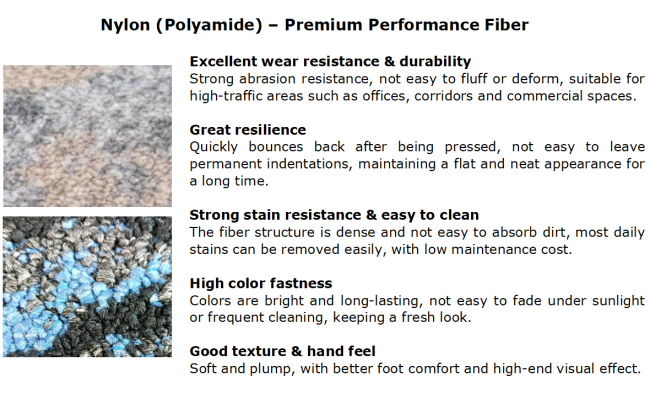
The treatment, applied during production, helps reduce the penetration of common stains such as coffee, tea, beverages, food grease and everyday dust into the fibres, keeping spills closer to the surface so they can be blotted or vacuumed away.
No. Nylon construction by itself does not establish a specific stain-resistance rating. Tiles with a dedicated anti-fouling treatment may offer improved cleanability for certain common stains, and for hotel and commercial projects the treatment details and supporting test documentation can be confirmed before purchase.
It uses a peel-and-stick format: remove the protective film from the back and press each 50×50 cm tile firmly into place on a clean, dry, level substrate, following the manufacturer's installation guidance.
Yes. When the installation system permits, a marked or worn tile can be lifted and replaced on its own, reducing the need to remove large areas of carpet and helping manage long-term flooring costs.
Yes. The nylon loop-pile surface is chosen for abrasion resistance and resilience, so it can handle regular foot traffic in offices, hotels, retail stores and other commercial settings.
Yes. A range of colours and patterns is available, and computer printing supports custom graphics and logos for branded flooring projects.
The tile is rated GB8624-2012 Class B1 for flame retardancy, supporting common commercial fire-safety expectations. Project-specific compliance documentation can be provided on request.
The backing you choose affects stability, adhesion and how the floor feels underfoot. All of the options below work with the modular 50×50 cm format; the right choice depends on the substrate, the level of traffic and whether the floor will be laid over a hard base or over an existing surface.
| Backing | Characteristics | Often Suited To |
|---|---|---|
| PVC | Firm, dimensionally stable and easy to handle | General commercial interiors and heavier use |
| PU | Flexible and quiet underfoot, comfortable to stand on | Offices, meeting rooms and hospitality areas |
| Bitumen | Dense and stable, with good weight and flatness | Large open areas and busy circulation routes |
| Non-woven | Lightweight and economical | Light commercial and residential rooms |
When comparing flooring, the purchase price tells only part of the story. A modular nylon tile can look slightly more expensive per square metre than a basic hard surface, but the cost over its service life is often lower because of how it is maintained and repaired. Routine vacuuming and prompt spot treatment keep the surface clean without heavy chemical use; a marked or worn tile is replaced individually rather than as part of a whole floor; and the floor does not need to be removed and re-laid when a layout changes. Add colour stability that avoids premature re-covering and a surface that keeps its neat appearance between cleanings, and the total cost of ownership becomes predictable — a key consideration for facilities teams, hotels, retailers and homeowners planning for the long term.
For designers and project teams drawing up a specification, the following checklist covers the points most worth confirming before an order:
| Point to Confirm | Why It Matters |
|---|---|
| Tile size and layout | Confirm the 50×50 cm square, pattern direction and any quarter-turn requirement |
| Colour and pattern | Match to the interior scheme; request samples for approval under the actual lighting |
| Backing type | Match the backing to the substrate, traffic level and required stability |
| Surface treatment | Confirm anti-fouling and antibacterial finish where hygiene and easy cleaning are priorities |
| Fire performance | Verify Class B1 (GB8624-2012) and request supporting documentation |
| Installation method | Confirm peel-and-stick suitability for the substrate and occupied building |
| Quantity and spares | Allow for cutting waste and keep a small stock of spare tiles for future repairs |
Buyers often ask how one modular carpet differs from another that looks similar online. The honest answer is that the differences usually lie in the construction, the finish and the practicalities of installation and repair rather than in a single headline number. A tighter loop pile keeps its appearance longer; a genuine anti-fouling treatment with documentation is easier to verify than a vague stain-resistance claim; a peel-and-stick backing simplifies laying and reduces adhesive mess; and a 50×50 cm modular format makes localised repair realistic rather than theoretical. When these details are confirmed rather than assumed, a specification becomes easier to defend and the floor is more likely to meet expectations over its life. We are happy to clarify any of these points and to supply samples and test documentation so the comparison can be made on facts.
A little routine care goes a long way with a modular carpet floor. Keep entrance matting in place to capture grit before it reaches the tile, address spills as soon as they happen, and follow the installation and cleaning recommendations appropriate to the chosen backing and adhesive. Avoid soaking the floor or using excessive water, which can affect adhesion, and use cleaning products suited to the fibre and finish. Where one area sees heavier use than the rest, mindful rotation or replacement of individual tiles keeps wear even across the room. With this level of care, the floor holds its appearance and performance for a long service life, protecting the investment and keeping the interior consistently well maintained.
We welcome enquiries for projects of any size, from a single room to a multi-floor commercial fit-out. Contact us to request a sample, confirm colours or pattern, or obtain a quotation.
- Free design consultation
- Custom logo and colour options
- Project-based quotation
Send us your room dimensions, preferred colour and expected quantity, and we will recommend the most suitable tile, backing and delivery schedule for your project.
Get in Touch
Have questions about our products or want to discuss a custom order? Our team is ready to help you.