
Wear Resistance Si3N4 Silicon Nitride Ceramic Classifier Wheel for Air Jet Mill
High Speed Si3N4 Silicon Nitride Ceramic Classifier Wheel for Air Jet Mill
Introduction:
In modern powder manufacturing, air classification determines powder quality, particle‑size distribution and product purity. The classifying wheel is the heart of jet mills and air classifiers, responsible for separating coarse and fine particles under high‑speed rotation.
Traditional classifying wheels made of stainless steel suffer from rapid abrasive wear, metal contamination and limited top rotating speed. Alumina and zirconia ceramics improve wear performance, yet they lack sufficient toughness and thermal‑shock resistance under demanding cyclic working conditions. Silicon nitride (Si₃N₄) ceramic classifier wheels fill this gap, combining high strength, fracture toughness, light weight and chemical inertness for high‑end powder production.
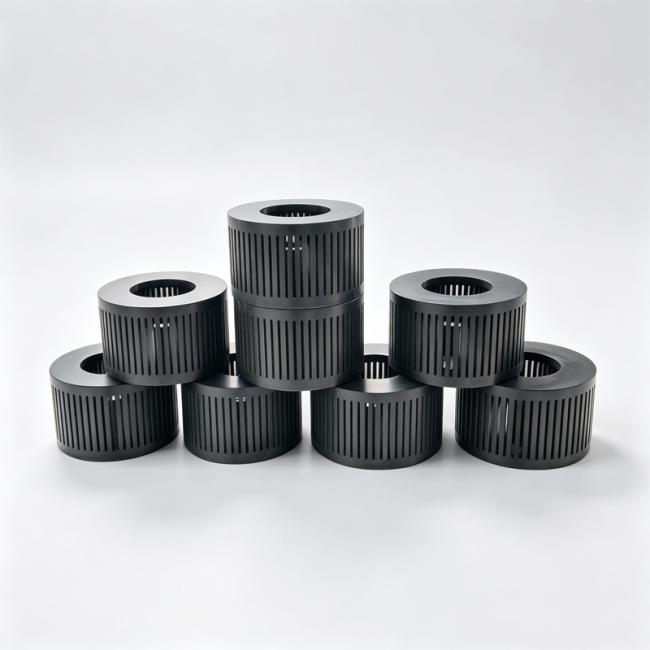
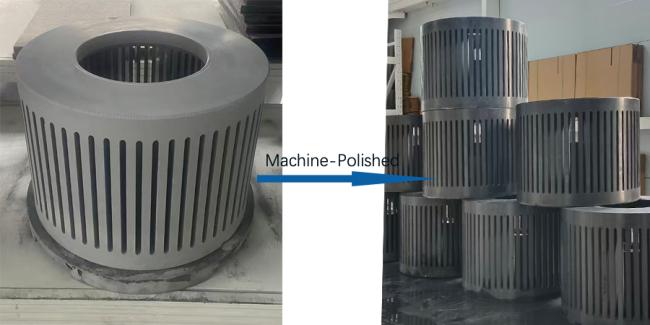
The silicon nitride ceramic classifier wheel is a high‑speed rotating precision rotor for jet milling and classification equipment, and can also be regarded as a specially‑structured classification pressure disc. Relying on centrifugal force generated by high‑speed rotation, it performs fine sorting and classification of powders. As the core functional component of the whole system, it works similarly to a high‑efficiency centrifuge. It accurately separates milled materials by particle size, screening and collecting only ultra‑fine powders meeting particle‑size requirements, so as to ensure uniform particle size and stable quality of final products.
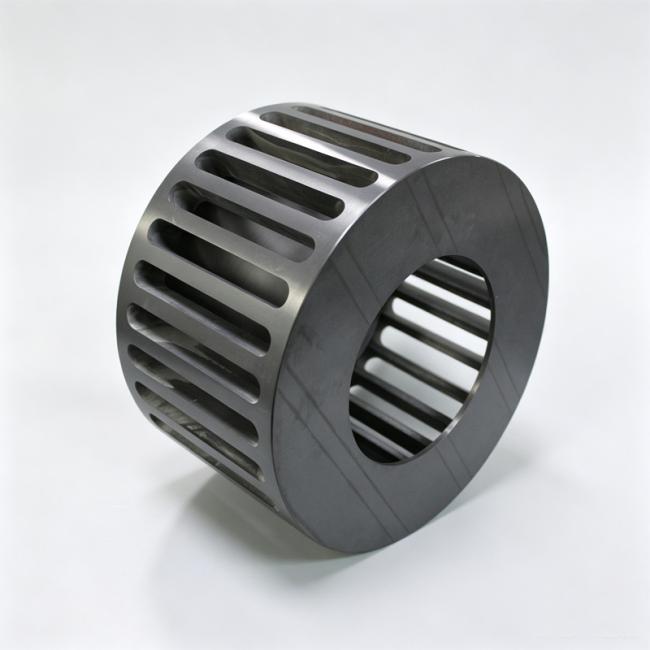
Working Principle of Classifying Wheel
Inside an air classifier, mixed powder particles are carried by airflow toward the rotating classifying wheel. Two competing forces act on each particle: centrifugal force generated by high‑speed rotation, and drag force from inward airflow.
1. Coarse particles: Centrifugal force exceeds air drag. Heavy coarse grains are thrown outward, returning to the grinding chamber for re‑crushing or entering coarse‑powder collection.
2. Fine particles: Air drag overcomes centrifugal force. Fine particles pass through wheel slot gaps, flow inward and are collected as finished ultra‑fine powder.
Operators adjust rotating speed to set cut‑off particle size. Higher speed delivers finer finished powder, while lower speed produces coarser fractions. The wheel’s dimensional stability and dynamic‑balance performance directly control particle‑size distribution width and classification sharpness.
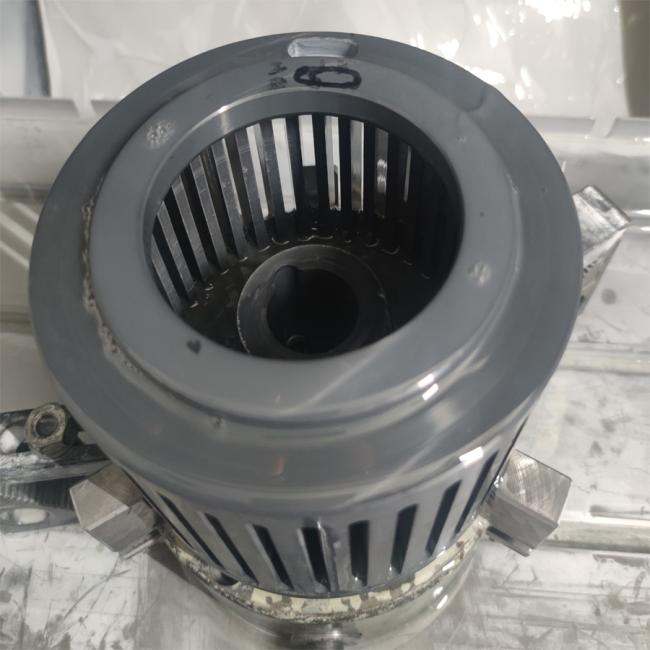
Why Silicon Nitride for Classifying Wheels
Silicon nitride distinguishes itself from metal and other technical ceramics with a balanced set of mechanical, thermal and chemical properties.
1. High hardness & excellent wear resistance
With Vickers hardness above 1500 HV, silicon nitride resists erosion from sharp abrasive powders. Service life is multiple times longer than stainless‑steel counterparts, lowering part‑replacement frequency and production downtime.
2. High fracture toughness & high‑speed reliability
Si₃N₄ features fracture toughness ≥6.0 MPa·m¹/². Unlike brittle alumina ceramic, it tolerates particle impact and mechanical shock. Low density (3.2 g/cm³, roughly 2/3 of steel weight) reduces rotary inertia. The wheel runs stably at speeds above 10 000 rpm with lower bearing load, supporting higher limit rotating speed and finer classification capacity.
3. Superior thermal‑shock resistance
Low thermal‑expansion coefficient enables outstanding thermal‑shock performance. It withstands sharp temperature fluctuations during continuous powder processing without cracking, ideal for processes with hot‑powder feeding or periodic temperature cycling.
4. Chemical inertness and zero‑metal contamination
Silicon nitride is chemically stable against most acids, alkalis and organic media. No metallic debris will contaminate processed powder. This property is critical for battery‑material, pharmaceutical, high‑purity mineral and ceramic‑powder manufacturing where impurity must be strictly controlledloongceram....
5. Precision manufacturability
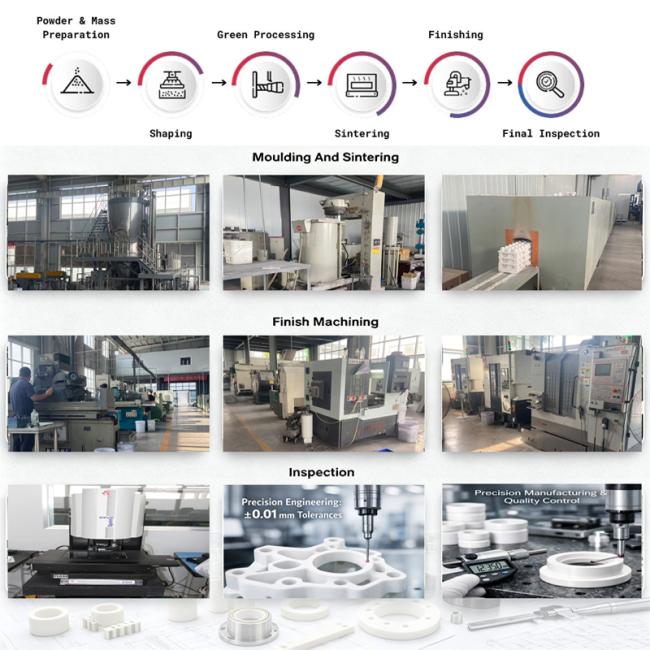
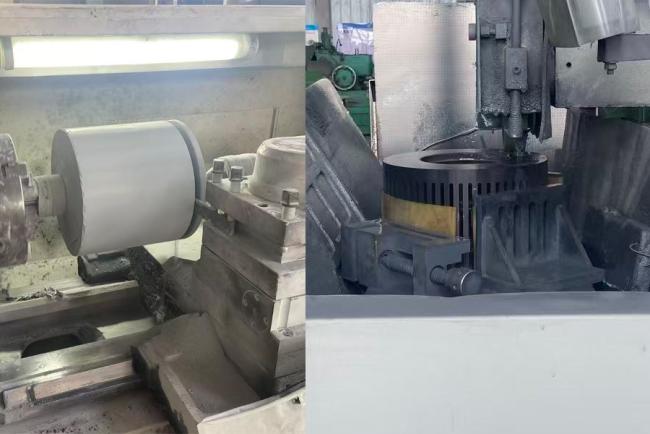
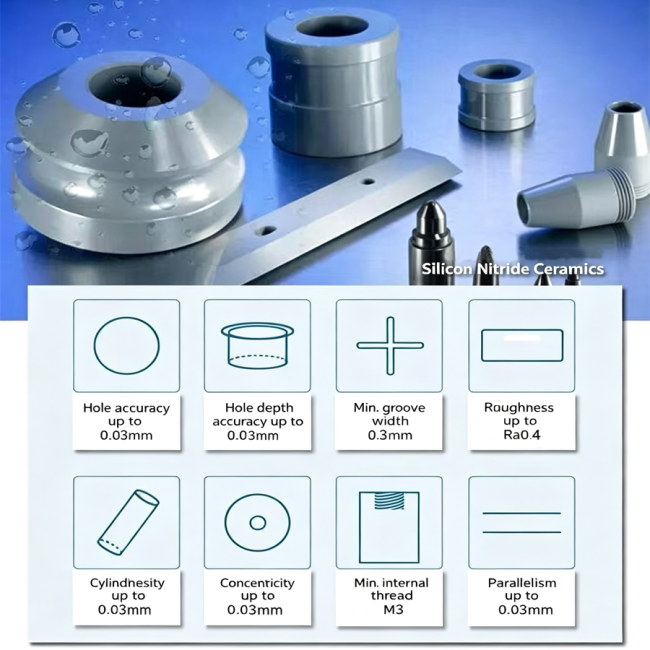
Integrated one‑piece sintered structure eliminates assembled‑blade loosening risk. Slots, shaft bore and dynamic‑balance holes can be machined to tight dimensional tolerances for precise aerodynamic profile and qualified dynamic balance.
Silicon Nitride Material Sheet
| Properties | Units | Silicone Nitride | |
| Mechanical | Density | gm/cc | 3.2 |
| Porosity | % | 0 | |
| Flexural Strength | Mpa | 830 | |
| Compressive Strength | Mpa | 2500 | |
| Elastic Modulus | Gpa | 310 | |
| Poisson's Ratio | / | 0.27 | |
| Hardness | kg/mm2 | 1580 | |
| Fracture Toughness KIC | Mpa *m 1/2 | 6.1 | |
| Thermal | Heat Conductivity | W/ m*k | 30 |
| Coefficient of Thermal Expansion | 10⁻⁶/K | 3.3 | |
| Specific Heat | j/kg*K | / | |
| Thermal Shock Resistance | °C | / | |
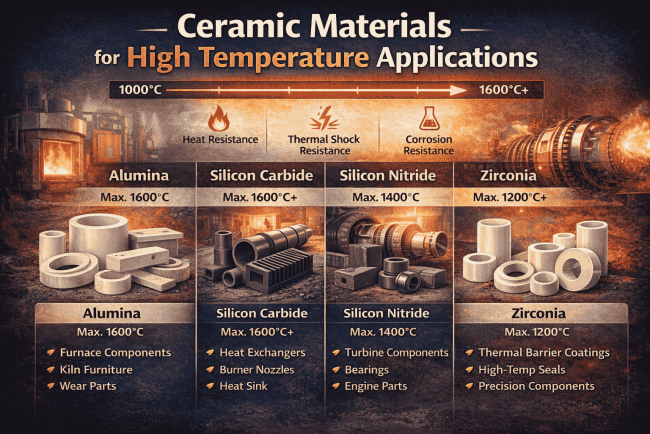
| Max UseTemperature | °C | 1400 | |
| Electrical | Dielectric Strength | ac-kv/mm | / |
| Dielectric Constant | / | 8 | |
| Loss Tangent | / | / | |
| Volume Resistivity | ohm•cm | >1014 | |
Main Application Areas
● New‑energy battery materials: Lithium‑iron phosphate, NCM cathode powder, anode powder ultra‑fine classification
● Advanced ceramics & mineral powder: High‑purity non‑metallic minerals, ceramic raw powder
● Pharmaceutical industry: Fine grading of active pharmaceutical ingredients and excipients
● Magnetic & metallic powders: Rare‑earth magnetic powder, inert metal powder free from metal pollution
● Functional chemical powder: Corrosive or high‑purity fine‑chemical intermediate powder processing
Get in Touch
Have questions about our products or want to discuss a custom order? Our team is ready to help you.