
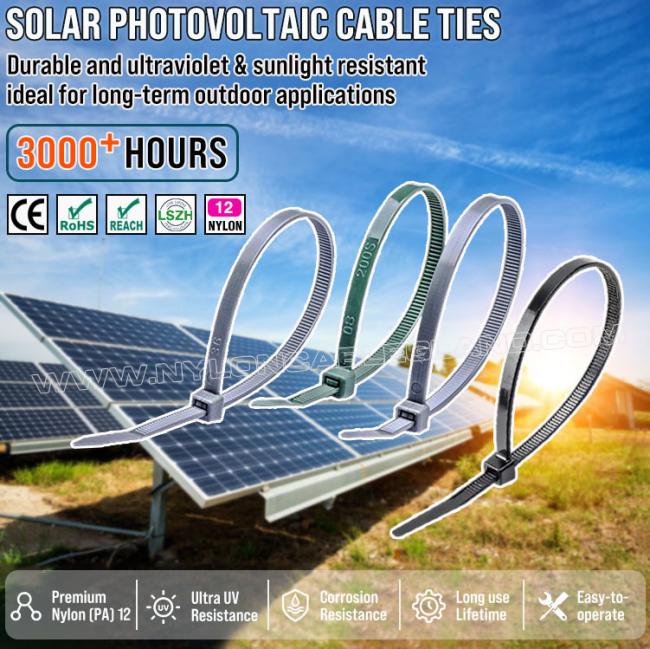
Nylon (PA) 12 UV-Resistant Cable Zip Tie 300mm x 4.8 (Ø 3-80mm), Excellent Salt & Chemical Resistance, for Solar Photovoltaic Industry
1. What Is A Nylon (Polyamide) 12 Cable Tie?
A Nylon (Polyamide) 12 cable tie is a type of premium cable management fastener crafted from Polyamide 12 (a high-performance engineering thermoplastic). Like a conventional cable tie, it is used to bundle, organize, and secure cables, hoses, pipes, and other components. However, Polyamide 12 offers significantly better environmental resistance than the more common Nylon (Polyamide) 66.
It is specifically designed for applications where cable bundles are exposed to:
- High humidity
- Saltwater or marine environments
- Chemicals and oils
- UV radiation
- Low temperatures
- Outdoor weathering
- Industrial pollution
Because of their excellent durability and long service life, they are widely used in demanding industrial and outdoor installations.
2. Why Do We Need the Nylon 12 Cable Ties?
Choosing Polyamide 12 cable ties can reduce long-term maintenance costs and improve system reliability.
Key reasons include:
- Longer service life
- Better resistance to moisture and humidity
- Superior chemical resistance
- Excellent UV stability for outdoor use
- Reliable performance in cold climates
- Reduced risk of brittle failure
- Greater flexibility and vibration resistance
- Lower maintenance and replacement frequency
- Better protection for critical wiring systems
- Suitable for demanding industrial environments
Although Polyamide 12 cable ties have a higher initial cost, they often provide a lower total cost of ownership in harsh applications due to their extended life time and reduced replacement needs.
3. When Are Polyamide 12 Cable Ties Needed?
Polyamide 12 cable ties are recommended when installations require long-term reliability under demanding conditions, such as:
- Outdoor electrical installations
- Coastal or marine environments
- High-humidity locations
- Cold climates
- Chemical processing facilities
- Oil and gas installations
- Food processing plants with frequent washdowns
- Heavy industrial machinery
- Renewable energy systems
- Transportation equipment exposed to vibration
For standard indoor cable management in dry, temperature-controlled environments, Polyamide 6.6 cable ties are often sufficient and more economical.
4. What Are The Features & Advantages Of Nylon 12 Cable Ties?
4.1. Excellent Moisture Resistance
One of Polyamide 12's biggest advantages is its very low moisture absorption.
Typical moisture absorption:
- Polyamide 12: approximately 0.5–1%
- Polyamide 6.6: approximately 2.5–3% (equilibrium at normal humidity)
Lower moisture absorption means:
- More stable dimensions
- More consistent tensile strength
- Better locking performance
- Reduced swelling
This is particularly important in humid climates.
4.2. Superior Chemical Resistance
Polyamide 12 performs well when exposed to:
- Oils
- Grease
- Hydraulic fluids
- Fuels
- Diesel
- Gasoline
- Salt solutions
- Mild acids
- Mild alkalis
- Industrial chemicals
This makes Polyamide 12 ideal for harsh industrial environments.
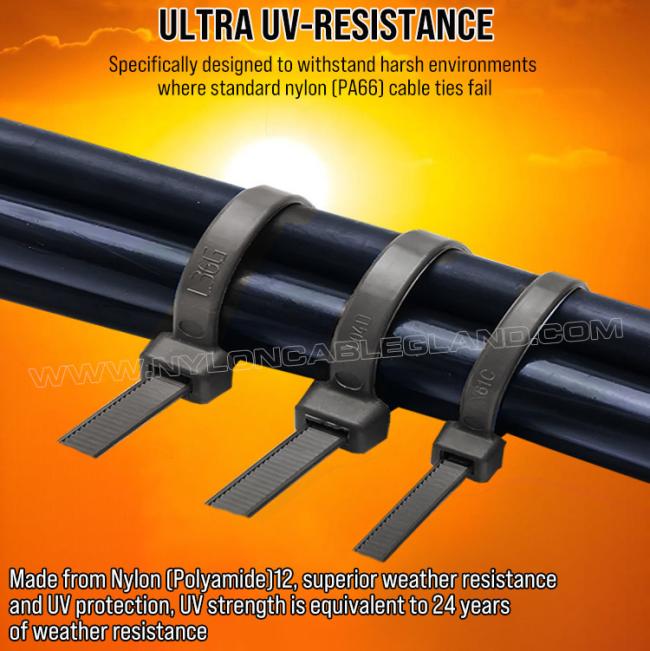
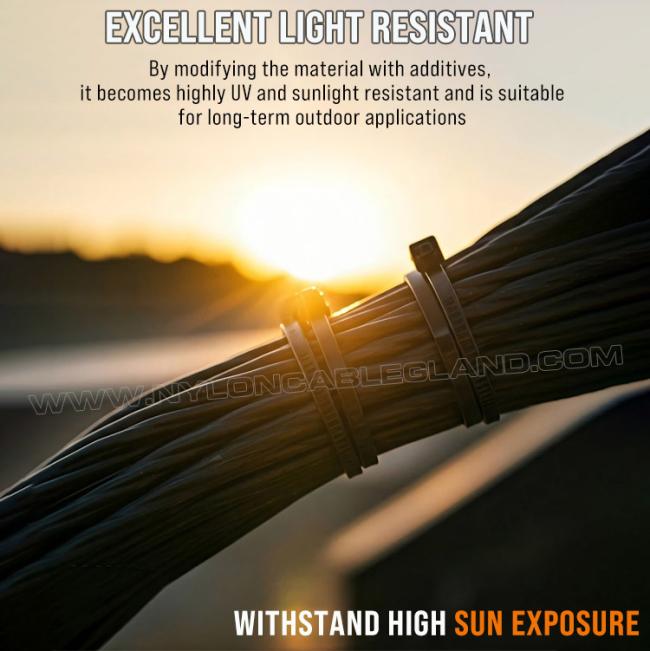
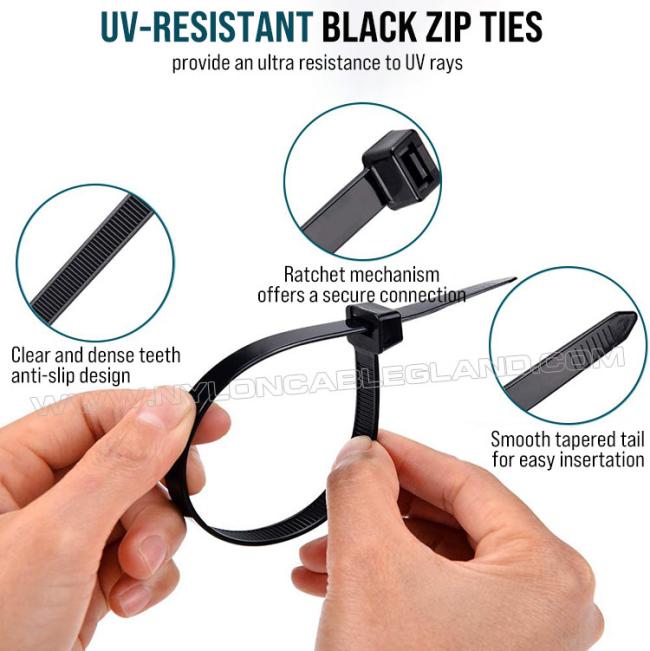
4.3. Excellent UV Resistance
Many Polyamide 12 cable ties are manufactured with UV stabilizers.
Advantages include:
- Long outdoor service life
- Better resistance to sunlight
- Reduced brittleness
- Less cracking after prolonged exposure
This makes them suitable for solar installations and outdoor telecommunications.
4.4. Outstanding Low-Temperature Performance
PA12 remains flexible even in very cold environments.
Typical operating temperature:
- −40°C to +85°C (Some premium grades may tolerate up to +105°C)
Unlike Polyamide 6.6, Polyamide 12 is much less likely to become brittle in freezing conditions.
4.5. Better Flexibility
Polyamide 12 is naturally more flexible than Polyamide 6.6.
Benefits:
- Easier installation
- Better vibration resistance
- Reduced stress concentration
- Lower risk of cracking
4.6. Excellent Fatigue Resistance
Polyamide 12 withstands repeated movement and vibration.
Suitable for:
- Moving machinery
- Rail vehicles
- Automotive wiring
- Wind turbines
4.7. Long Outdoor Service Life
Because Polyamide 12 combines:
- UV resistance
- Moisture resistance
- Chemical resistance
It typically lasts much longer outdoors than standard Nylon 6.6 cable ties.
4.8. Reduced Stress Cracking
Polyamide 12 is much less susceptible to environmental stress cracking caused by:
- Chemicals
- Humidity
- Mechanical loading
5. What Is The Difference Between Polyamide 12 & Standard Polyamide 66?
Comparison: Polyamide 12 vs Standard Polyamide 6.6
| Property | Nylon (Polyamide)12 | Standard Nylon 66 (PA66) |
| Moisture absorption | Very low | Moderate to high |
| Dimensional stability | Excellent | Moderate |
| UV resistance | Excellent (UV grades) | Fair (unless UV stabilized) |
| Chemical resistance | Excellent | Good |
| Oil resistance | Excellent | Moderate |
| Saltwater resistance | Excellent | Moderate |
| Flexibility | High | Moderate |
| Low-temperature performance | Excellent (down to about −60°C) | Good (typically down to about −40°C) |
| Outdoor durability | Excellent | Moderate |
| Fatigue resistance | Excellent | Good |
| Cost | Higher | Lower |
| Typical service life outdoors | Longer | Shorter |
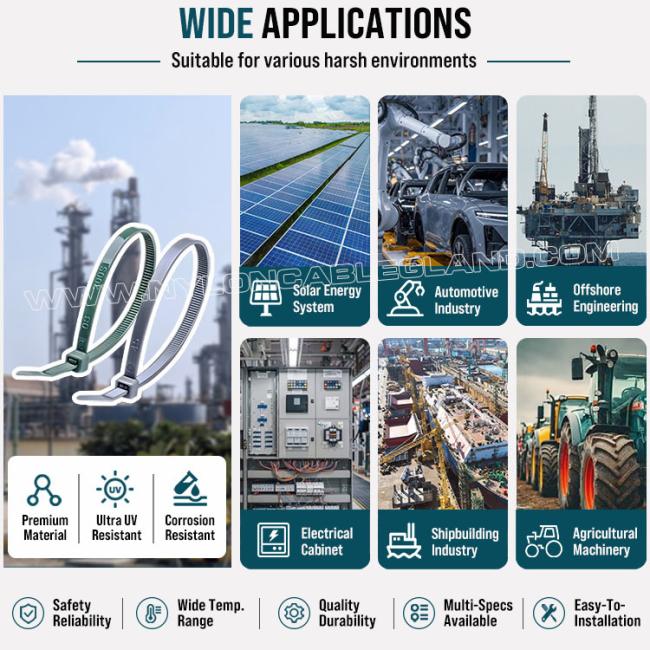
6. In Which Fields Or Industries Are These Cable Ties Used?
Polyamide 12 cable ties are widely used in industries where environmental durability is critical.
| Industry | Typical Applications |
| Solar energy | Securing photovoltaic cables and outdoor wiring |
| Wind power | Cable management inside towers and nacelles |
| Marine | Ships, ports, offshore platforms, docks |
| Oil & gas | Refineries, drilling equipment, pipelines |
| Chemical processing | Cable routing around chemical equipment |
| Automotive | Engine compartments, chassis wiring, electric vehicles |
| Rail transportation | Cable harnesses exposed to vibration and weather |
| Aerospace | Selected lightweight cable management applications (subject to certification requirements) |
| Telecommunications | Outdoor fiber optic and communication cabinets |
| Construction | Building facades, outdoor electrical systems |
| Utilities | Power distribution, substations, smart grid infrastructure |
| Mining | Heavy equipment, conveyors, outdoor electrical systems |
| Water treatment | Pumps, filtration systems, wastewater facilities |
| Food & beverage | Washdown areas where approved materials are specified |
| Industrial automation | Robotics, moving machinery, cable carriers |
7. Conclusion
Nylon (Polyamide) 12 cable ties are a premium alternative to standard Nylon 66 cable ties. Their defining advantages are low moisture absorption, excellent chemical resistance, superior UV and weather resistance, and outstanding low-temperature flexibility. These properties make them especially suitable for outdoor infrastructure, marine installations, renewable energy, transportation, and heavy industrial environments where standard Polyamid 6.6 cable ties may degrade more quickly.
For general indoor applications, Polyamide 6.6 cable ties remain a cost-effective choice. However, when long-term performance in harsh environmental conditions is essential, the higher upfront cost of Polyamide 12 cable ties are often justified by their greater durability, improved reliability, and reduced maintenance over the product's service life.
Get in Touch
Have questions about our products or want to discuss a custom order? Our team is ready to help you.