
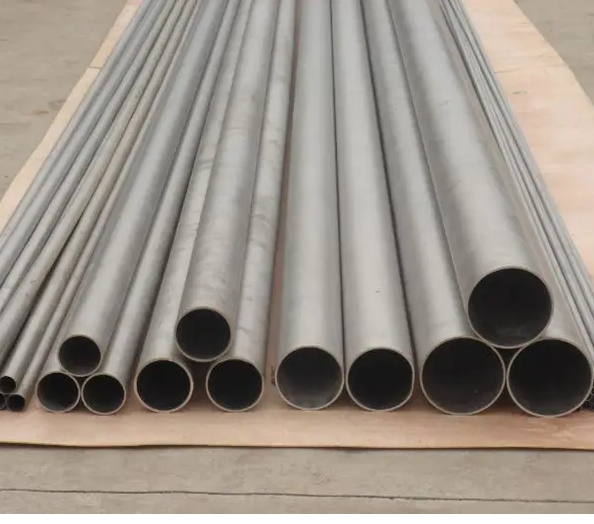
Welded Drawn Industrial High Nickel Alloy Tubing 200 201
Industrial High Nickel Alloy Tubing Welded & Drawn Nickle 200 201 For Sale
Nickel based alloys have a higher ability to accept alloying elements in solid solution than other stainless steel or iron-based alloys. They can
therefore maintain higher metallurgical stability. The combination of high alloying with multiple elements can provide very good corrosion resistance in a wide range of environments while still maintaining good welding and forming characteristics.
Nickel alloys are excellent for heat exchangers in the chemical processing and nuclear industries. They’re used in steam generator tubing in the nuclear power industry, in high-temperature aircraft systems, and in oil and gas extraction programmes where corrosion-, pressure- and temperature-resistant tubing is required. Their corrosion resistance also makes them useful in desalination equipment.
Vessels, heat exchangers, pipes, pumps, valves, scrubbers, and other equipment components used in the marine engineering, chemical, petrochemical, hydrocarbon, thermal and food processing, oil and gas extraction, power generation, and pollution control industries are prime applications for these high-performance alloys.
| Type | Nickel 201 alloy tube/ pipe |
| Technique | Nickel welded tube |
| Standard | ASTM B163/ ASME SB163, ASTM B725/ ASME SB725 |
| Outer Diameter | 6.35 mm OD To 152 mm OD |
| Length | Max, 15m |
| Shape | ‘U’ bent, Hollow, Hydraulic, LSAW, Boiler, Straight Tube, Tube Coil, Round, Rectangular, Square Etc |
| Surface | Polished, AP (Annealed & Pickled), BA (Bright & Annealed), MF |
| Processing | Hot rolling, cold rolling, drawing, extruding |
| Applications | Oil Tube, Gas Tube, Fluid Tube, Boiler Tube, Heat exchanger Tube, |
Applications
The major use of nickel is in the preparation of alloys. Nickel alloys are characterized by strength, ductility, and resistance to corrosion and heat. About 65 % of the nickel consumed in the Western World is used to make stainless steel, whose composition can vary but is typically iron with around 18% chromium and 8% nickel. 12 % of all the nickel consumed goes into super alloys. The remaining 23% of consumption is divided between alloy steels, rechargeable batteries, catalysts and other chemicals, coinage, foundry products, and plating.
Nickel is easy to work and can be drawn into wire. It resist corrosion even at high temperatures and for this reason it is used in gas turbines and rocket engines. Monel is an alloy of nickel and copper (e.g. 70% nickel, 30% copper with traces of iron, manganese and silicon), which is not only hard but can resist corrosion by sea water, so that it is ideal for propeller shaft in boats and desalination plants.
Get in Touch
Have questions about our products or want to discuss a custom order? Our team is ready to help you.