
Paper Making Metallurgical Nonionic Polyacrylamide 9003-05-8
Metallurgical Environment Fields Nonionic Polyacrylamide 9003-05-8
Nonionic emulsion polyacrylamide is a high-efficiency liquid flocculant of our company. It adopts the advanced technology of water-in-oil, uses W/0 emulsifier, re-oil polymerization reaction, and has high conversion ratewith high conversion rate, high molecular weight, high stability, multi-function,instant,etc.
Description
Polyacrylamide, also known as PAM, is an extremely water-soluble high polymer. It finds use in Paper Making, Chemical, Petroleum, Textile, Metallurgical and environment protection fields.
- Non-ionic polyacrylamide (NPAM) is a water soluble polymer formed from acrylamide (a compound with the molecular formula C3H5NO) subunits.
- Non-ionic polyacrylamide has a big range of high molecular weight from 5-8 million, with an anionic charge density ranging from 0-10%.
- Our N830 grade has low to medium molecular weight, low charge degree.
- It is most often used to increase the viscosity of water (creating a thicker solution) or to encourage flocculation of particles present in water.
- Due to the polar groups on the molecular chain containing a certain amount, it can through the adsorption of solid particles suspended in water, bridging between particles or through the charge and make the particle formation of large flocs condensation. So, it can accelerate the settlement of particles in suspension, have obvious to speed up the solution to clarify, promote filtering and other effects.
Specifications
| Appearance: | Off-White Granular Powder | |
| Ionic Charge: | Non-ionic | |
| Particle Size: | 20-100 mesh | |
| Molecular Weight: | Low to Medium | |
| Hydrolysis Degree: | Low | |
| Solid Content: | 89% Min | |
| Approximate Brookfield viscosity at 25° C: | @ 1.0% | >1500 |
| @ 0.50% | >600 | |
| @ 0.25% | >300 | |
| Bulk Density: | About 0.6-0.8 | |
| Specific Gravity at 25°C: | 1.01-1.1 | |
|
Recommended Working Concentration: |
0.1-0.5% | |
| PH (1% aqua solution): | 6-9 | |
| Storage Temperature (°C): | 0 - 35 | |
| Shelf Life: | 2 years | |
Application Methods:
| 1 |
Dissolving concentration: |
Polyacrylamdie (polyelectrolyte/flocculant) should be standardly be dissolved to 0.1-0.5% concentration. |
| 2 |
Dissolving time: |
The time required to dissolve the flocculant varies according to the type of flocculant, water quality, temperature and agitation. However, most flocculants generally require around 1 hour of agitation to completely dissolve the powder. Incomplete mixture of flocculant or lumping may inhibit the performance of the flocculant. |
| 3 |
Agitation speed: |
The ideal revolution of the agitator is between 200-400rpm. A high speed agitator operating without reducing the revolution of a motor is not advised, since it may cut the molecules of the flocculant. An ideal agitator motor should be of 1HP for a 1-2m3 mixing tank. |
| 4 |
Application and Dosage: |
The dosage range of varies from 1 - 3.0 ppm depending upon the type of effluent and application. Advised to do jar tests for evaluating the functioning and approximate dosage. |
| 5 | Jar Test: | Put sample of effluent in a beaker and add it as designated, agitate for 1 minute at 100-120 rpm and then slowly agitate at 60rpm. Determine the flocs properly at this time and note the sedimentation and clarity of top solution. |
Package and Storage:
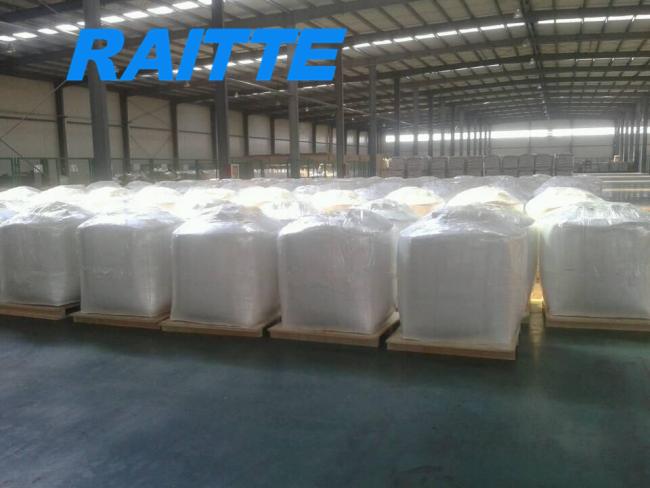
- Packed in Kraft or PE bags with inner plastic bags, with each bag containing 25kgs, or 750kgs net big bag.
- Stored in original packaging in cool and dry place, away from sources of heat, flame and direct sunlight.
Get in Touch
Have questions about our products or want to discuss a custom order? Our team is ready to help you.