
Titanium Blind Plate Flange DIN 2502 Gr1 Gr2 Gr5 PN16 Plate Flange for Pipeline Systems
Titanium Blind Plate Flange DIN 2502 Gr2 Gr5 PN16 Plate Flange for Welding PLFF PLRF for Pipeline Systems
1.Product Introduction of DIN2502 Titanium Plate Flange
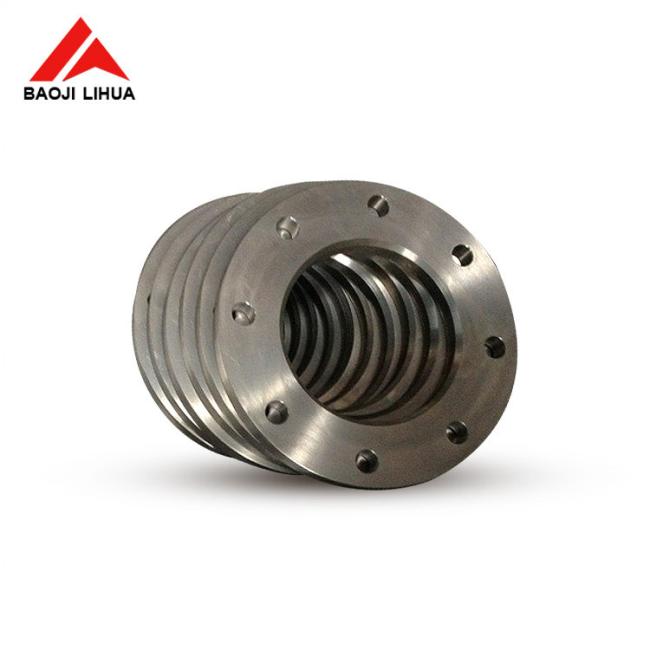
DIN2502 Titanium Plate Flanges refer to a specific type of titanium flange that adheres to DIN (Deutsches Institut für Normung) standards. DIN standards are German technical standards used in various industries to ensure compatibility, interchangeability, and quality of products.Titanium plate flanges are a specific type of flange used in piping systems to connect pipes to other pipes, equipment, or valves. They are characterized by their flat design with no raised sealing face and typically thicker construction compared to other types of flanges, providing sufficient strength and rigidity for bolt attachment and sealing.
- Standard: DIN 2502
- Type: Plate Flange
- Material: Titanium (typically Grade 2 or Grade 5)
- Design: The DIN 2502 standard specifies plate flanges with a loose flange ring. This means the flange consists of a flat, circular plate with bolt holes around the perimeter and an inner diameter matching the pipe bore. It also includes a separate flange ring that sits inside the bolt circle to aid in alignment and facilitate sealing.
-
Dimensions: The DIN 2502 Titanium Plate Flange dimensions are standardized to ensure compatibility with pipes and other equipment adhering to DIN specifications. This includes outer diameter (OD), bolt circle diameter, bolt hole size, and thickness, which vary depending on the nominal size and pressure rating (PN class).
-
Pressure Ratings: Available in various pressure classes (PN 6, PN 10, PN 16, PN 25, PN 40), which determine the maximum allowable working pressure based on the flange’s design and material properties.
During installation, titanium plate flanges are aligned with the pipe or equipment port and secured using bolts that are pre-installed through holes drilled in the flange. A full-face gasket is used to cover the entire surface of the flange to ensure a seal and prevent leakage during system operation.
2. Grades of DIN 2502 Titanium Plate Flange
Titanium Grade 2:
- Composition: Titanium Grade 2, also known as commercially pure titanium (CP Ti), is composed of 99.2% titanium, with the remaining 0.8% consisting primarily of iron and oxygen.
- Properties:
- Strength: It has good strength, comparable to some low-alloy steels.
- Corrosion Resistance: Grade 2 titanium exhibits excellent corrosion resistance, especially in environments where chlorides are present.
- Fabricability: It is readily weldable and formable, making it suitable for various manufacturing processes.
- Applications:
- Chemical processing equipment
- Marine and offshore applications
- Medical implants and surgical instruments
- Aerospace components where weight savings and corrosion resistance are critical
Titanium Grade 5 (Ti-6Al-4V):
- Composition: Titanium Grade 5 is an alloy composed of 90% titanium, 6% aluminum, and 4% vanadium.
- Properties:
- Strength: Grade 5 titanium is significantly stronger than Grade 2, making it ideal for high-strength applications.
- Corrosion Resistance: It offers good corrosion resistance, although not as high as Grade 2 in some environments.
- Heat Resistance: Grade 5 maintains excellent strength at elevated temperatures.
- Lightweight: Like all titanium alloys, Grade 5 is lightweight compared to many other metals.
- Applications:
- Aerospace components (aircraft structural components, engine parts)
- Automotive racing (engine components, exhaust systems)
- Biomedical implants (orthopedic implants, dental implants)
- Marine components
- Sports equipment (bicycle frames, golf clubs)
Selection Considerations:
- Corrosion Environment: Grade 2 is preferred for applications requiring superior corrosion resistance, especially in chlorinated environments. Grade 5 is suitable where higher strength and moderate corrosion resistance are needed.
- Strength Requirements: Grade 5 offers superior strength over Grade 2, making it suitable for load-bearing applications where weight and strength are critical factors.
- Cost: Grade 5 titanium is generally more expensive than Grade 2 due to its alloying elements and enhanced properties.
Both Grade 2 and Grade 5 titanium have their distinct advantages and are chosen based on specific application requirements for strength, corrosion resistance, and other mechanical properties.
3. Specifications for DIN2502 PN16 Titanium Plate Flange
| Nominal Pipe Size | Diameter of | Flange Dia | Flange I.D | Thk of Flanges | Dia of Bolt Cirlce | No. of | Dia of Bolt Holes | Weight |
|---|---|---|---|---|---|---|---|---|
| DN | Pipe | D | D5 | B | K | holes | D2 | KG |
| 10 | 17.20 | 90 | 17.70 | 14 | 60 | 4 | 14 | 0.60 |
| 15 | 21.30 | 95 | 22.00 | 14 | 65 | 4 | 14 | 0.67 |
| 20 | 26.90 | 105 | 27.60 | 16 | 75 | 4 | 14 | 0.94 |
| 25 | 33.70 | 115 | 34.40 | 16 | 85 | 4 | 14 | 1.11 |
| 32 | 42.40 | 140 | 43.10 | 16 | 100 | 4 | 18 | 1.62 |
| 40 | 48.30 | 150 | 49.00 | 16 | 110 | 4 | 18 | 1.85 |
| 50 | 60.30 | 165 | 61.10 | 18 | 125 | 4 | 18 | 2.46 |
| 65 | 76.10 | 185 | 77.10 | 18 | 145 | 4 | 18 | 2.99 |
| 80 | 88.90 | 200 | 90.30 | 20 | 160 | 8 | 18 | 3.61 |
| 100 | 114.30 | 220 | 115.90 | 20 | 180 | 8 | 18 | 3.99 |
| 125 | 139.70 | 250 | 141.60 | 22 | 210 | 8 | 18 | 5.41 |
| 150 | 168.30 | 285 | 170.50 | 22 | 240 | 8 | 22 | 6.55 |
| 175 | 193.70 | 315 | 196.10 | 24 | 270 | 8 | 22 | 8.42 |
| 200 | 219.10 | 340 | 221.80 | 24 | 295 | 12 | 22 | 8.97 |
| 250 | 273.00 | 405 | 276.20 | 26 | 355 | 12 | 26 | 12.76 |
| 300 | 323.90 | 460 | 327.60 | 28 | 410 | 12 | 26 | 16.60 |
| 350 | 355.60 | 520 | 359.70 | 30 | 470 | 16 | 26 | 24.08 |
| 400 | 406.40 | 580 | 411.00 | 32 | 525 | 16 | 30 | 30.20 |
| 450 | 457.00 | 640 | 462.30 | 38 | 585 | 20 | 30 | 41.67 |
| 500 | 508.00 | 715 | 513.60 | 38 | 650 | 20 | 33 | 52.87 |
| 600 | 610.00 | 840 | 616.50 | 42 | 770 | 20 | 36 | 77.58 |
| 700 | 711.00 | 910 | 716.00 | 44 | 840 | 24 | 36 | 77.13 |
| 800 | 813.00 | 1025 | 818.00 | 50 | 950 | 24 | 39 | 106.35 |
| 900 | 914.00 | 1125 | 920.00 | 54 | 1050 | 28 | 39 | 125.39 |
| 1000 | 1016.00 | 1255 | 1022.00 | 60 | 1170 | 28 | 42 | 177.99 |
4. Standards of Titanium Plate Flange
AFNOR NF E29-200-1: French standard for flanges, including titanium flanges.
ASME ANSI B16.5: American Society of Mechanical Engineers (ASME) standard for pipe flanges and flanged fittings. It covers titanium flanges used in North America and internationally.
AWWA C207: American Water Works Association (AWWA) standard for steel pipe flanges for waterworks service, including titanium flanges used in water treatment applications.
BS1560, BS 4504, BS 10: British standards for pipe flanges and bolting, including titanium materials.
ISO7005-1: International Organization for Standardization (ISO) standard for metallic flanges, including titanium flanges.
MSS SP 44: Manufacturer's Standardization Society (MSS) of the Valve and Fittings Industry standard for steel pipeline flanges. It includes titanium flanges.
AS2129: Australian standard for flanges, including titanium flanges.
CSA Z245.12: Canadian standard for steel pipe flanges, including titanium materials.
DIN2573, DIN2576, DIN2501, DIN2502: German standards (DIN) for flanges, covering various types and dimensions of titanium flanges.
EN1092-1, EN1759-1: European standards (EN) for flanges, including titanium flanges.
JIS B2220: Japanese Industrial Standards (JIS) for steel pipe flanges, including titanium flanges.
UNI 2276, UNI 2277, UNI 2278, UNI 6089, UNI 6090: Italian standards (UNI) for pipe flanges, including titanium materials.
5. Applications of DIN 2502 Titanium Plate Flange
- Pipeline Construction: Used to join sections of pipelines, ensuring secure and leak-free connections during fluid transport.
- Refineries and Petrochemical Plants: Installed in processing units for connecting vessels, reactors, and heat exchangers, where resistance to corrosive chemicals is essential.
- Offshore Platforms: Employed in offshore drilling rigs and production platforms to withstand marine environments and harsh weather conditions.
- Gas Processing Facilities: Utilized in compressors, pumps, and valves to maintain operational integrity and safety.
Get in Touch
Have questions about our products or want to discuss a custom order? Our team is ready to help you.