
Class Approval MED Free Fall Lifeboat Launching Appliance Ship Life Saving Equipment
Free-Fall Lifeboat Launching Appliance
Product Overview
A free-fall lifeboat launching appliance is the stern-mounted system that supports a free-fall lifeboat in the stowed and ready-to-launch positions, enables the boat to clear the ship safely during free-fall launch, and provides a secondary means for lowering and recovery. The documented systems use a structural davit/ramp arrangement together with hydraulic outboarding or positioning components, a hydraulic winch or recovery winch, wire rope, control valves, electrical controls and shipboard foundation interfaces.
The available product files document two representative configurations: 70DF matched to an 59FF free-fall lifeboat, and F75 matched to a FN-6.65 lifeboat in the supplied technical page. Both systems use a 50 kN hoisting-load reference and a documented boat-hoisting speed of at least 3.0 m/min, but their working loads and system details are not identical. Selection must therefore be based on the actual approved lifeboat weight, free-fall geometry, installation height, recovery condition, hydraulic/electrical interfaces and certification requirement.
Quick Specifications
| Item | Documented Series Summary |
| Equipment type | Free-fall lifeboat launching and recovery appliance |
| Documented models | 70DF and F75 |
| Operation | Free-fall launch plus hydraulic / winch-assisted secondary lowering and recovery |
| Working-load evidence | 70 kN for 70DF; 75 kN for F75 |
| Maximum hoisting-load evidence | 50 kN on both documented configurations |
| Boat hoisting speed | ≥3.0 m/min |
| Design attitude | 20° list / 10° trim in the documented specifications |
Main Technical Parameters
Range / Configuration Summary
| Model | Working Load | Hoisting Load | Hoisting Speed | Boat Fall | Matched Boat Evidence |
| 70DF | 70 kN | 50 kN | ≥3.0 m/min | 18×19, Ø20 mm, 1770 grade | 59FF; 18P / 5,285 kg in technical specification |
| F75 | 75 kN | 50 kN | ≥3.0 m/min | 18×19, Ø20 mm, 1770 grade, galvanized, non-rotating | FN-6.65 in supplied technical page |
Hydraulic / Electrical Configuration
| Configuration Item | 70DF | F75 |
| Hydraulic function | Hydraulic cylinder pushes the boat/appliance outboard; hydraulic winch used for secondary lowering/recovery | Hydraulic outboarding/positioning and FW45 hydraulic winch in supplied specification |
| Motor | M2QA160L4A (ABB) | Y160L-4-H |
| Motor power | 15 kW | 15 kW |
| Power supply | AC 440 V / 60 Hz / 3 phase | 440 V / 60 Hz / 3 phase |
| Motor protection / insulation | IP56 / Class F | IP56 / Class F |
| Control box | IP56 documented in supply scope | IP56; SS316 box; 220 V single-phase control circuit documented |
| Self-weight | Approx. 9,000 kg | Approx. 7,500 kg davit + approx. 1,000 kg maintenance platform |
Structure & Components
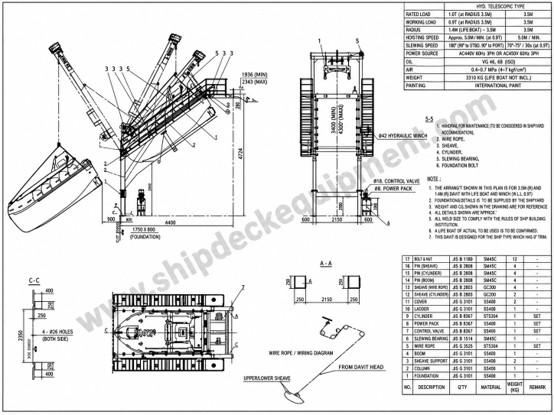
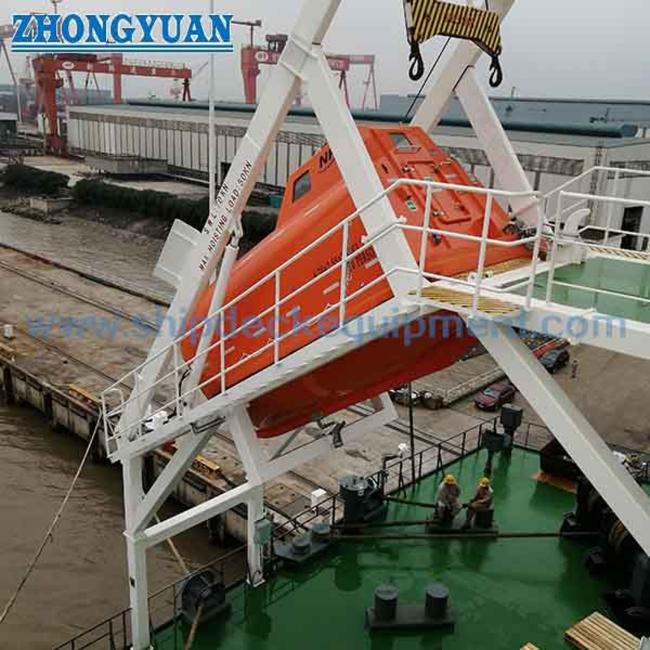
The documented free-fall launching systems comprise the main davit/ramp or frame structure, davit arm, hydraulic winch, hydraulic pump station with electric motor, hydraulic control valves, steel wire rope and fittings, electrical starter/control equipment, push buttons and local hydraulic piping. The final arrangement also interfaces with the lifeboat securing/release system, ship structure and maintenance access.
Drive & Control
Hydraulic power is used for the controlled outboarding or positioning function and for the recovery arrangement in the documented systems. 70DF uses a 15 kW electric motor-driven hydraulic system and an IP56 electrical control package. The F75 specification also lists a 15 kW motor, IP56 protection and a hydraulic FW45 winch, together with an IP56 control box and push-button arrangement.
The free-fall launch itself is initiated by the lifeboat release mechanism from inside the boat. The launching appliance must prevent accidental release in the unattended stowed position, while the secondary launch/recovery arrangement must remain compatible with the approved lifeboat and installation.
How It Works
Free-fall mode: occupants embark and secure themselves → the boat is placed in the approved ready-to-launch condition → the protected release is operated from inside the lifeboat → the lifeboat travels along the launching path and clears the ship within its approved free-fall geometry.
Secondary lowering / recovery mode: the hydraulic system positions or outboards the boat/appliance → the winch and falls lower or recover the lifeboat within the approved hoisting/recovery load → the boat is returned to and secured in the stowed position. The 70DF technical specification states recovery with four persons in the boat.
Installation & Maintenance Considerations
The launching appliance and lifeboat operate as one system. IMO LSA Code section 6.1.4 requires the installation to protect occupants from harmful acceleration forces, ensure effective clearing of the ship, prevent sparking/incendiary friction during launch, prevent accidental release in the unattended stowed position and keep the installation height within the lifeboat's approved free-fall certification height.
For replacement or newbuilding work, the shipyard should provide stern arrangement and foundation drawings, free-fall / installation height, lifeboat model and fully loaded weight, hydraulic/electrical interfaces and maintenance-access constraints. Deck assembly, electrical cable routing, interconnecting hydraulic piping and onboard testing are identified as shipyard-side items in the 70DF/F75 technical material unless otherwise agreed.
Inspection & Documentation
Launching appliances should be supported by approved/general arrangement drawings, hydraulic and electrical documentation, operating instructions, test records and the certification required for the project. IMO resolution MSC.402(96) requires examination of launching structures, wires and sheaves, lubrication, limit switches where fitted, stored-power systems, hydraulic systems and associated controls. The resolution also covers operational testing of the free-fall lifeboat release function without launching the boat, following the approved manufacturer's arrangement.
IMO adopted further amendments in 2026 concerning simulated testing of free-fall lifeboat release systems; the relevant MSC 111 resolutions remain listed by IMO as awaiting certification. They should therefore be tracked as an upcoming regulatory change rather than presented as an already-effective product requirement.
Selection & Inquiry Guide
1. Provide the free-fall lifeboat model, approved fully loaded weight, capacity and free-fall certification height.
2. Provide the stern installation drawing, ramp/skid geometry, foundation interface and required recovery condition.
3. Confirm the required working/hoisting load, wire-rope specification, hydraulic/electrical power supply and control arrangement.
4. Confirm whether the requirement is a complete new system or a replacement for an existing launching appliance; for replacement, provide the existing GA and foundation drawing.
5. Confirm class, flag and statutory certification requirements before finalizing the model and supply scope.
Applications
Cargo vessels | Tankers | Offshore / oil installations where supported by the approved boat-and-appliance system | Newbuilding stern free-fall installations | Replacement of existing free-fall launching appliances
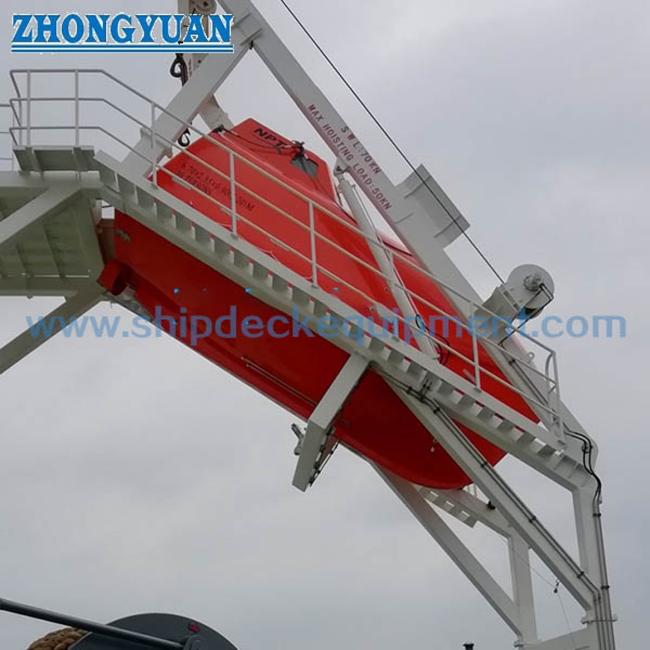
Drawing & Photos
FAQ
Q1. Is the launching appliance used during the normal free-fall launch? It supports and guides the boat in the stowed/launching arrangement; the free-fall release is initiated from inside the lifeboat. The appliance also provides the secondary lowering and recovery functions.
Q2. Can 70DF be selected only from passenger capacity? No. The approved fully loaded boat weight, free-fall height, geometry, recovery condition and certification must be checked.
Q3. Are 70DF and F75 interchangeable? No. They are separate documented systems with different working loads, components and matching evidence. Interchangeability would require engineering and approval review.
Get in Touch
Have questions about our products or want to discuss a custom order? Our team is ready to help you.