
Bolt Anchorage Staghorn Dock Bollard | Cast Steel Quayside Ship Mooring Equipment
Bolt Anchorage Staghorn Dock Bollard | Cast Steel Quayside Ship Mooring Equipment
Product Overview
The bolt anchorage staghorn dock bollard is a quayside mooring bollard used on ports, wharves, docks, jetties, and marine terminals to secure vessel mooring ropes. Its staghorn-shaped head allows the mooring rope to be turned and held around the bollard while the mooring force is transferred to the quay foundation through anchorage bolts. Because this is a safety-related mooring component on the dock, casting quality, smooth load transition, anchorage bolt design, and foundation interface should be treated as key purchasing and engineering points.
This bollard can be supplied in cast C-Mn steel, cast steel, cast stainless steel, cast iron, or ductile cast iron / SG iron according to project requirement. In normal production, wooden pattern casting is used to help control casting shape, mould accuracy, and transition quality while reducing the risk of harmful gas pores and slag inclusions. Smooth rounded transitions are finished around the horn and body to reduce local stress concentration. UT, MT, and FEA review can be arranged when required by the customer specification, terminal owner, or approval procedure.
Quick Specifications
- Product type: Bolt anchorage staghorn dock bollard → quayside mooring point for vessel berthing and securing operations.
- Nominal capacity range: 10 to 150 tonnes → used for initial bollard selection; final SWL / permissible load marking should follow project design approval.
- Bolt quantity: 5 to 7 anchorage bolts → bolt number increases with bollard size to help transfer mooring force into the quay foundation.
- Material options: Cast C-Mn steel, cast steel, cast stainless steel, cast iron, ductile cast iron / SG iron → final grade is confirmed by project specification.
- Casting method: Wooden pattern casting as the normal production route → supports controlled shape, smoother transitions, and casting quality control.
- Rope lead angle reference: vertical -45° to +45°, horizontal 0° to 180° according to supplied data → actual rope direction should be checked with berth arrangement.
- Anchorage system: Hot-dip galvanized carbon steel anchorage bolts → selected for strength and corrosion resistance; grade, diameter, and length to be confirmed.
- Surface treatment: Sa 2.5 blasting + one layer epoxy shop primer as reference → polished, galvanized, painted, or customized treatment available when specified.
Main Technical Parameters
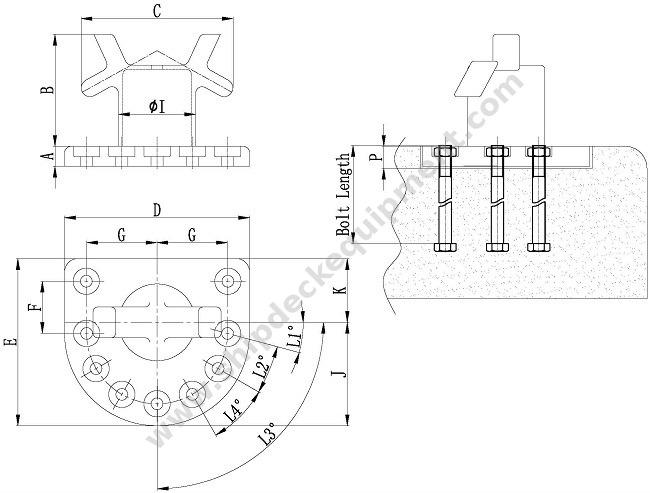
Main webpage dimensions for bolt anchorage staghorn dock bollards. Dimensions are in mm unless otherwise stated. Capacity is quoted from the supplied data for selection reference; final SWL, permissible load marking, safety factor basis, and foundation design should be confirmed according to project documents.
| Capacity (tonnes) |
A | D | E | F | G | H | J | K | Bolt No. |
| 10 | 166 | 352 | 55 | 350 | 305 | 102 | 382 | 115 | 5 |
| 15 | 178 | 400 | 65 | 400 | 350 | 130 | 420 | 127 | 5 |
| 20 | 203 | 467 | 70 | 485 | 405 | 165 | 410 | 165 | 5 |
| 30 | 254 | 530 | 75 | 610 | 570 | 265 | 505 | 185 | 5 |
| 40 | 300 | 617 | 75 | 610 | 610 | 305 | 60 | 210 | 5 |
| 50 | 300 | 598 | 85 | 762 | 660 | 280 | 560 | 230 | 5 |
| 60 | 300 | 604 | 70 | 762 | 660 | 280 | 560 | 230 | 6 |
| 75 | 355 | 742 | 95 | 850 | 725 | 305 | 760 | 240 | 7 |
| 100 | 360 | 774 | 115 | 965 | 840 | 356 | 760 | 240 | 7 |
| 150 | 430 | 850 | 115 | 1015 | 915 | 380 | 840 | 280 | 7 |
Selection & Inquiry Guide
Step 1: Confirm staghorn dock bollard type and required capacity from 10 to 150 tonnes according to berth mooring design, vessel size, rope arrangement, and lead angle.
Step 2: Confirm material requirement: cast C-Mn steel, cast steel, cast stainless steel, cast iron, or ductile cast iron / SG iron. If wear resistance or impact behavior is important, state the required material grade clearly.
Step 3: Confirm anchorage arrangement: bolt quantity, bolt layout, bolt material, coating, strength grade, diameter, length, embedded depth, nuts, washers, and installation template if required.
Step 4: Confirm surface treatment: Sa 2.5 blasting + shop primer, final paint system, color, coating thickness, polishing requirement, or hot-dip galvanizing requirement for bolts.
Step 5: Confirm inspection and engineering documents: material certificate, dimensional inspection, UT / MT, FEA calculation, load basis, class / third-party witness inspection, or terminal owner approval if required.
Step 6: Provide quantity, installation position, application port / berth information, delivery destination, required delivery time, GA drawing, foundation drawing, and existing bollard photos for replacement projects.
Structure
Staghorn-shaped cast body | Rounded horn transitions | Rope-wrapping contact area | Flanged base | Anchorage bolt holes | Hot-dip galvanized anchorage bolts | Quay foundation connection | Painted or specified surface treatment
Casting, Anchorage & Engineering Advantages
- The staghorn-shaped head supports rope turning and holding at quayside berths where vessels may approach the bollard from different mooring directions.
- Wooden pattern casting helps control mould shape, dimensional consistency, and curved transition areas before final machining, dressing, and surface treatment.
- Casting quality is a critical control point because harmful gas pores, slag inclusions, or shrinkage indications in high-stress areas may affect mooring safety and inspection acceptance.
- Smooth arc transitions around the horn and body are finished to reduce local stress concentration and avoid sharp rope-contact areas.
- Ductile cast iron / SG iron can be selected when the project requires improved wear and impact-resistance characteristics compared with ordinary grey cast iron, subject to material grade confirmation.
- Hot-dip galvanized carbon steel anchorage bolts provide corrosion resistance for the foundation connection; bolt strength grade and embedded details should follow the berth foundation design.
- UT and MT inspection can be arranged according to customer requirement, with the inspection scope, acceptance criteria, and witness requirement confirmed before production.
- FEA-based calculation is available upon request to review stress distribution at the horn transition, base, bolt-hole area, and foundation interface under specified load cases.
Custom Attributes
- Product Name: Staghorn dock bollard → quayside mooring bollard for vessel rope securing.
- Capacity Range: 10–150 tonnes → selected according to berth design load and vessel mooring arrangement.
- Material: Cast C-Mn steel / cast steel / cast stainless steel / cast iron / ductile cast iron / SG iron → final material standard and grade should be confirmed before production.
- Casting Method: Wooden pattern casting → helps control shape, wall transition, and casting surface quality.
- Safety Factor: 3 times as supplied → final design safety factor and SWL / permissible load marking should follow project approval requirement.
- Lead Angle: -45° to +45° vertical and 0° to 180° horizontal according to supplied data → actual rope direction should be confirmed from berth layout drawing.
- Anchorage Bolts: Hot-dip galvanized carbon steel → strength grade, diameter, length, embedment, nuts, washers, and bolt template to be confirmed.
- NDT Inspection: UT / MT available upon request → acceptance criteria and inspection scope should be specified in the order.
- FEA Calculation: Available according to customer requirement → useful for checking stress concentration and foundation interface under defined load cases.
- Surface Treatment: Sa 2.5 blasting + epoxy shop primer / polished / galvanized / customized finish → final system follows port environment and project specification.
How It Works
Vessel mooring line approaches the quay → Rope is placed around the staghorn bollard head → Smooth rounded contact areas support rope turning and holding → Mooring force is transferred through the cast body and flanged base → Anchorage bolts transfer the load into the quay foundation → Inspection and coating are completed according to project requirement
Applications
Port terminals | Quayside berths | Wharves | Jetties | Docks | Shipyards | Repair yards | Harbor mooring stations | Commercial marine terminals | Replacement of existing dock bollards
Certifications & Advantages
Certificates and inspection documents can be arranged according to project requirement, material traceability, NDT scope, load basis, and approval procedure.
Certification: Third party inspection certificate, Pull load test certificate.
Drawing & Photos
FAQ
Q1: Is the 10 to 150 tonnes capacity range the final product SWL?
A1: The table uses the supplied capacity values for selection reference. Final SWL, permissible load marking, safety factor basis, anchorage design, foundation design, and approval scope should be confirmed according to the berth project documents before production.
Q2: Why is casting quality especially important for this dock bollard?
A2: Dock bollards are safety-related mooring components. Harmful casting indications in the horn transition, base, bolt-hole area, or rope-contact surface may affect load transfer and safety. Controlled casting, smooth radius finishing, dimensional inspection, and optional UT / MT inspection help reduce this risk.
Q3: What should be confirmed before ordering the anchorage bolts?
A3: Confirm bolt quantity, diameter, length, material, strength grade, hot-dip galvanizing requirement, nuts, washers, embedded depth, bolt template, foundation drawing, and site installation condition. If these details are not specified, they should be confirmed before final manufacturing.
Get in Touch
Have questions about our products or want to discuss a custom order? Our team is ready to help you.