
Minimally Invasive Surgical Diode Laser
Minimally Invasive Therapy PLDD Surgical Diode Laser For Back Pain And Herniated Disc
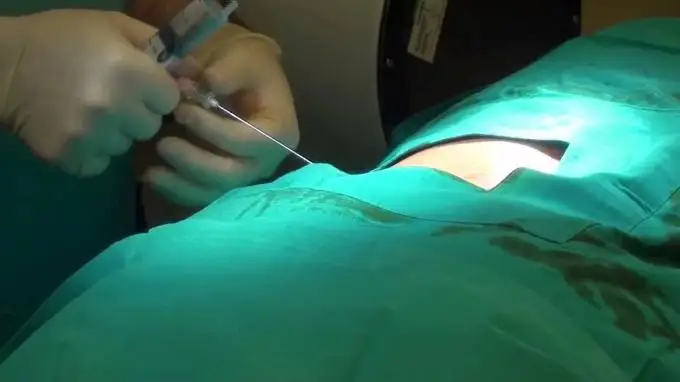
The PLDD is a minimally invasive technique for the treatment of disc herniations. It uses only a thin needle in which an optical fiber is inserted and it uses local anesthesia. The needle is introduced posteriorly in the lumbar cases and at the anterior right lateral level of the neck for cervicl cases, at an exact entry point. The needle is pushed forward carefully, under radiological control, to reach the center of the disk from which the disc herniation originates.
Advantages of PLDD lasers
The PLDD laser simply requires a much faster recovery period than open surgery. And for patients who prioritize aesthetics, they are also very appropriate candidates for this laser, because the scar is also minimal and only requires a small incision of about 7 mm.
The PLDD procedure is very simple because it does not require anesthesia (only local anesthesia), does not need fasting, and patients can go home or have one day care after only 1-2 hours of observation.
When should consider minimally-invasive PLDD procedure

Cervical problems
Lumbar problems
In this procedure, laser energy is transmitted through a thin optical fiber into the disc. The aim of PLDD is to vaporize a small portion of the inner core. The ablation of a relatively small volume of the inner core results in an important reduction of intra-discal pressure, thus inducing reduction of disc herniation.
PLDD is the minimally-invasive medical procedure developed by Dr. Daniel S.J. Choy in 1986 that uses a laser beam to treat back and neck pain caused by a herniated disc.
Percutaneous laser disc decompression (PLDD) is the utmost minimally invasive percutaneous laser technique in the treatment of the disc hernias, cervical hernias, dorsal hernias (except for the segment T1-T5), and lumbar hernias. The procedure uses the laser energy to absorb the water within the herniated nucleus pulposus creating a decompression.
The PLDD treatment is performed on an outpatient basis using only local anesthesia. During the procedure, a thin needle is inserted into the herniated disc under x-ray or CT guidance. An optical fiber is inserted through the needle and laser energy is sent through the fiber, vaporizing a tiny portion of the disc nucleus. This creates a partial vacuum which draws the herniation away from the nerve root, thereby relieving the pain. The effect usually is immediate.
Specifications
| Laser Type | GaAIAs Diode Laser |
| Wavelength | 1470nm |
| Peak Power | 15w |
| Operation Mode | CW, Single / Repeat Pulse |
| Pulse Duration | 10us-3s |
| Repetition Rate | 0.2Hz-50KHz |
| Pilot Beam | Red Diode Laser of 650nm, Power<5mw |
| Control Mode | High resolution 7inch Touch screen (600*1024px) |
| Transmission System | Medical Fibers With SMA905 Connector |
| Dimensions | 148(W)*208(L)*265(H)mm |
| Weight | 4.1KG |
Accessories
Dimed providing a full set of high quality standard and optional accessories, such as puncture needle, Y-valve,optical fiber, safety goggles, footswitch, fiber
cutter, carry case, cart and etc.

Benefits
Perfect tissue effect
Micro-invasive percutaneous access
The procedure is accompanied by minimal pain
The procedure can be performed under local anesthesia
No risk of scarring
Faster return to normal activity - in most cases the patient does not require a stay in a rehabilitation clinic
Get in Touch
Have questions about our products or want to discuss a custom order? Our team is ready to help you.