
Acid Resistant Material Chemical Laboratory Fume Cupboard CE Certified
Product Description
Company Info.
Customer Question & Answer Ask something for more details
- Overview
- Product Description
- Product Parameters
- Specialty Designs
- Detailed Photos
- FAQ
Basic Info.
Product Description
Laboratory fume cupboards serve to control exposure to toxic, offensive or flammable vapors, gases and aerosols. Fume hoods are the primary method of exposure control in the laboratory. The laboratory fume cupboard is a type of local exhaust ventilation system (engineering control). A typical fume cupboard is a cabinet with a moveable front sash (window) made out of safety glass. A properly used and properly functioning fume cupboard exhausts hazardous gases, dusts, mists, and vapors from a confined location and helps protect workers from inhalation exposure.
Most fume hoods for industrial purposes are ducted. A large variety of ducted fume hoods exist. In most designs, conditioned (i.e. heated or cooled) air is drawn from the lab space into the fume hood and then dispersed via ducts into the outside atmosphere.
The fume hood is only one part of the lab ventilation system. Because recirculation of lab air to the rest of the facility is not permitted, air handling units serving the non-laboratory areas are kept segregated from the laboratory units. To improve indoor air quality, some laboratories also utilize single-pass air handling systems, wherein air that is heated or cooled is used only once prior to discharge. Many laboratories continue to use return air systems to the laboratory areas to minimize energy and running costs, while still providing adequate ventilation rates for acceptable working conditions. The fume hoods serve to evacuate hazardous levels of contaminant.
To reduce lab ventilation energy costs, variable air volume (VAV) systems are employed, which reduce the volume of the air exhausted as the fume hood sash is closed. This product is often enhanced by an automatic sash closing device, which will close the fume hood sash when the user leaves the fume hood face. The result is that the hoods are operating at the minimum exhaust volume whenever no one is actually working in front of them.
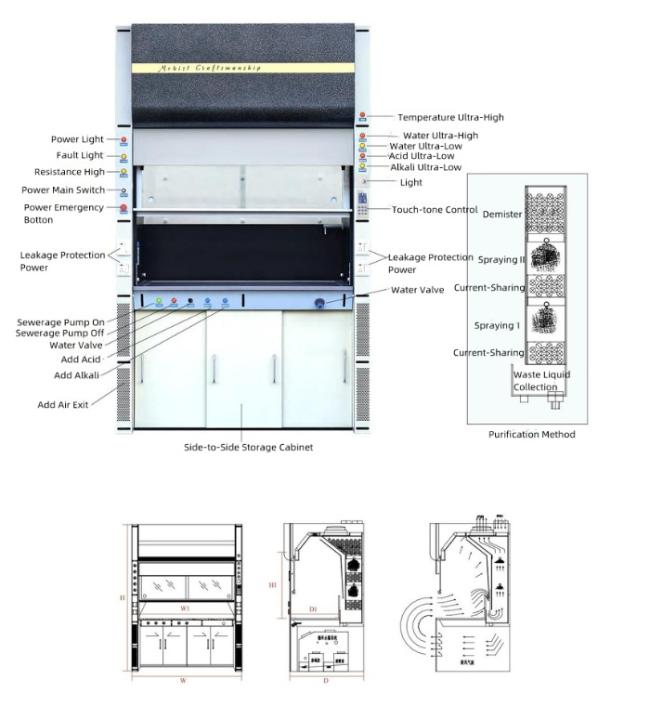
| Model Specification | WJ-1500A | WJ-1500B | WJ-1800A | WJ-1800B |
| External dimensions of equipment(mm) | 1500(W)*1205 (D) *2400 (H) | 1800(W)*1205 (D) *2400 (H) | ||
| Dimension of works pace (mm) | 1260(W1)*780(D1) *1100 (H1) | 1560(W1)*780(D1) *1100 (H1) | ||
| Panel material | 20+6mm thick butterfly ceramics | |||
| Material of internal lining board | 5mm thick ceramic fiber board | |||
| Diversion structure | Lower air return | |||
| Control system | Button control panel (LCD panel) | |||
| PH value control | The medium is alkaline water solution; manual monitoring, and manual control through acid pump and alkali pump. | |||
| Input power | Three-phase five-wire 380V/50A | |||
| Current for air fan | Not over 2.8A(380V or 220V can be directly connected) | |||
| Maximum load of socket | 12 KW(total of 4 sockets) | |||
| Water tap | 1 set (remote control valve + water nozzle) | No | 1 set (remote control valve + water nozzle) | No |
| Water discharge way | Magnetic chemical pump strong discharge | |||
| Using environment | For non-explosion indoor use, within 0-40 degrees Celsius. | |||
| Applicable fields | Inorganic chemistry experiment; Food, medicine, electronics, environment, metallurgy, mining, etc. | |||
| Ways of Purification | Spray sodium hydroxide solution, no less than 8 cubic meters/hour | Spray sodium hydroxide solution.no less than 12 cubic meters/ hour | ||
| Ways of surface air speed control | Manual control (through the electric air valve to adjust the exhaust air volume or adjust the height of the moving door) | |||
| Average surface air speed | 0.6-0.8 m/s Exhaust air volume: 1420-1890m3/h (when door height h =500mm) | 0.6-0.8 m/s Exhaust air volume: 1760-2340m3/h (when door height h =500mm) | ||
| Speed deviation of surface air | Not higher than 10% | |||
| The average intensity of illumination | Not less than 700 Lux; Standard white and uv-free yellow LED lamps; The illumination is adjustable. | |||
| Noise | Within 55 decibels | |||
| Flow display | White smoke can pass through the exhaust outlet, no overflow. | |||
| Safety inspection | No spikes, edges; Charged body and the exposed metal resistance is greater than 2 mQ; Under 1500V voltage, no breakdown or flashover occurred for 1min test. | |||
| Resistance of exhaust cabinet | Less than 160 pa | |||
| Power consumption | Less than 1.0kw/h (excluding power consumption of fans and external instruments) | Less than 1.2kw/h (excluding power consumption of fans and external instruments) | ||
| Water consumption | Less than 3.2L/ h | Less than 4.0L/ h | ||
| Performance of wind compensation | With a unique wind compensation structure, the volume of the wind will not cause turbulence in exhaust cabinet and will not directly blow to the staff (need to connect to the air compensation system of the laboratory) | |||
| Air volume regulating valve | 315mm diameter flanged type anti-corrosion electric air flow regulating valve (electric contact actuator) | |||
Acid digestion
These units are typically constructed of polypropylene to resist the corrosive effects of acids at high concentrations. If hydrofluoric acid is being used in the hood, the hood's transparent sash should be constructed of polycarbonate which resists etching better than glass. Hood ductwork should be lined with polypropylene or coated with PTFE (Teflon).
Downflow
Downflow fume hoods, also called downflow work stations, are typically ductless fume hoods designed to protect the user and the environment from hazardous vapors generated on the work surface. A downward air flow is generated and hazardous vapors are collected through slits in the work surface.
Perchloric acid
These units feature a waterwash system (scrubber - see below) in the ductwork. Because dense perchloric acid fumes settle and form explosive crystals, it is vital that the ductwork be cleaned internally with a series of sprays.
Radioisotope
This fume hood is made with a coved stainless steel liner and coved integral stainless steel countertop that is reinforced to handle the weight of lead bricks or blocks.
Scrubber
This type of fume hood absorbs the fumes through a chamber filled with plastic shapes, which are doused with a scrubbing medium. The chemicals are washed into a sump, which is often filled with a neutralizing liquid. The fumes are then dispersed, or disposed of, in the conventional manner.
Waterwash
These fume hoods have an internal wash system that cleans the interior of the unit, to prevent a build-up of dangerous chemicals.

Fume Hoods vs. Biosafety Cabinets
Both chemical fume hoods and biosafety cabinets are specialized types of laboratory equipment. While chemical fume hoods and biosafety cabinets look similar and both protect laboratory workers from laboratory hazards - their purpose, function, and operation differ significantly.
A chemical fume hood is designed to remove chemical fumes and aerosols from the work area while a biosafety cabinet is designed to provide both a clean work environment and protection for employees who create aerosols when working with infectious agents or toxins.
A chemical fume hood protects the user while a biosafety cabinet protects the user, the environment, and the material. Biosafety cabinets have high-efficiency particulate air (HEPA) filters while chemical fume hoods do not. The HEPA filter in the exhaust system of a biosafety cabinet will effectively trap all known infectious agents and ensure that only microbe-free exhaust air is discharged from the cabinet (i.e., 99.97% of particles 0.3 µm in diameter and 99.99% of particles of greater or smaller size).
The images below show basic examples of the airflow design for the two types of cabinets.
Get in Touch
Have questions about our products or want to discuss a custom order? Our team is ready to help you.