
Chemical Laboratory Explosion Proof Heat Resistant Fume Hood with Acid & Alkali Resistant
Product Description
Company Info.
Customer Question & Answer Ask something for more details
- Overview
- Product Description
- Product Parameters
- More About the Fume Hood
- Detailed Photos
- Fume Hood Maintenance
- FAQ
Basic Info.
Product Description
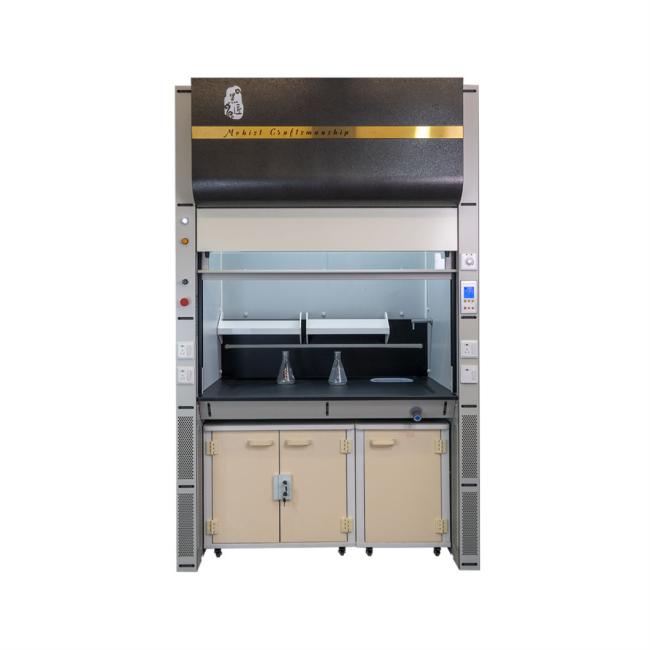
Fume hoods are a type of ventilation system used in many laboratories throughout the University. Their primary function is to exhaust chemical fumes, vapors, gases, dusts, mists, and aerosols. They also serve as physical barriers between reactions and the laboratory environment, offering a measure of protection against inhalation exposure, chemical spills, run-away reactions, and fires.
A typical fume hood has a box-like structure with a moveable sash window. Experimental procedures are performed within the hood which is consistently and safely ventilated, usually by means of an extract blower and ductwork. Chemical fumes are exhausted and diluted many times over in the atmosphere and have an insignificant effect on human health.
Fume hoods function by maintaining a relatively negative interior pressure while continuously drawing air through the sash opening, which prevents contaminants from escaping.
A suitable hood face velocity (the speed at which air is drawn into the hood) is critical to safe and effective operation. While excessive face velocities can result in turbulence and reduce containment, insufficient velocities also compromise performance.
In general, a hood's cubic face velocity is recommended to be between 0.3 m/s (60 cubic feet per minute) and 0.5 m/s (100 fpm).
| Model Specification | WJ-1500A | WJ-1500B | WJ-1800A | WJ-1800B |
| External dimensions of equipment(mm) | 1500(W)*1205 (D) *2400 (H) | 1800(W)*1205 (D) *2400 (H) | ||
| Dimension of works pace (mm) | 1260(W1)*780(D1) *1100 (H1) | 1560(W1)*780(D1) *1100 (H1) | ||
| Panel material | 20+6mm thick butterfly ceramics | |||
| Material of internal lining board | 5mm thick ceramic fiber board | |||
| Diversion structure | Lower air return | |||
| Control system | Button control panel (LCD panel) | |||
| PH value control | The medium is alkaline water solution; manual monitoring, and manual control through acid pump and alkali pump. | |||
| Input power | Three-phase five-wire 380V/50A | |||
| Current for air fan | Not over 2.8A(380V or 220V can be directly connected) | |||
| Maximum load of socket | 12 KW(total of 4 sockets) | |||
| Water tap | 1 set (remote control valve + water nozzle) | No | 1 set (remote control valve + water nozzle) | No |
| Water discharge way | Magnetic chemical pump strong discharge | |||
| Using environment | For non-explosion indoor use, within 0-40 degrees Celsius. | |||
| Applicable fields | Inorganic chemistry experiment; Food, medicine, electronics, environment, metallurgy, mining, etc. | |||
| Ways of Purification | Spray sodium hydroxide solution, no less than 8 cubic meters/hour | Spray sodium hydroxide solution.no less than 12 cubic meters/ hour | ||
| Ways of surface air speed control | Manual control (through the electric air valve to adjust the exhaust air volume or adjust the height of the moving door) | |||
| Average surface air speed | 0.6-0.8 m/s Exhaust air volume: 1420-1890m3/h (when door height h =500mm) | 0.6-0.8 m/s Exhaust air volume: 1760-2340m3/h (when door height h =500mm) | ||
| Speed deviation of surface air | Not higher than 10% | |||
| The average intensity of illumination | Not less than 700 Lux; Standard white and uv-free yellow LED lamps; The illumination is adjustable. | |||
| Noise | Within 55 decibels | |||
| Flow display | White smoke can pass through the exhaust outlet, no overflow. | |||
| Safety inspection | No spikes, edges; Charged body and the exposed metal resistance is greater than 2 mQ; Under 1500V voltage, no breakdown or flashover occurred for 1min test. | |||
| Resistance of exhaust cabinet | Less than 160 pa | |||
| Power consumption | Less than 1.0kw/h (excluding power consumption of fans and external instruments) | Less than 1.2kw/h (excluding power consumption of fans and external instruments) | ||
| Water consumption | Less than 3.2L/ h | Less than 4.0L/ h | ||
| Performance of wind compensation | With a unique wind compensation structure, the volume of the wind will not cause turbulence in exhaust cabinet and will not directly blow to the staff (need to connect to the air compensation system of the laboratory) | |||
| Air volume regulating valve | 315mm diameter flanged type anti-corrosion electric air flow regulating valve (electric contact actuator) | |||
A fume hood essentially looks like an enclosed industrial workbench. To break it down, a fume hood is made up of:
The body: The body of the fume hood contains a work surface, enclosed completely on three sides, on which lab personnel can conduct their experiments / research.
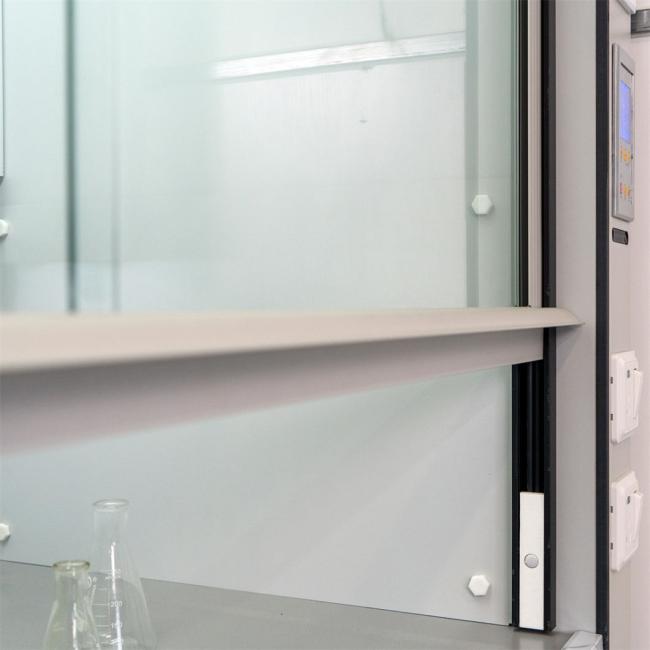
The sash: The sash is the fourth side to the hood, basically a window between the employee and the volatile compounds he or she is working with.
The exhaust duct: The exhaust duct releases any contaminated air to the outside. Usually this duct is connected to the building's HVAC infrastructure, but there are ductless fume hoods available if flexibility, lower cost, and energy efficiency are key drivers for your business or institution.
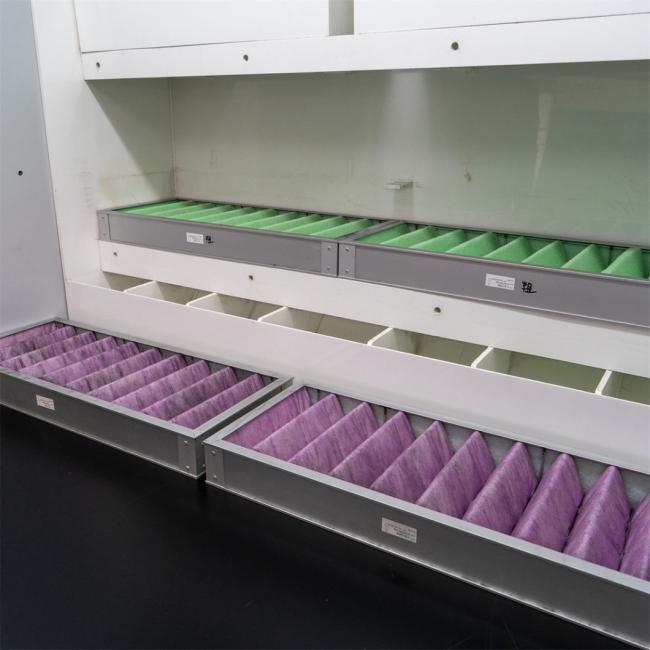
The baffles: The baffles are slotted panels that control the amount of air flowing into the hood from the surrounding environment

• Hoods should be evaluated by the user before each use to ensure adequate face velocities and the absence of excessive turbulence.
• In case of exhaust system failure while using a hood, shut off all services and accessories and lower the sash completely. Leave the area immediately.• Fume hoods should be certified, at least annually, to ensure they are operating safely. Typical tests include face velocity measurements, smoke tests and tracer gas containment. Tracer gas containment tests are especially crucial, as studies have shown that face velocity is not a good predictor of fume hood leakage.
• Laboratory fume hoods are one of the most important used and abused hazard control devices. We should understand that the combined use of safety glasses, protective gloves, laboratory smocks, good safety practices, and laboratory fume hoods are very important elements in protecting us from a potentially hazardous exposure.
• Laboratory fume hoods only protect users when they are used properly and are working correctly. A fume hood is designed to protect the user and room occupants from exposure to vapors, aerosols, toxic materials, odorous, and other harmful substances. A secondary purpose is to serve as a protective shield when working with potentially explosive or highly reactive materials. This is accomplished by lowering the hood sash.
6 Questions to Ask When Buying a Fume Hood:
-Which chemicals will you use within the hood?
-Is a ducted or ductless hood best suited to your needs and available space?
-Where will you place the fume hood in the lab? Consider workflows, access to external exhaust systems, and competing air patterns.
-What size fume hood will best suit your needs? Be sure to consider what (if any) equipment will be enclosed in the hood.
-Are any service fixtures or accessories such as airflow monitors, electrical outlets, water, or gas fixtures required?
-Are base cabinets for acid, solvent, or non-chemical storage required?
Get in Touch
Have questions about our products or want to discuss a custom order? Our team is ready to help you.