
28LHS Series 115N Force 2 Phase Nema11 No Captive & External Nut Hybrid linear Stepper Motors Linear Acuators
1. Kaifull Hybrid Linear Stepper Motors Features and Advantages
Hybrid Linear Stepper Motor is a device that combines the motor and screw mechanical transmission. It converts the rotation movement into a linear movement and It mainly includes the following key components:
- Electric: Usually use a step motor or servo motor to convert the electrical energy into a rotation motion.
- Screw: This is a thread rod, which is connected to the motor shaft. The rotation movement of the motor is passed to the screw.
- Narut: The nut is located on the screw, it cooperates with the thread of the screw. When the motor rotates, the nut moves linearly along the screw.
- Load: The load is usually connected to the nut to achieve the required linear displacement through the linear movement of the nut.
- Control system: Manage the motor by electronic control system to achieve accurate position and speed control.
The technical features and advantages as bellow,
- High accuracy: Because the screw rod is a spiral line, the stepping motor with a drive can make the position accuracy high, usually 0.01 mm.
- Large torque: The torque of the stepping motor with a screw drive is relatively large, which can withstand large loads and inertia.
- Simple structure: The transmission structure of the screw is simple, and there is no need to specialize in a dedicated deceleration mechanism. The cost is low.
- Lack of resistance to interference: Since the stepper motor controls the discrete signal, it has a small impact on environmental interference.
- Convenient control: Step motor with a drive can achieve efficient control by programming and high degree of automation.
- In summary, the stepping motor has the advantages of simple, high accuracy, high precision, large torque, lack of disruption, and convenient control. It is often used in the field control, positioning and screw transmission in automation equipment.
Applications:
Hybrid linear stepper motors are widely used in high -precision requirements automation applications, such as factory automation, precision calibration, precision fluid measurement, and accurate position movement, electronic production, semiconductor production, medical equipment’s, testing platforms, factory automation, etc.
2. Hybrid Stepper Motor Naming Rules and General Technical Specifications
Linear stepper motor naming rules,
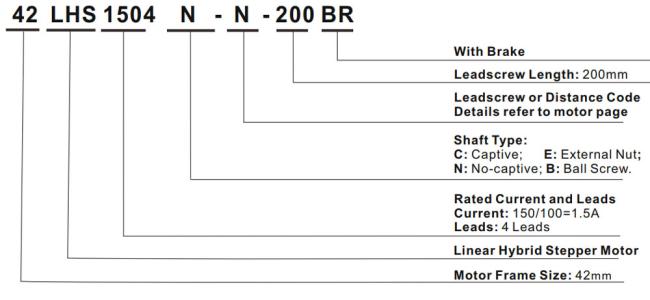
General Specifications,
| Step Angle | 1.8° (2 Phase) |
| Step Angle Accuracy | ±0.09° |
| Size | Nema 8 |
| Insulation Grade | 500VDC, 20 MΩ Min. ,Class B |
| Dielectric Strengt | 500 VAC for 1 Minute |
| Temperature Rise | Less than 80℃ (Rated Current) |
| Suface Temperature | Max.Allowed 100℃ |
| Humidity Range | 20% to 90% RH |
| IP Grade | IP40 |
| Certificates | Rohs, CE, CCC |
3. 20LHS0494/0244/0164 Captive Type Hybrid Linear Stepper Motor Performance Datasheet
| Model Name | Wiring |
Rated Voltage |
Rated Current |
Resistance /phase |
Inductance /phase |
Power Consumption | Temp. Rise | Weight |
Insulation Resistance |
|
28LHS1004 |
Bipolar |
2.5V | 0.49A | 5.1Ω | 1.5mH | 4.2W | 75℃ | 119g | 20MΩ |
| 28LHS0424 |
5V |
0.24A |
20.4Ω | 5.0mH | |||||
| 28LHS0184 |
7.5V |
0.16A |
45.9Ω | 11.7mH | |||||
| 28LHS0426 | Unipolar | 5V | 0.42A | 11.9Ω | 3.3mH | ||||
| 28LHS0186 | 12V | 0.18A | 68.6Ω | 19.5mH |
Note: Customization of motor specifications available.
Available leadscrew specifications,
| Code | Leadscrew Thread Dimensions in mm | ||
| diameter | step | lead | |
| 7 | φ4.76 | 0.003175 | 0.635 |
| 9 | φ4.76 | 0.00635 | 1.27 |
| 3 | φ4.76 | 0.0127 | 2.54 |
| J | φ4.76 | 0.0254 | 5.08 |
4. Mechanical Dimensions (in mm)
External Nut Type Mechanical Drawings as bellow,

No-capative Type mechanical drawings as bellow,

5. Force and Pulse Rate Curves

6. Wirings

Get in Touch
Have questions about our products or want to discuss a custom order? Our team is ready to help you.