
Premium 316LMod Stainless Steel Plate High Corrosion Resistance For Chemical / Marine
Premium 316LMod Stainless Steel Plate High Corrosion Resistance for Chemical/Marine Applications
Products Specification
| Products Name | 316LMod Stainless Steel Plate |
| Main Grades | Stainless Steel J1, J2, J4, 201, 202, 301, 304, 304H, 304L, 309, 309S, 310, 310S, 316, 316L, 316TI,316Lmod, 321, 321H, 347, 409, 410, 410S, 420, 430, 441, 904L,630,631,254SMO,253MA,2205,2507.etc |
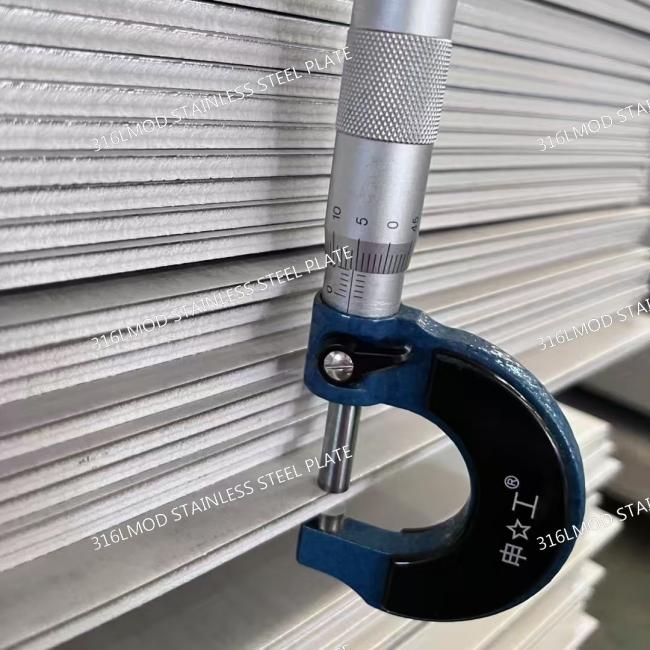
| Thickness | 3.0 - 80.0mm |
| Width | 1250mm,1500mm ,1800mm,2000mm, or custom other size as request |
| Length | 2000mm, 2440mm, 3000mm, 5800mm, 6000mm, AS PER CUSTOMER’S REQUIREMENT |
| Type of Material | Laser Cutting |
| Form | Plate / coil |
| Test Certificate | Yes. |
| Finish | NO.1, 2B, 2D, 2H, 2R, No.4, HAIRLINE, SCOTCH BRITE, SATIN FINISH, NO.8, BA. |
| Brand | TISCO, LISCO,BAOSTEEL , POSCO, JISCO |
PRODUCT INFORMATION: 316L MOD (EN 1.4429 / UNS S31653) STAINLESS STEEL PLATE
1. Material Designation:
-
Common Names: 316L Mod, 316L Enhanced, 316LN+
-
Standard Grades: EN 1.4429, UNS S31653, ASTM A240
-
Also Known As: Modified 316L, Super 316L
2. Key Composition (Typical % Weight):
-
Chromium (Cr): 16.5 - 18.5% (Provides basic corrosion resistance & passivation)
-
Nickel (Ni): 10.0 - 13.0% (Enhances ductility, toughness & corrosion resistance)
-
Molybdenum (Mo): 2.7 - 3.3% (Significantly boosts resistance to pitting & crevice corrosion, higher than standard 316L)
-
Manganese (Mn): ≤ 2.0%
-
Silicon (Si): ≤ 0.75%
-
Nitrogen (N): 0.10 - 0.16% (Increases strength & further enhances pitting resistance)
-
Carbon (C): ≤ 0.030% (Low carbon minimizes sensitization/weld decay)
-
Phosphorus (P): ≤ 0.045%
-
Sulfur (S): ≤ 0.030%
-
Iron (Fe): Balance
3. Superior Properties:
-
Enhanced Corrosion Resistance: Significantly outperforms standard 316L, especially in aggressive chloride-containing environments (seawater, chemical processing, coastal areas). Excellent resistance to pitting and crevice corrosion.
-
Pitting Resistance Equivalent (PRE): PRE > 34 (Calculated as %Cr + 3.3x%Mo + 16x%N), indicating superior performance vs. standard 316L (PRE ~26).
-
Good Weldability: Low carbon content minimizes carbide precipitation in the heat-affected zone (HAZ), making it suitable for welding without post-weld annealing in most cases. Standard austenitic SS welding procedures apply.
-
High Strength: Nitrogen addition provides higher yield and tensile strength compared to standard 316L while maintaining good ductility.
-
Excellent Formability & Toughness: Maintains the good fabrication characteristics of austenitic stainless steels.
-
Good High-Temperature Performance: Suitable for moderate elevated temperature service.
4. Primary Applications (Where superior corrosion resistance is critical):
-
Offshore & Marine Equipment (platforms, piping, seawater handling)
-
Chemical & Petrochemical Processing (vessels, heat exchangers, piping)
-
Desalination Plants (evaporators, RO units)
-
Pulp & Paper Industry (bleach plants)
-
Flue Gas Desulfurization (FGD) Systems
-
Pharmaceutical & Food Processing Equipment
-
Coastal Architecture & Structural Applications
-
Heat Exchangers (tubing, shells - especially with cooling water)
-
Pollution Control Equipment
5. Available Forms & Specifications:
-
Form: Plate (Hot Rolled or Cold Rolled)
-
Thickness Range: Typically 3.0mm (0.125") up to 100mm (4") or more (subject to mill capability)
-
Width Range: Up to 2000mm (78") or more (subject to mill capability)
-
Length Range: Up to 6000mm (20ft) or more (subject to mill capability). Cut-to-length available.
-
Standards: Compliant with ASTM A240/A240M, EN 10088-2, ASME SA-240, etc. Certificates (EN 10204 3.1/3.2) available.
-
Surface Finish: Standard Mill Finish (No. 1, 2B), Brushed (No. 4), Polished (e.g., BA, Mirror), as required. Pickled & Passivated standard.
6. Physical Properties (Typical):
-
Density: 7.98 g/cm³ (0.288 lb/in³)
-
Melting Range: ~1390 - 1440 °C (~2534 - 2624 °F)
-
Modulus of Elasticity: 200 GPa (29 x 10^6 psi)
-
Thermal Expansion: 16.0 μm/m·°C (8.9 μin/in·°F) @ 20-100°C
-
Thermal Conductivity: 15 W/m·K @ 100°C
-
Electrical Resistivity: 0.74 μΩ·m
-
Magnetic Properties: Essentially non-magnetic when annealed (low permeability).
7. Key Advantages vs. Standard 316L:
-
Higher Molybdenum (Mo): Directly increases resistance to chloride pitting/crevice corrosion.
-
Controlled Nitrogen (N) Addition: Boosts strength and further enhances pitting resistance (synergy with Mo).
-
Higher PRE Number: Quantifiably superior corrosion performance.
-
Maintains Fabricability: Similar weldability and formability to 316L.
8. Availability:
-
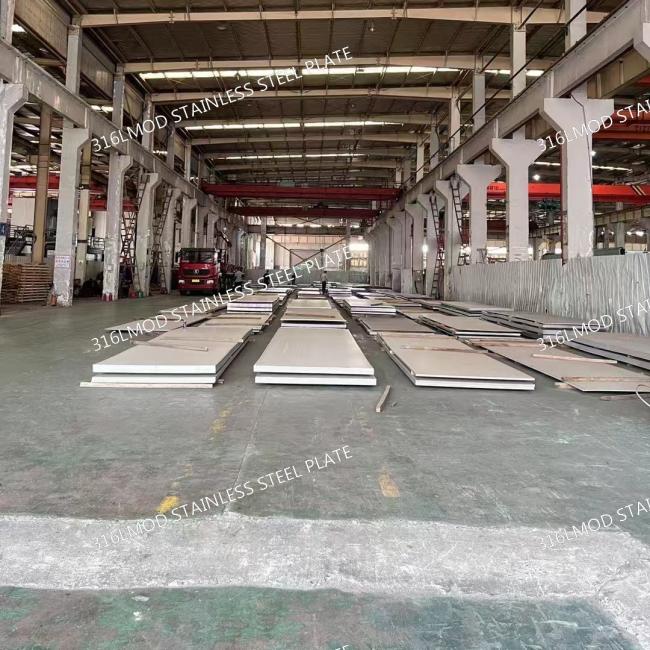
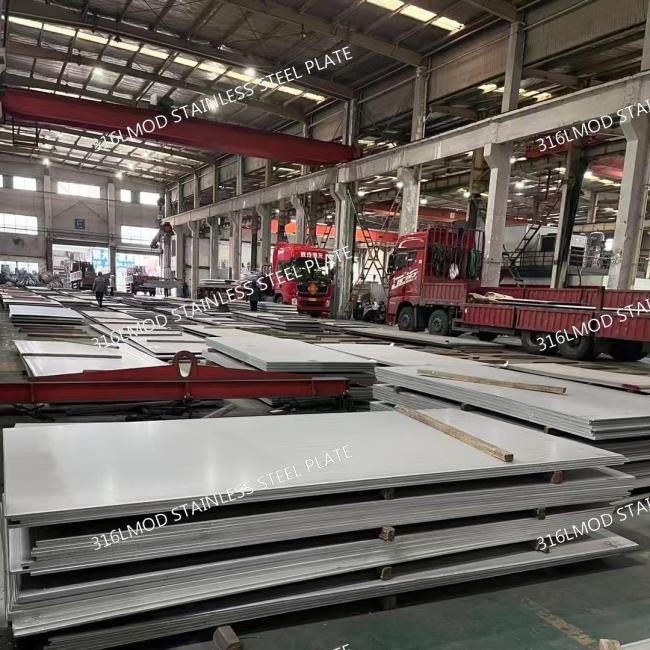
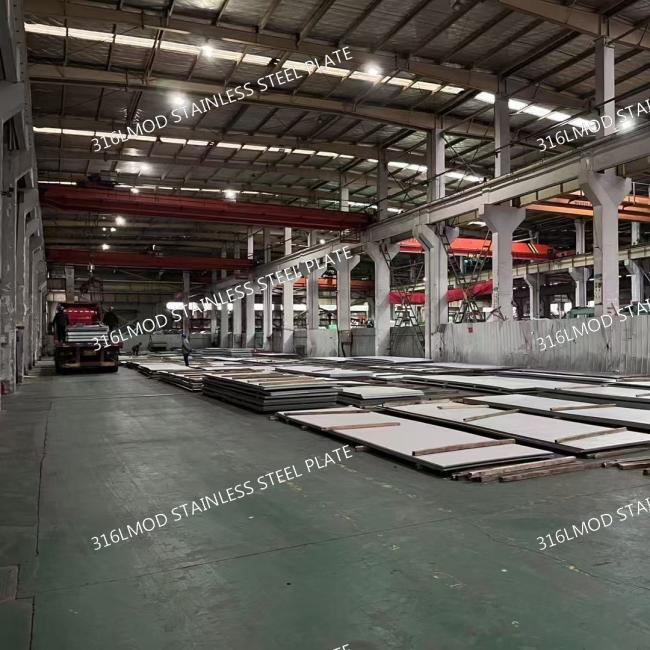
Stocked in various thicknesses, widths, and lengths.
-
Custom cutting, forming, and machining services often available.
-
Contact us for specific size inquiries, pricing, and material certification details.
Get in Touch
Have questions about our products or want to discuss a custom order? Our team is ready to help you.