
RS485 4-20mA Digital pH Sensor with 2-12 pH Range and 0-80°C Temperature for Water Quality Monitoring
This digital pH sensor is engineered for general industrial processes and agricultural water-fertilizer machinery systems. Featuring a double salt bridge design and dual-layer permeable interface, it effectively resists medium backflow. The ceramic porous electrode exudation interface minimizes clogging, while the PTFE large-ring diaphragm ensures long-term electrode durability for reliable water quality monitoring.
- Spherical sensing bulb: Enlarged sensitive area for faster response and stable signal output
- PA+GF housing: Withstands high temperatures from 0-60°C
- Quad-core shielded cable: High-quality dedicated wiring ensures precise signal transmission
- Dual salt bridge system: Enhanced resistance to medium backflow
- Ceramic sand core liquid junction: Reduced clogging for consistent performance
| Parameter | Specification |
|---|---|
| pH Range | 2-12 pH |
| pH Zero Point | 7.00±0.25 |
| Temperature Range | 0-80°C |
| Output | RS485 & 4-20mA |
| Pressure Resistance | 0-0.3MPa |
| Housing Material | PA+GF |
| Membrane Resistance | <500MΩ |
| Reference System | Ag/AgCl/KCl |
| Liquid Junction | Ceramic Sand Core |
| Electrolyte Solution | KCl |
| Connection Thread | NPT 3/4" |
The pH electrode operates on the Nernst equation principle, utilizing a galvanic cell system that converts chemical reaction energy into electrical energy. This system consists of two half-cells: a measuring sensor with potential related to specific ion activity, and a reference sensor connected to the measurement solution and instrument.
Before use, unscrew the electrode protective cap and install with appropriate mounting brackets or accessories.
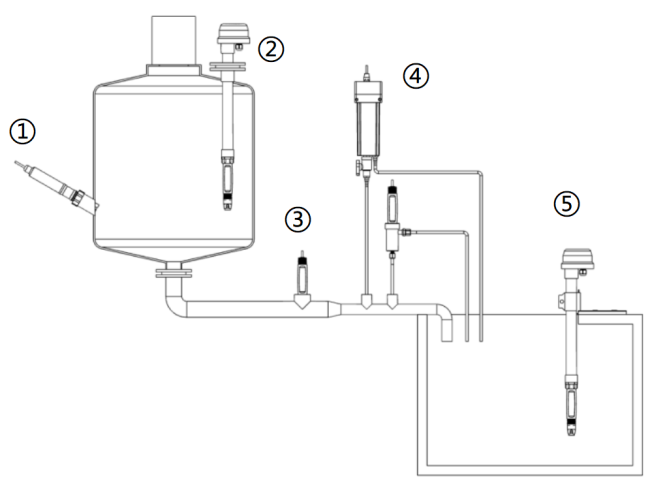
- Sidewall Installation: Ensure interface tilt angle exceeds 15 degrees
- Top Flange Installation: Note flange dimensions and electrode insertion depth
- Pipe Installation: Consider pipe diameter, flow velocity, and pressure
- Flow-Through Installation: Monitor flow velocity and pressure parameters
- Submersion Installation: Adjust bracket length as required for application
- Before use, unscrew protective cap and immerse electrode bulb and liquid junction in sample
- Rinse with water if salt crystals form near electrode tip
- Check for air bubbles in glass bulb by shaking electrode vertically
- Keep glass membrane hydrated for fast response - rinse thoroughly after measurement
- Add storage solution (3 mol/L KCl) to protective cap after calibration
- Ensure terminal connections remain dry; clean with anhydrous alcohol if contaminated
- Avoid prolonged immersion in distilled water, protein solutions, or contact with silicone grease
- For aged electrodes with cloudy membranes, soak in 10% HCl then rinse thoroughly
- Regularly clean and calibrate electrode; replace if calibration fails after maintenance
With proper maintenance, electrodes typically last over 12 months under normal conditions. Unused electrodes have a shelf life of 12-24 months when stored correctly. Exposure to strong acids, bases, high temperatures, or corrosive liquids may shorten lifespan. Note that electrodes are consumables and generally not covered by warranty.
- Use fresh pH/ORP standard buffer solutions of appropriate concentrations
- Remove protective cap and rinse electrode with distilled water
- Set instrument to calibration mode (refer to instrument manual)
- After calibration, proceed with actual sample measurements
Get in Touch
Have questions about our products or want to discuss a custom order? Our team is ready to help you.