
-75C 30Kg Small Pharmaceutical Freeze Dryer Pharmaceutical Lyophilizer
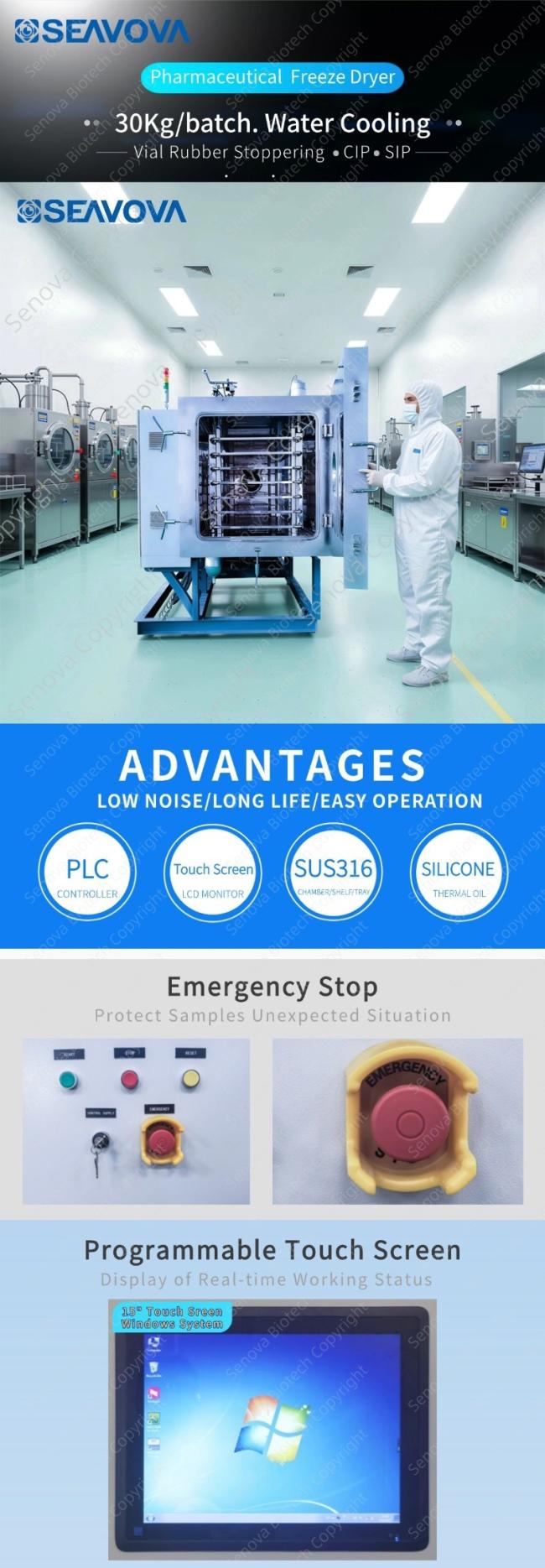
- PLC +PC control system with WIFI remote control
- Water cooling system
- 316L stainless steel chamber and trays
- SUS304 stainless steel chamber housing
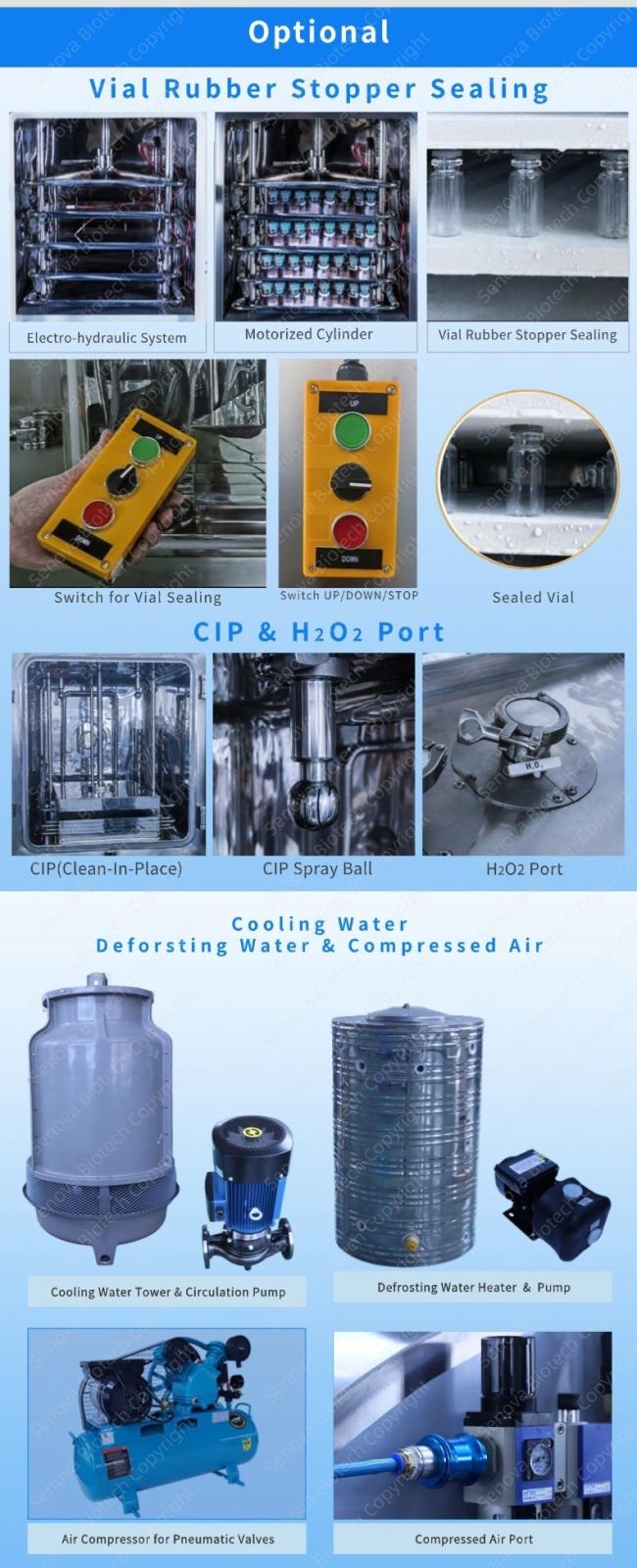
- Hydraulic top press device for shelf cleaning and vial rubber stopper sealing
- Tilt angle at the bottom meeting CIP and SIP(Sterilization-in-Place) draining requests
- Shelves filled with silicon oil with satisfactory temperature uniformity with difference <1℃
- Side leakage of vacuum is tested with helium mass spectrometer to ensure high vacuum
- CIP(Clean-In-Place)
- SIP(Sterilization-in-Place)
- H2O2 sterilization port
| Model | NovaDryer-FS30 |
| Output Capacity(approx.) | 13,000 units of vials 16mm diameter |
| 6,900units of vials 22mm diameter | |
| Maximum icing capacity | 60kg |
| Load Capacity (suggested) | 40Kg |
| Vial rubber stoppering top press device (Optional) | Hydraulic stoppering |
| Control | Microprocessor |
| Dimension of unit (approx.) (L*W*H,mm) | 4,200* 1,300* 3.300 |
| (with hydraulic cylinder) | (Final dimension based on design) |
| Weight (approx.) | 3,800kg |
| Chamber material | AISI304L |
| Temperature control range | -55°C to + 80°C |
| Qty of shelves | 6+ 1(upper radiant shelf) |
| Dimensions (L*W*H,mm) | 900* 600 * 20 |
| Total usable area (m2) | 3.24 |
| Shelf Spacing (mm) | 100 |
| Condenser final temperature | ≤-75°C |
| Extreme vacuum | ≤1*10 -2mbar |
| Software | TF – 5000 |
| PLC control system | Omron |
| Computer | Len0v0 |
| Electricity - total electrical load | 16kW (380V/50Hz, 3Phase, 5Wire) |
| Cooling water for refrigerant cooling | 8m3/hr (1.5≤P≤2bar, T≤25°C) |
| Water for injection for chamber cleaning | 150L/min (P≥5bar, T=80°C) |
| Compressed air for pneumatic valves | 40L/min (6≤P≤8bar) |


Freeze-drying, or lyophilization, preserves perishable items by freezing and sublimating water through pressure reduction, an ancient practice from 13th-century Andean Indians. It refined in the 1950s. Developed for blood plasma in World War II, it later entered consumer food markets. Albert Altmann freeze-dried organ pieces in 1890; 1920s patents included rabies virus freeze-drying. The 1950s saw camping food applications. NASA adopted it for space food, notably freeze-dried ice cream on Apollo 7 and Gemini. Nestlé’s 1965 instant coffee made it mainstream. Early applications by Aztecs and Eskimos involved biological sample preservation. Contemporary freeze-drying freezes products in specialized chambers with heaters to form solid granules determined by chamber design.
Advantages: foods last 7–8 times longer than fresh, retain nutrients, save money, and are convenient. Freeze-dried foods are nutritious, and dairy preserves probiotics.
Senova, a freeze dryer innovator for 15 years, serves over 80 countries with dependable performance and support, launching an EU office in 2024.
Get in Touch
Have questions about our products or want to discuss a custom order? Our team is ready to help you.