
XRF ICP AA Lithium Tetraborate Flux X Ray Flux Alumina Fusion Flux
Lithium Tetraborate X-ray Flux for Alumina Fusion
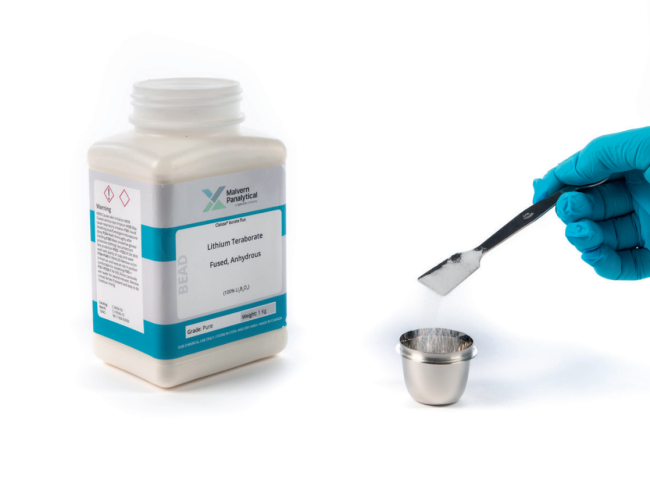
Lithium Tetraborate X-ray Flux for Alumina Fusion use Laboratory Sample Preparation Equipment
introduce
Lithium tetraborate is a chemical reagent with the molecular formula Li₂B₄O₇. It is used in enamel manufacturing, X-ray fluorescence analysis, etc.
Which Lithium Tetraborate Fluxes are Suitable for Alumina
Lithium tetraborate (Li₂B₄O₇) is the most commonly used flux chemical for X-ray fluorescence (XRF) and inductively-coupled plasma mass spectroscopy (ICP-MS). It is transparent to light element X-rays, meaning it does not interfere with key spectral analyses. Yet it has a relatively high melting point (930C), which makes it difficult to fuse with some ores (i.e. bauxite). Often it is best to use a mixture of lithium tetraborate flux with lithium metaborate (LiBO₂) which has a lower melting point (849C) and generally better solubility
At XRF Scientific, we recommend a mixture of Lithium Tetraborate and metaborate at ratios of 50:50. This makes an ideal general purpose flux with excellent fusion compatibility for neutral samples. Our 50:50 lithium tetraborate/lithium metaborate mixture is perfect for alumina fusion and promotes rapid matrix decomposition with low loss on ignition (LOI)
Our fluxes can be used to prepare almost any types of samples for XRF and ICP analysis. Our experts will be happy to guide you so you use the right flux for your application and get the best analytical results. A handy flux selection wheel is available to help you make the right choice of chemicals.
Product Selection
When choosing a Lithium Borate Flux for your XRF or ICP application there are a number of factors to be considered:
-
MELTING POINT
- The melting point of the flux should be sufficiently high so that the sample is fully dissolved but not too high that it causes volatilisation. This is particularly important for volatile compounds such as those containing Na, K and S.
-
PURITY
- The purity of the flux is important in minimising sample contamination and background intensities. Where trace level accuracy is required (particularly for ICP), the purity of the flux is critical.
-
HYGROSCOPY
- The level of moisture retention in the flux can have a significant impact on the weighing accuracy and fusion process. In general, pre-fused fluxes minimise water absorption over extended periods
-
ACIDITY/BASICITY
- The choice of flux depends on the acidity/basicity of the sample and ideally the combination of flux and sample should be as close to neutral as possible.
-
ADDITIVES
- There are a number of additives that can be added to the flux to improve the overall outcome:
- Oxidant: this helps ensure that full oxidation of all compounds takes place either before flux melting or during the fusion process. It is important in reducing chemical attack of platinum labware and attaining a successful fusion bead.
- Releasing agent: certain samples can stick to the mould, a releasing agent (non-wetting agent) assists with the process by increasing the surface tension of the molten mix, thereby assisting with release.
.
Get in Touch
Have questions about our products or want to discuss a custom order? Our team is ready to help you.