
Open Hearth Furnace Magnesite Brick 95% Mgo Fused And Sintered Magnesia Brick For Steelmaking
Magnesia-chrome bricks are alkaline refractory products, generally produced from sintered magnesia (with an MgO content between 89% and 92%) and refractory-grade chrome ore. Due to the presence of impurities, the refractory grains are bonded by silicates. The term "magnesia-chrome brick" commonly used in China generally refers to fired ordinary magnesia-chrome bricks, also known as silicate-bonded magnesia-chrome bricks, or simply magnesia-chrome bricks.
Magnesia-chrome bricks are primarily composed of periclase and magnesia-chrome spinel as the main crystalline phases, fired in an oxidizing atmosphere at 1600-1800°C. They can also be made into unfired bricks using chemical binders such as water glass.
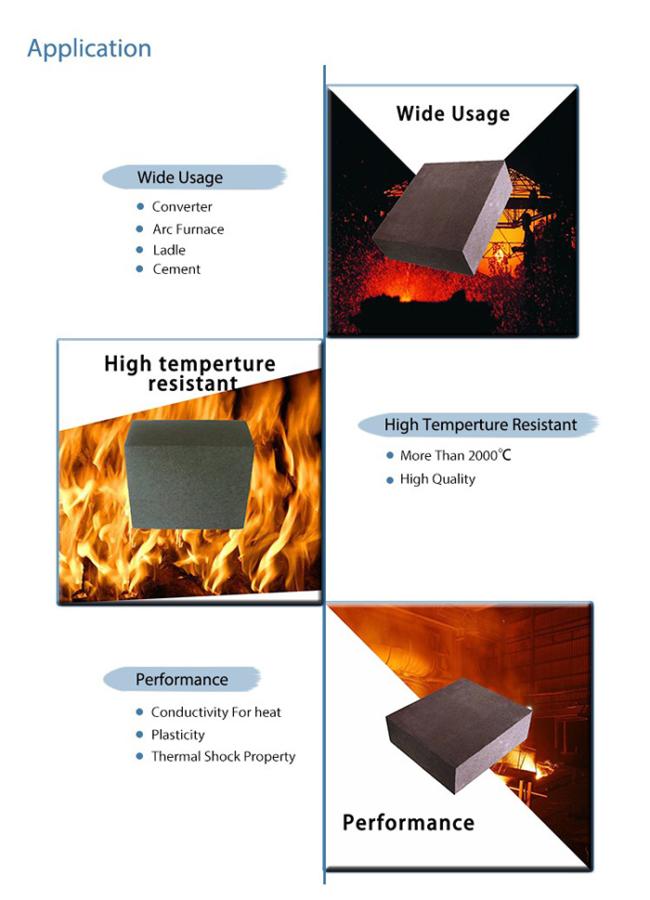
Refractoriness is greater than 2000°C, the load softening temperature is generally above 1550°C, they have good high-temperature volume stability, and good resistance to thermal shock.
Mainly used in cement rotary kilns, glass furnace regenerators, steelmaking furnace linings, permanent layers of refining ladles, non-ferrous metallurgical furnaces, lime kilns, hot metal mixers, and high-temperature furnace linings for refractory materials, etc.
- Excellent structural toughness and thermal shock stability. During the firing and use of magnesia-iron spinel bricks, Fe2+ ions diffuse into the surrounding magnesium oxide matrix, while some Mg2+ ions diffuse into the iron-aluminum spinel particles, reacting with the alumina remaining from the decomposition of iron-aluminum spinel to form magnesium-aluminum spinel. This active effect creates a large number of microcracks within the product during firing and use. The presence of these cracks helps to buffer thermal stress and improve the thermal shock stability of the product. Importantly, the decomposition process of iron-aluminum spinel and the mutual diffusion of Fe2+ and Mg2+ ions continue at high temperatures, giving the MgO-FeAl2O4 refractory material good structural toughness throughout its high-temperature use.
- High strength and strong corrosion resistance. The iron-aluminum spinel and high-purity magnesia in the product are mutually soluble, resulting in a uniform and dense structure with well-developed grains. The particles and matrix are connected by intergranular spinel phases, resulting in good bonding and significantly improving the high-temperature strength and resistance to corrosion by clinker liquid phase.
- Good clinker coating adhesion. During use, both Fe2O3 and Al2O3 in the product readily react with CaO in the cement clinker to form low-melting point minerals such as C2F and C4AF. These minerals have a certain viscosity and can firmly adhere to the hot surface of the magnesia-iron (aluminum) spinel brick, forming a stable kiln lining.
Get in Touch
Have questions about our products or want to discuss a custom order? Our team is ready to help you.