
BVVB Flat Sheathed Wires 300V 500V Space Saving Mineral Insulated Copper Cable
BVVB 2x2.5mm² Flat Twin Copper Sheathed Wire 300/500V Space Saving Household Cable
Cable Designation & Meaning
|
Code |
Meaning |
|---|---|
|
B |
Fixed wiring (Class B, fixed installation) |
|
V |
PVC insulation |
|
V |
PVC sheath |
|
B |
Flat profile (twin parallel) |
|
2×2.5 mm² |
Two cores, each 2.5 mm² copper |
Construction: Two parallel solid (Class 1) or stranded (Class 2) copper conductors, each PVC insulated, laid side-by-side and extruded with a common flat PVC outer sheath.
Applicable Standards
- GB/T 5023.4-2008 / IEC 60227-4 — Polyvinyl chloride insulated cables of rated voltages up to and including 450/750 V — Part 4: Sheathed cables for fixed wiring
- GB/T 3956 / IEC 60228 — Conductors (Class 1 solid or Class 2 stranded copper)
- GB/T 2951 / IEC 60811 — Insulating and sheathing materials — Common test methods
- GB/T 18380 / IEC 60332-1 — Flame retardant (single cable, passes)
- GB/T 5023.2-2008 / IEC 60227-2 — Test methods
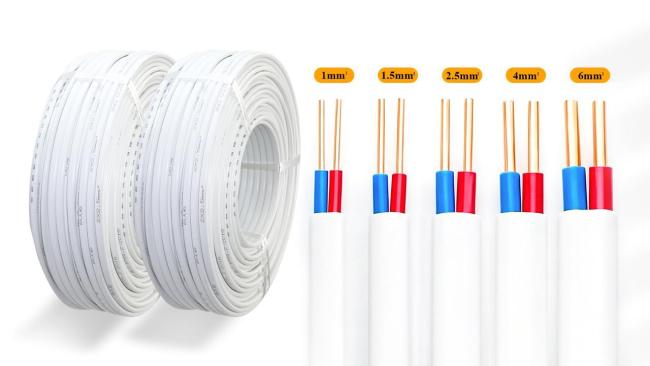
BVVB-2×2.5 mm² — Flat PVC Sheathed Copper Building Wire — Specification & Engineering Data
1. Overview & Ratings. BVVB-2×2.5 is a flat twin-core PVC sheathed copper building wire rated 300/500 V, 70 °C continuous. Built per GB/T 5023 / IEC 60227. The flat shape allows direct wall-surface mounting without conduit. Two 2.5 mm² stranded copper conductors side by side in a flat PVC jacket. Finished flat dimensions ≈ 5.0×10.0 mm, ≈ 105 kg/km, 100 m coils.
2. Construction Stack (Conductor → Outer).
| Layer | Build | Wall | Dimensions |
|---|---|---|---|
| Conductors (×2) | Stranded annealed Cu, Class 2, 2×2.5 mm² | — | ≈ 1.78 mm each |
| PVC insulation (per core) | Polyvinyl chloride | ≈ 0.7 mm | ≈ 3.2 mm each |
| Flat PVC sheath | PVC, light grey/white | ≈ 1.5 mm | ≈ 5.0×10.0 mm (finished) |
3. Electrical Characteristics. DC resistance ≤ 7.41 Ω/km at 20 °C (Cu 2.5 mm²); test voltage 2.0 kV AC / 5 min; insulation resistance ≥ 20 MΩ·km. Nominal ampacity ≈ 23 A (free air, 30 °C). Voltage drop ≈ 2.6 V/A·100 m.
Insulation & Sheath Data
|
Property |
Value |
|---|---|
|
Insulation material |
PVC (polyvinyl chloride), Type TI1/TI2 |
|
Outer sheath material |
PVC (polyvinyl chloride), Type TM1/TM2 |
|
Long-term service temp. |
70 °C (continuous, both insulation & sheath) |
|
Short-circuit temp. (≤5 s) |
160 °C (Cu conductor limit for PVC) |
|
Emergency overload temp. |
105 °C (short term) |
|
Test voltage AC (5 min) |
2.0 kV (routine test, 450/750 V class) |
|
Dielectric strength |
≥ 15 kV/mm (room temp.) |
Electrical Parameters
|
Parameter |
Value |
Note |
|---|---|---|
|
Rated voltage U₀/U |
300 / 500 V |
GB/T 5023.4 / IEC 60227-4 (common sheath rating) |
|
Max. system voltage |
500 V AC |
— |
|
Test voltage AC (5 min) |
2.0 kV |
Routine test |
|
DC resistance @20 °C (solid) |
≤ 7.41 Ω/km |
GB/T 3956 Class 1 Cu max, 2.5 mm² |
|
DC resistance @20 °C (stranded) |
≤ 7.41 Ω/km |
GB/T 3956 Class 2 Cu max, 2.5 mm² |
|
AC resistance @70 °C (est.) |
≈ 9.4 Ω/km |
per core |
|
Current rating in air (30 °C) |
20 A |
2-core flat, open air, reference value |
|
Current rating clipped to wall (30 °C) |
18 A |
surface-mounted, typical installation |
|
Current rating in conduit (30 °C) |
16 A |
enclosed in conduit |
|
Short-circuit current (1 s, Cu, 160 °C) |
≈ 0.28 kA (280 A) |
2.5 mm² Cu |
|
Frequency |
50/60 Hz AC |
— |
Reference values: 2×2.5 mm² at 16–18 A, single-phase 230 V → max load ≈ 3.7–4.1 kW. Voltage drop at 18 A ≈ 169 V/km per core (≈7.4% per 100 m at 230 V — limit to ≤ 40 m run without upsize).
4. Thermal & Mechanical. 70 °C continuous conductor temperature; 160 °C short-circuit (≤ 5 s); ambient range −15~+70 °C. Bend ≥ 3 × OD ≈ 30 mm. Flat shape lies flush on wall surfaces.
Temperature Characteristics
|
Property |
Value |
|---|---|
|
Max. conductor operating temp. |
70 °C (continuous) |
|
Max. short-circuit temp. (≤5 s) |
160 °C (Cu conductor, PVC limit) |
|
Emergency overload temp. |
105 °C (not recommended for continuous) |
|
Min. installation ambient temp. |
0 °C (PVC); below 0 °C pre-heating required |
|
Service ambient range |
−15 °C to +70 °C (PVC insulation & sheath) |
|
Fire survival |
Standard (flame retardant single cable) |
Fire Performance (BVVB — Standard)
|
Property |
Value / Requirement |
|---|---|
|
Flame retardant |
IEC 60332-1 (single cable, passes) |
|
Halogen content |
Contains halogen (PVC insulation & sheath) |
|
Smoke density |
Standard (non-low-smoke) |
|
Corrosivity |
Corrosive (PVC) |
|
Fire survival (circuit integrity) |
Not applicable (standard version) |
5. Installation Practice & Handling. Can be surface-mounted directly on walls using cable clips — no conduit needed. Strip outer sheath carefully to avoid nicking inner cores. At 105 kg/km, moderate weight. Indoor use only.
Mechanical & Installation Parameters
|
Parameter |
Value |
Remarks |
|---|---|---|
|
Minimum bending radius |
≥ 4 × cable thickness → ≈ 40 mm (at 10 mm H) |
flat profile, careful bending |
|
Max. pulling tension |
250 N |
solid Cu conductor |
|
Direct burial |
Not recommended (no mechanical protection; use PVC conduit) |
— |
|
Surface mounting |
Excellent (flat profile clips neatly to walls) |
cable clips every 200–300 mm |
|
Conduit ID |
≥ 16 mm (for 2-core flat) |
use oval conduit for flat profile |
|
Fixing |
cable clips, trunking, conduit |
flat shape ideal for surface wiring |
|
Impact resistance |
Low (PVC sheath only) |
protect with conduit in exposed areas |
|
Water resistance |
Moisture-resistant (PVC) |
not waterproof; indoor dry areas preferred |
|
UV resistance |
Poor (PVC degrades in sunlight) |
indoor use only; outdoor requires UV-resistant conduit |
|
Termination note |
Strip 10–12 mm sheath + 8–10 mm insulation; use standard screw terminals |
solid conductor direct into terminal |
6. Typical Service Applications. Indoor lighting circuits, wall-surface wiring, small appliance connections, extension leads, workshop bench power — where direct surface mounting is preferred over concealed conduit.
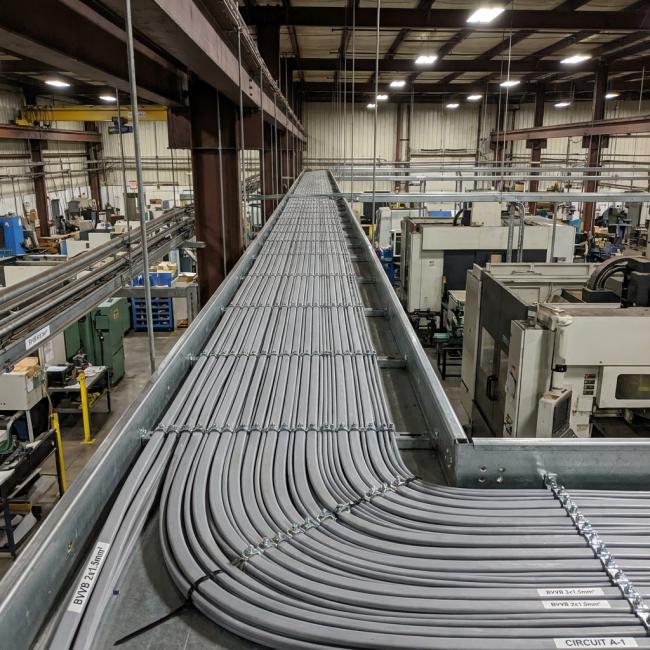
7. Testing & QA Regime. Routine: conductor DC resistance, 2.0 kV AC / 5 min withstand, insulation resistance, dimensional check. Type: heating test, bending test, flame retardancy, cold bend at −15 °C.
The Wire Parameters
| BVVB-2×2.5 mm² — Flat PVC Sheathed Copper Building Wire — Full Parameter Sheet | ||||
| Flat sheathed cable · 2× copper conductors / PVC insulation / flat PVC sheath · 300/500 V · 70 °C · ≈ 5.0 × 10.0 mm | ||||
| Section | Parameter | Value | Unit | Remarks / Standard |
| 01 · Identification | ||||
| Cable type | BVVB — flat PVC sheathed copper building wire | — | Flat sheathed wiring | |
| Rated voltage (U0/U) | 300/500 | V | Building / indoor | |
| Number of cores | 2 × 2.5 | — | 2-core (L/N) | |
| Conductor material | Annealed copper | — | Class 1 solid or Class 2 stranded | |
| Insulation material | PVC (polyvinyl chloride) | — | Per core | |
| Sheath material | PVC (flat, light grey/white) | — | Outer sheath | |
| Standard | GB/T 5023 / IEC 60227 | — | Flat sheathed cable | |
| Application | Fixed indoor wiring, wall surface, lighting | — | Building electrical | |
| Shape | Flat | — | BVVB = flat | |
| 02 · Conductor (Copper) | ||||
| Conductor type | Annealed copper, stranded | — | Class 2 per GB/T 3956 | |
| Conductor area | 2 × 2.5 | mm² | 2-core | |
| Stranding construction | 19 × 0.41 mm (approx.) | — | Stranded round | |
| DC resistance @ 20 °C | ≤ 7.41 | Ω/km | Cu 2.5 mm² max | |
| Conductor weight per km | ≈ 45 | kg/km | 2×2.5 Cu | |
| Conductor diameter | ≈ 1.78 | mm | Approx. | |
| 03 · Insulation & Sheath | ||||
| Insulation type | PVC (per core) | — | General-purpose | |
| Insulation thickness | ≈ 0.7 | mm | 300/500 V | |
| Sheath type | PVC flat sheath | — | Outer | |
| Sheath thickness | ≈ 1.5 | mm | Flat | |
| Finished overall dimensions | ≈ 5.0 × 10.0 | mm | Flat rectangular | |
| Sheath color | Light grey / white | — | Standard | |
| 04 · Electrical | ||||
| Rated voltage (U0/U) | 300/500 | V | Flat sheathed | |
| Max voltage | 500 | V | Phase-to-phase | |
| DC resistance @ 20 °C | ≤ 7.41 | Ω/km | Cu 2.5 mm² | |
| Insulation resistance | ≥ 20 | MΩ·km | PVC | |
| Test voltage (AC) | 2.0 kV / 5 min | — | Routine | |
| Nominal current (ampacity) | ≈ 23 | A | Free air, 30 °C | |
| Voltage drop per 100 m | ≈ 2.6 | V/A·100m | At 7.41 Ω/km | |
| 05 · Thermal | ||||
| Max conductor temp. | 70 | °C | PVC rated | |
| Short-circuit temp. | 160 | °C | Max 5 s | |
| Ambient range | -15 ~ +70 | °C | Indoor | |
| Laying temperature | ≥ 0 | °C | Indoor | |
| 06 · Mechanical | ||||
| Min bending radius (fixed) | ≥ 3 × OD ≈ 30 | mm | Flat cable | |
| Shape | Flat | — | Easy to lay on wall | |
| Crush resistance | Good | — | Sheathed | |
| 07 · Installation | ||||
| Laying methods | Wall surface, conduit, trunking, lighting circuits | — | Flat wiring | |
| Connectors | Crimp lugs / screw terminals | — | Standard | |
| Special tools | Wire stripper, cutter | — | Basic | |
| Bend radius | ≥ 3 × OD ≈ 30 mm | — | Flat cable | |
| 08 · Packing | ||||
| Standard supply length | 100 m / coil | m | Flat sheathed | |
| Reel / packing type | Coil, wrapped | — | Plastic bag | |
| Surface marking | BVVB, 2×2.5, 300/500V, GB/T 5023, metre marks | — | Continuous printing | |
| Storage conditions | Dry, indoor | — | Protect from moisture | |
| 09 · Applications | ||||
| Typical use | Indoor lighting, wall surface wiring, small appliances, extension leads | — | Building electrical | |
| Max system voltage | 500 | V | 300/500 V | |
| Application level | Low voltage | — | Indoor building | |
| 10 · Core Identification | ||||
| Core 1 | Red / brown | — | Phase L | |
| Core 2 | Blue / light | — | Neutral N | |
| Sheath | Light grey / white | — | Outer | |
| Earth | No earth core (2-core) | — | Add earth separately if needed | |
The Wire Test Parameters
| Test Parameters — BVVB-2×2.5 mm² Flat Sheathed Cable | ||||
| No. | Test Item | Test Condition / Method | Requirement | Type |
| 1 | Conductor DC resistance | GB/T 3956, 20 °C | ≤ 7.41 Ω/km (Cu 2.5 mm²) | Routine |
| 2 | Voltage test (AC) | 2.0 kV AC, 5 min | No breakdown | Routine |
| 3 | Insulation resistance | 500 V DC | ≥ 20 MΩ·km | Routine |
| 4 | Insulation thickness | Micrometer | ≥ 0.7 mm per core | Routine |
| 5 | Heating test | 70 °C conductor, 2 h | No damage | Type |
| 6 | Bending test | 3× OD, 3 cycles | No damage | Type |
| 7 | Flame retardancy | IEC 60332-1 | Self-extinguishing | Type |
| 8 | Dimensional check | Caliper | ≈ 5.0 × 10.0 mm flat | Routine |
| 9 | Conductor continuity | Per GB/T 3956 | Both cores continuous | Routine |
| 10 | Cold bend test | -15 °C, bending | No cracking | Type |
| 11 | Sheath thickness | Micrometer | PVC ≥ 1.5 mm | Routine |
| 12 | Printing legibility | Visual | Marking readable | Routine |
The Wire Cross Section Structure
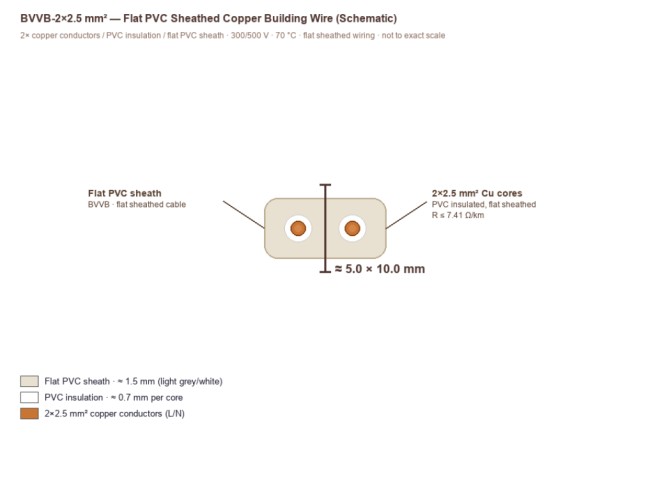
| BVVB-2×2.5 mm² — Cross-Section Construction Diagram (Schematic) | |||||
| Flat sheathed cable: 2×Cu conductors → PVC insulation → flat PVC sheath · 300/500 V · 70 °C · ≈ 5.0 × 10.0 mm | |||||
| No. | Layer | Material / Construction | Nominal Thickness (mm) | Dimensions (mm) | Function / Remarks |
| 1 | Conductors (×2) | Stranded annealed copper, Class 2, 2 × 2.5 mm² | — | ≈ 1.78 each | R ≤ 7.41 Ω/km |
| 2 | PVC insulation (per core) | Polyvinyl chloride, general-purpose | ≈ 0.7 | ≈ 3.2 each | 300/500 V rated |
| 3 | Flat PVC sheath | PVC flat sheath, light grey/white | ≈ 1.5 | ≈ 5.0 × 10.0 | Outer protection |
| Key Dimensions & Properties (expanded) | |||||
| Finished flat dimensions | ≈ 5.0 × 10.0 | mm | Overall | ||
| Approx. cable mass | ≈ 105 | kg/km | 2-core flat | ||
| Nominal voltage rating | 300/500 | V | Indoor building | ||
| Max conductor temp. | 70 | °C | PVC rated | ||
| Short-circuit temp. | 160 | °C | Max 5 s | ||
| Min bending radius (fixed) | ≥ 3 × OD ≈ 30 | mm | Flat cable | ||
| DC resistance @ 20 °C | ≤ 7.41 | Ω/km | Cu 2.5 mm² | ||
| Test voltage (AC) | 2.0 kV / 5 min | — | Routine | ||
| Nominal current (ampacity) | ≈ 23 | A | Free air, 30 °C | ||
| Number of cores | 2 | — | L + N | ||
| Shape | Flat | — | Easy wall mounting | ||
| Sheath color | Light grey / white | — | Standard | ||
| Standard | GB/T 5023 / IEC 60227 | — | Flat sheathed | ||
| Application | Indoor lighting / wall wiring | — | Building electrical | ||
| Schematic — not to exact scale. Finished flat dimensions ≈ 5.0×10.0 mm and weight ≈ 105 kg/km from cross-referenced industry samples. BVVB-2×2.5 is a flat twin-core PVC sheathed copper building wire. Values marked (est.) require confirmation against the factory test certificate. | |||||
Construction Description
| Construction Description — BVVB-2×2.5 mm² flat sheathed cable | |||
| Layer-by-layer flat sheathed cable: 2×Cu conductors / PVC insulation / flat PVC sheath · 300/500 V · 70 °C · ≈ 5.0×10.0 mm | |||
| 1. Product Identity & Ratings | |||
| BVVB-2×2.5 is a flat twin-core PVC sheathed copper building wire rated 300/500 V, 70 °C continuous. Built per GB/T 5023 / IEC 60227. The flat shape makes it ideal for wall-surface mounting and lighting circuits. Finished flat dimensions ≈ 5.0×10.0 mm, mass ≈ 105 kg/km, 100 m coils. | |||
| 2. Two Copper Conductors (2×2.5) | |||
| Two 2.5 mm² stranded annealed copper conductors (Class 2, 19×0.41 mm each), laid side by side. DC resistance ≤ 7.41 Ω/km at 20 °C. One core is phase (red/brown), the other is neutral (blue/light). | |||
| 3. PVC Insulation & Flat Sheath | |||
| Each core has PVC insulation ≈ 0.7 mm thick. The two insulated cores are enclosed in a flat PVC sheath ≈ 1.5 mm thick, light grey/white. The flat sheath provides mechanical protection and allows surface mounting without conduit. | |||
| 4. BVVB vs BV Difference | |||
| BVVB is a flat sheathed cable — two cores already assembled in a flat PVC jacket. BV is a single bare-insulated wire that must be pulled into conduit. BVVB can be surface-mounted directly on walls, which saves conduit cost. The flat shape also runs cleaner on wall surfaces. | |||
| 5. Site Handling & Operational Notes | |||
| • Bend radius 3×OD (≈ 30 mm). • Can be surface-mounted on walls. • Use cable clips to secure. • Strip the outer sheath carefully. • At 105 kg/km, moderate weight. • Indoor use only. • Store dry. |
8. Standards & Conformity. GB/T 5023 (PVC insulated cables); IEC 60227 (international equivalent); GB/T 3956 (conductors). Rated 300/500 V.
9. Packaging, Storage & Logistics. 100 m per coil, plastic wrapped. Continuous marking: BVVB, 2×2.5, 300/500V, GB/T 5023, metre marks. Store dry, indoor.
10. Procurement Specification. State "BVVB-2×2.5" + length. No earth core in 2-core version. Confirm against factory test certificate.
11. Cable Industry FAQ.
- Q1: What does "BVVB" mean? B = fixed building wire; V = PVC insulation; V = PVC sheath; B = flat shape. It is a flat twin-core sheathed cable.
- Q2: What is the difference between BVVB and BVR? BVR is a single-core flexible wire (4.0 mm², round, must go in conduit). BVVB is a flat twin-core sheathed cable (2×2.5 mm², can be surface-mounted directly). BVVB saves conduit cost; BVR is more flexible.
- Q3: Why is the voltage rating 300/500 V instead of 450/750 V? Flat sheathed cables (BVVB) are rated 300/500 V because the flat sheath construction is for lower-voltage lighting circuits. The 450/750 V rating applies to single-core BV/BVR wires.
- Q4: Can BVVB be used outdoors? No — standard PVC sheath is not UV-resistant. For outdoor use, use outdoor-rated cable or conduit.
- Q5: Can I surface-mount BVVB directly on walls? Yes — that is the primary advantage. Use cable clips or trunking to secure the flat cable. No conduit needed for indoor dry locations.
- Q6: What is the ampacity? Approximately 23 A in free air at 30 °C. In enclosed spaces, derate to ~18 A.
- Q7: Does BVVB have an earth core? The 2-core version (2×2.5) has only L + N. For earth connection, use BVVB-3×2.5 (3-core) or run a separate earth wire.
- Q8: What is the flat dimension? ≈ 5.0 mm thick × 10.0 mm wide. The flat profile lies flush against walls and ceilings.
- Q9: How do I terminate BVVB? Split the two cores by carefully slicing the flat sheath web between them. Strip each core individually and terminate into a 2-pole terminal block or plug.
- Q10: Is BVVB fire-resistant? No — BVVB is general-purpose PVC. For fire circuits, use mineral-insulated fire cables.
- Q11: Can BVVB be buried in walls? Yes — it can be chased into walls, though conduit is recommended for protection and future replacement. The flat shape sits well in shallow chases.
Get in Touch
Have questions about our products or want to discuss a custom order? Our team is ready to help you.