
Polyacrylamide PAM Polyelectrolyte Water And Sewage Treatment Chemicals Used In Stp Plant
Polyacrylamide (PAM) plays a crucial role as a chemical in water and sewage treatment due to its ability to improve the efficiency of solid-liquid separation. Its key functions include:
1. Flocculation
PAM helps bind small suspended particles and colloids in water into larger aggregates (flocs), which settle more quickly during sedimentation.
2. Sludge Thickening and Dewatering
In sewage treatment, PAM, especially cationic PAM, improves sludge thickening and enhances dewatering by increasing water removal. This reduces sludge volume and disposal costs.
3. Primary and Secondary Clarification
PAM is used in both primary and secondary treatment stages to clarify water by removing suspended particles and organic matter. It works as a coagulant aid to enhance sedimentation.
4. Dissolved Air Flotation (DAF)
PAM improves the efficiency of the DAF process by promoting the aggregation of fine particles and oils, making it easier for them to attach to air bubbles and float to the surface for removal.
5. Organic and Inorganic Pollutant Removal
PAM aids in the removal of color, organic matter, and metal ions from wastewater by enhancing particle settling and reducing water turbidity.
6. COD and BOD Reduction
By facilitating the removal of suspended and dissolved solids, PAM helps reduce Chemical Oxygen Demand (COD) and Biological Oxygen Demand (BOD) in treated water.
7. Enhanced Coagulation Aid
PAM is often used with coagulants such as polyaluminum chloride (PAC) or ferric salts to improve coagulation efficiency and reduce chemical dosages.
Conclusion
As a versatile water and sewage treatment chemical, Polyacrylamide plays a key role in:
- Flocculation and sedimentation,
- Sludge thickening and dewatering,
- Clarification and flotation,
- COD/BOD reduction,
- Improving overall treatment efficiency.
Its application helps optimize treatment processes, minimize sludge volumes, and enhance water quality, making it an essential tool in both municipal and industrial wastewater management.
BLUFLOC SERIES POLYACRYLAMIDE POWDER
DESCRIPTION
Blufloc Polyacrylamide is a solid, water-soluble polymer available in varying molecular weights and charge densities. It is classified into anionic, cationic, and nonionic types.
It is most commonly used to:
- Increase the viscosity of water (creating a thicker solution).
- Facilitate flocculation of particles in water, leading to rapid settlement of suspended solids.
ADVANTAGES
- Cost-effective: Economical to use with lower dosage levels.
- Water-soluble: Easily dissolves in water and works rapidly.
- Non-corrosive: Safe at suggested dosages, effective and economical even at low levels.
- Reduces coagulant dependency: Eliminates or reduces the need for alum and ferric salts when used as primary coagulants.
- Sludge reduction: Enhances the dewatering process in sludge management systems.
APPLICATION FIELDS
1. Raw Water Treatment
- Flocculation
- Clarification
- Dewatering of lime alum sludge and recovery of water
2. Industrial Wastewater Treatment
- Primary clarification
- Secondary & tertiary treatment
- Sludge thickening & dewatering
- Color removal
- Dissolved Air Floatation
3. Sewage Treatment
- Primary treatment
- Sludge thickening & dewatering
4. Process Industries
- Sugar and Juice Industry: Clarification
- Paper Making: Retention, wet strengthening agent, resident agent, and water recovery
- Sugar Manufacturing: Mud settling
- Chlor-Alkali: Brine clarification
- Thermal Power: Clarification of scrubber water
- Mining & Metallurgy: Tailings thickening and water recovery
- Coal Industry: Tailings thickening and water recovery
- Construction: Soil and road stabilization, concrete making
5. Petroleum and Gas Field
- Drilling fluids
- Enhanced Oil Recovery (EOR)
- Fluid loss control
- Lubrication
- Shale stabilization
TYPICAL PRODUCTS & PROPERTIES:
| Specifications: | Index: | |||
| Appearance: | Off-White Granular Powder | |||
| Ionic Charge: | Anionic | Cationic | Nonionic | |
| Particle Size: |
20- 100 mesh
|
|||
| Molecular Weight: | 5-25million | 5- 12million | 5- 12million | |
| Anionic Degree: |
5-100% |
5-80% |
0%-5% |
|
| Solid Content: | 89% Minimum | |||
| Bulk Density: | About 0.8 | |||
|
Recommended Concentration: |
Working |
0.1-0.5% |
||
| Storage Temperature (°C): |
0 - 35
|
|||
| Shelf Life: | 2 years | |||


Package
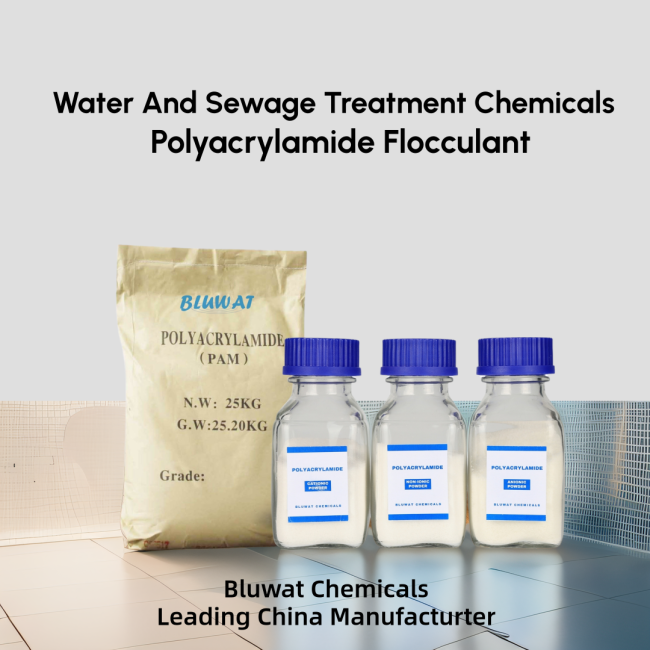
Packed in kraft paper or PE bags with inner plastic bags, with each bag containing 25kgs, or 750kgs net big bag
Get in Touch
Have questions about our products or want to discuss a custom order? Our team is ready to help you.