
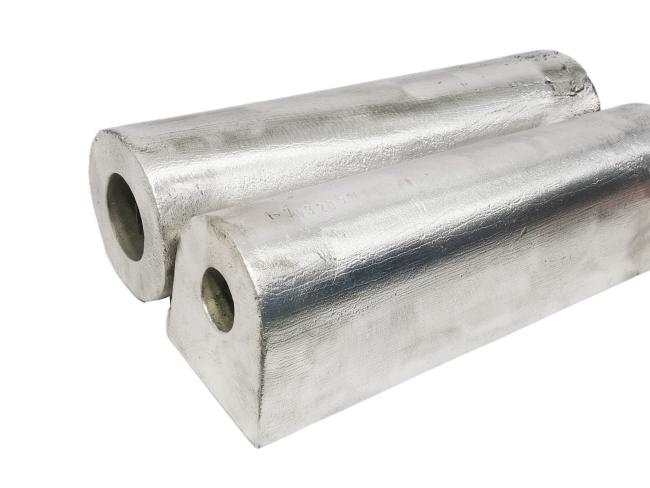
17 Lb Magnesium Anode Galvanic Corrosion Sacrificial Mg 8000Ω
High Potential Magnesium Anode Used In Soils With Resistivity Greater Than 8000Ω
Introduction:
When metal structures are submerged or buried, oxidation can cause rusting, which is a chemical reaction of the metal with its surroundings. This reaction can lead to loss of metal and ultimately overall structural integrity over time, if left unaddressed, until the point of failure.
Sacrificial anodes (or primary cells) are the main component of current cathodic protection systems. These blocks, rods, plates, or extruded strips are made of metal alloys that are less voltage active than the structural alloys that need protection. In other words, the electron supply that facilitates the dissolution of the primary metal will be transferred or consumed by the "sacrificial" metal.
The potential of the high-potential magnesium anode is -1.75V CSE, and the driving voltage is 0.85V; the potential of the low-potential magnesium anode is -1.55V CSE, and the driving voltage is 0.7V. High potential sacrificial anodes are recommended in soils with a resistivity greater than 8000Ω.cm
Chemical composition %:
| Alloy |
Al |
Mn |
Si |
Cu |
Ni |
Fe |
Other impurity(each) |
Total Impurities |
| Mg-Mn | 0.01 | 0.50-1.30 | 0.05 | 0.005 | 0.001 | 0.03 | 0.05 | 0.30 |
The electrochemical performance of:
|
Open voltage |
Closed voltage |
Actual capacity |
Efficiency |
| 1.70-1.75 | 1.58-1.62 | 1230min | 50min |
Specification:
| Type | Weight(kg) | Width(mm) | Hight(mm) | Length(mm) | Insert |
| 9D2-1 | 4.1 | 63.5 | 63.5 | 669.9 | Strip |
| 9D2-2 | 4.1 | 69.9 | 76.2 | 560 | Strip |
| 14D2-1 | 6.35 | 63.5 | 63.5 | 1054 | Strip |
| 14D2-2 | 6.35 | 69.9 | 76.2 | 850.9 | Strip |
| 20D2-1 | 9.1 | 63.5 | 63.5 | 1505 | Strip |
| 20D2-2 | 9.1 | 69.9 | 76.2 | 1270 | Strip |
| 9D3 | 4.1 | 88.9 | 95.25 | 258.8 | Strip |
| 17D3 | 7.7 | 88.9 | 95.25 | 657.2 | Strip |
| 32D5 | 14.5 | 139.7 | 146.05 | 523.9 | Strip |
| 48D5 | 21.8 | 139.7 | 146.05 | 765.2 | Strip |
Features:
The main characteristics of high-potential magnesium alloy sacrificial anodes are large electricity per unit mass, high potential, small specific gravity, negative potential, high driving voltage to Fe, low current efficiency, etc., especially suitable for high resistivity media. When using magnesium alloy sacrificial anode, care should be taken to avoid collision with steel structure. American standard ASTM8431993 (2003) and Chinese standard GB/T177312004 both require the current efficiency of high-potential magnesium alloy sacrificial anodes to be higher than 50% and the potential higher than 1.77 V.
Application:
Applicable to anti-corrosion protection of the oil, gas, water supply, and drainage pipelines, as well as the protection of harbor, ship, reservoir, gate, and other projects in the water.
D type and R type photo:
Get in Touch
Have questions about our products or want to discuss a custom order? Our team is ready to help you.