
ASTM A234 WP9 CL1 Seamless 180 Degree Return Bend For Power Generation Plants
ASTM A234 WP9 CL1 Seamless 180 Degree Return Bend For Power Generation Plants
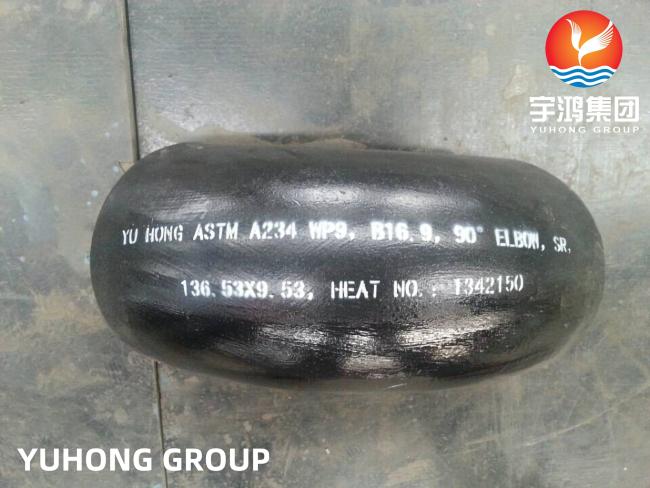
An ASTM A234 WP9 CL1 Seamless 180 Degree Return Bend is a high-performance, U-shaped pipe fitting made from a seamless 9% chromium, 1% molybdenum alloy steel with a standard wall thickness. It is specifically engineered for use in critical piping systems that operate under high pressure and high temperatures.
Here are some detailed breakdowns:
1. Material: ASTM A234 WP9 CLASS 1
(1). Chemical Composition
The chemical composition for A234 WP9 is given in percentage by weight (%).
| Element | Composition (%) | Notes |
| Carbon (C) | 0.15 max | Controlled for weldability and strength. |
| Manganese (Mn) | 0.30 - 0.60 | Improves strength and hardenability. |
| Phosphorus (P) | 0.03 max | Impurity, kept low to improve toughness. |
| Sulfur (S) | 0.03 max | Impurity, kept low to improve weldability and toughness. |
| Silicon (Si) | 0.50 - 1.00 | A deoxidizer, contributes to strength. |
| Chromium (Cr) | 8.00 - 10.00 | Key element for high-temperature strength and corrosion/oxidation resistance. |
| Molybdenum (Mo) | 0.90 - 1.10 | Key element for high-temperature strength and creep resistance. |
Key Takeaway: The core of this alloy is the 9% Chromium and 1% Molybdenum, which gives it the common name 9Cr-1Mo steel, renowned for its high-temperature performance.
(2). Mechanical Properties
The mechanical properties are determined from a test specimen in the heat-treated condition (normalized and tempered).
| Property | Requirement | |
| Tensile Strength | ≥ 585 MPa (85 ksi) | |
| Yield Strength (at 0.2% offset) | ≥ 415 MPa (60 ksi) | |
| Elongation in 2 inches (50.8 mm) | ≥ 20% | The minimum elongation requirement decreases slightly for thicker sections, as per the standard's standard reduction formula. |
| Hardness (Brinell) | ≤ 192 HBW (or equivalent HRB/HV) | This is a maximum limit to ensure good weldability and machinability. |
Key Takeaway: The material has a high minimum yield and tensile strength, ensuring it can withstand high internal pressures. The elongation value indicates good ductility, and the hardness limit ensures the material is suitable for fabrication.
3. Heat Treatment
This is a critical part of achieving the specified mechanical properties. ASTM A234 requires that WP9 fittings be supplied in the normalized and tempered condition.
- Normalizing: Heated to a temperature above its critical transformation temperature (typically around 1650-1750°F / 900-955°C) and then air-cooled. This refines the grain structure.
- Tempering: Reheated to a specific lower temperature (typically between 1250-1350°F / 675-730°C) and then cooled. This relieves internal stresses from normalizing and optimizes the combination of strength and toughness.
4. 180 Degree Return Bend
This is crucial for high-pressure and high-temperature applications because it creates a more uniform, reliable, and stronger fitting with no weak points like a weld seam.
Performance Characteristics of ASTM A234 WP9 CL1 Seamless 180 Degree Return Bend:
- High-Temperature Strength
- Excellent Creep Resistance
- Good Ductility
- Controlled Hardness
Primary Application Category: High-Temperature Service
The key feature of the WP9 (9% Chromium, 1% Molybdenum) material is its excellent strength and resistance to oxidation (scaling) at elevated temperatures. This makes it a go-to choice for systems operating in the 540°C to 650°C (1000°F to 1200°F) range.
Specific Industries and Systems
1. Power Generation Plants (Fossil Fuel & Nuclear)
This is the most common application. The return bend is used to create complex tubing layouts that must withstand extreme conditions.
- Boiler Systems: In the superheater and reheater sections where steam is heated to its highest temperatures and pressures. The 180-degree return bend is essential for creating continuous tube loops within the boiler walls and convection passes.
- Steam Piping: For high-pressure main steam and hot reheat steam lines that carry steam from the boiler to the turbine.
- Heat Exchangers: Used in the tube bundles of heat exchangers and economizers where the flow needs to be reversed.
2. Petroleum Refineries & Petrochemical Plants
In these facilities, the fitting is used in processes that involve cracking and reforming hydrocarbons at high temperatures.
- Furnace Piping: Within the tubes of process furnaces and heaters where hydrocarbons are heated to very high temperatures.
- Catalytic Cracking Units: In transfer lines that carry hot, corrosive catalysts and gases.
- Hydrogen Service: Suitable for certain high-temperature hydrogen-containing environments due to its alloy content.
3. Other Industrial Processes
Any industrial process requiring reliable high-temperature piping.
- Chemical Processing Plants: For handling high-temperature process streams.
- Pulp and Paper Mills: In recovery boilers where black liquor is burned at high temperatures.
Get in Touch
Have questions about our products or want to discuss a custom order? Our team is ready to help you.