
Low Speed Floor Standing Centrifuge NovaFuge NovaFuge F104-5K
It is widely used in clinical medicine, clinical laboratory, biological engineering, Genetic engineering, immunology. It is suitable for the separation and purification of radioimmunoassay, water analysis, biochemistry, pharmaceutical and blood products.
- Advanced microprocessor control system
- Dual model availability (refrigerated/non-refrigerated)
- Multiple display options (LED/LCD)
- Programmable motorized lid operation
- Real-time RPM/RCF adjustment capability
- Maintenance-free induction motor
- 30 programmable functions standard
- Automatic rotor identification
- Comprehensive error code system
- Pneumatic spring-assisted lid opening
- Right-side hinge design
- Manual emergency lid release
- Dual version availability for F105-5R
- Blood-bag specific programming
- Standard laboratory configuration
| Model | NovaFuge F104-5K |
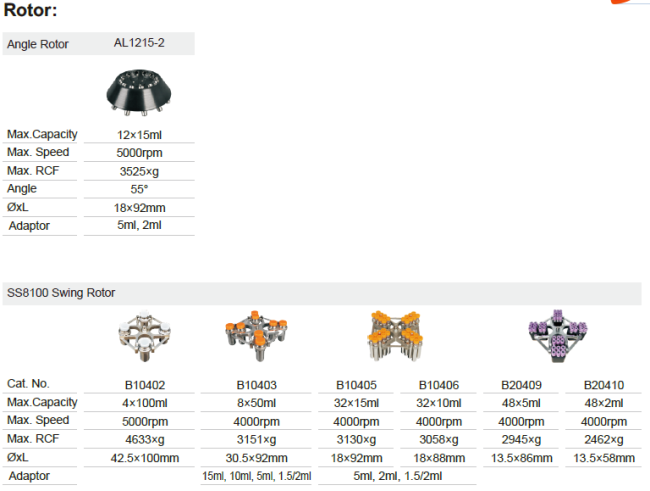
| Max. RPM/RCF for angle rotor | 5000rpm / 3525*g |
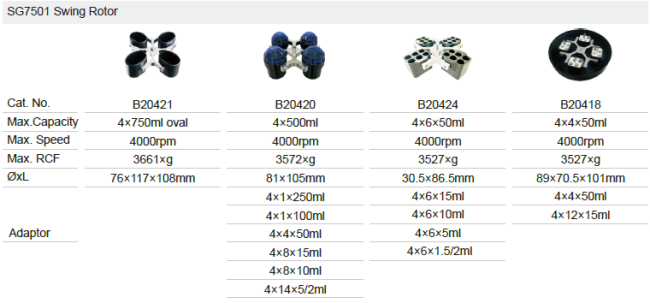
| Max. RPM/RCF for swing rotor | 5000rpm / 4633*g |
| Max. Capacity for angle rotor | 12*15ml |
| Max. Capacity for swing rotor | 4*1000ml, 148*5ml |
| Speed increment | 50rpm |
| Speed accuracy | ±20 rpm |
| Temp. range | - |
| Temp accuracy | - |
| Timer range | 0~99min50s / 23h59min |
| Acc / Dec rates | 12/12 |
| Program memory | *30 |
| Power supply | AC220V 50/60Hz |
| Power requirement | 1KW |
| Noise | <58db |
| Display | LCD screen |
| Machine Body | Metal frame |
| Motor | Converter Motor, direct drive |
| Net weight (without rotor) | 133kg |
| Machine Dimension(L*W*H) | 630*740*900mm |
Introduction about centrifuge
Serving as a mechanical separator, the centrifuge uses rotational motion to isolate target materials from a fluid medium. The generated force field propels heavier components toward the outer wall of the holding vessel. This technology is embodied in two common lab forms: the versatile benchtop centrifuge and the high-performance floor-standing centrifuge. Both types employ specialized rotors—either at a fixed angle or on swinging hinges—to optimize separation. Choosing correctly involves analyzing application-specific parameters like necessary g-force, run frequency, temperature constraints, and the instrument's safety and maintenance profile.
Get in Touch
Have questions about our products or want to discuss a custom order? Our team is ready to help you.