
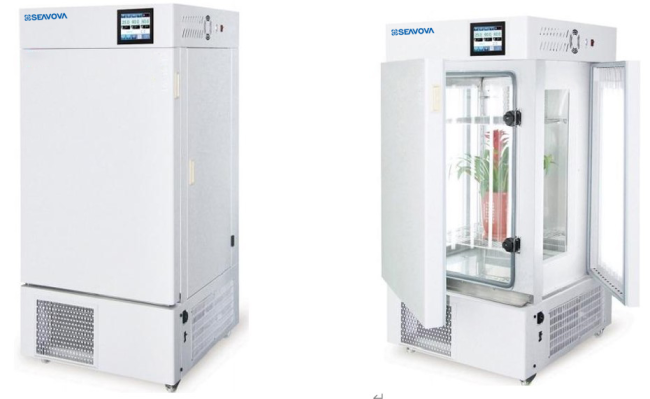
300L Climate Chamber CMS-300B with humidity control
- Programmable PID temperature controller with touch screen interface
- Advanced air circulation: forced convection + vertical diffusion
- Unique 3-side illumination system with 5 adjustable light levels
- High-temperature resistant door gasket and air duct structure
- Separate drainage pipes for chamber cleaning efficiency
- Detachable sensor protective covers for easy maintenance
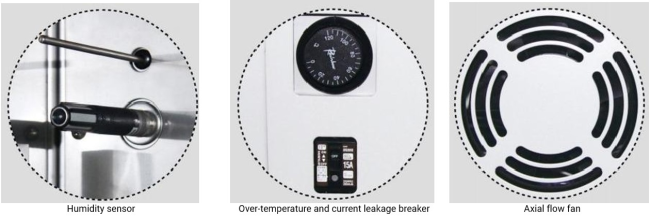
- Comprehensive safety: leakage protection, door alarm, power failure alarm
- Premium components: German compressors, Swiss humidity sensors
- Independent temperature safety device with adjustable settings
- Water shortage/overflow and compressor protection systems
| Model | CMS-300A | CMS-450A | CMS-800A | CMS-1000A |
| CMS-300B | CMS-450B | CMS-800B | CMS-1000B | |
| Convection Mode | Forced convection | |||
| Control Mode | Balance | |||
| Temperature Resolution | 0.1℃ | |||
| Temperature Control Range | With illumination: 10℃~65℃ Without illumination: 0℃~65℃/±0.1℃ | |||
| Humidity Control Range | <20~95%RH/±1.5%RH | |||
| Illumination | 0~25000LX,5-grade adjustment(Optional: 0-30000LX) | |||
| Working Temperature | 5℃~30℃ | |||
| Programme Control | Programmable LCD with touch screen | |||
| Overall Dimensions(W*D*H,mm) | 800*910*1610 | 790*990*1860 | 1200*1100*1900 | 1540*1100*1900 |
| Chamber Dimensions(W*D*H,mm) | 600*565*900 | 605*650*1150 | 1020*700*1150 | 1280*700*1150 |
| Volume | 305L | 452L | 822L | 1030L |
| Refrigerant | R134a | |||
| Rated Power | 2200W | 2450WV | 3100W | 3500W |
| Water Tank Capacity | 20L | |||
| Power Supply | AC-220V,50/60HZ | |||
| Safety Protection | Compressor over pressure protection, over heat protection,current leakage progection, over load, under pressure, water shortage protction | |||
| Shelf Qty. | 3 | |||
| Notes: Humidity control,water tank and water pipes are not available for CMS-300A/450A/800A/100A | ||||
Beyond biomedical labs, incubators are vital tools in environmental science and ecology. Researchers use them to simulate specific environmental conditions for controlled experiments. Refrigerated incubators can mimic seasonal cold temperatures to study seed dormancy and germination patterns of plants, informing conservation and agriculture.
For soil science, incubators maintain constant temperatures to study microbial respiration rates, nutrient cycling (like nitrogen mineralization), and decomposition processes of organic matter, key for understanding carbon sequestration and climate change impacts. In aquatic ecology, incubators are used to culture algae under specific light and temperature regimes for biofuel research or to test the effects of pollutants (e.g., heavy metals, pesticides) on planktonic organisms in toxicity bioassays.
Microbiologists studying extremophiles might use incubators to recreate high-temperature (thermophiles) or low-temperature (psychrophiles) environments. By providing a stable, replicable microcosm, incubators allow environmental scientists to isolate and study the effects of single variables—like temperature rise due to global warming—on biological systems, generating predictive models for ecosystem changes.
Get in Touch
Have questions about our products or want to discuss a custom order? Our team is ready to help you.