
280L Horizontal Cylindrical Autoclave HCPS-B280
280L Horizontal Cylindrical Autoclave HCPS-B280
Features:
- Gravity exchange technology ensures complete air removal, enhancing steam penetration and sterilization efficacy.
- Smart control system auto-regulates steam based on chamber temperature for consistent cycle performance.
- Perfect for clinics and research institutes to process a wide range of medical and laboratory items.
- Simple automated operation with an added drying function suitable for preparing sterile dressings.
- Equipped with auto-protection against over-temperature, over-pressure, and water shortage (with alarm).
- Secure door mechanism locks until internal pressure is safely reduced to 0.027MPa.
- Integrated safety valve releases steam automatically when pressure exceeds 0.24MPa.
- All-stainless steel construction guarantees a sanitary, durable, and easy-to-clean chamber.
Specifications
| Model | HCPS-B280 |
| Chamber volume | 280L |
| Chamber size | φ600*1000mm |
| Working pressure | 0.22MPa |
| Working temperature | 134℃ |
| Temperature control range | 105℃ - 134℃ |
| Sterilization time | 0-60 min |
| Drying time | 0-60 min |
| Heat average | ≤±2℃ |
| Power | 12KW,380V/50Hz |
| Dimensions | 1400*770*1780 |
| Packing size | 1680*920*1950 |
| G.W/N.W(Kg) | 465/365 |
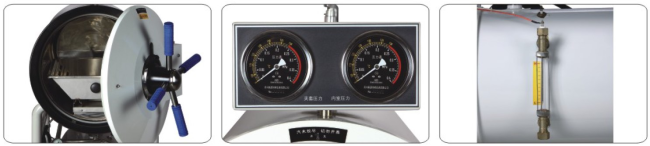
Introduction about autoclave
The autoclave is a precision instrument for sterilization, relying on the physical properties of pressurized steam. By heating water within a sealed chamber, it produces saturated steam that, under pressure of 15-30 psi, reaches temperatures between 121°C and 134°C. This environment is uniformly lethal to microorganisms. The standardized cycle ensures consistency: air is evacuated, steam penetrates the load for a timed exposure, and finally, the chamber is vented. In medical contexts, it processes everything from simple forceps to complex robotic surgery components. Dental practices use it to meet stringent infection control guidelines.
In laboratories, it is used for sterilizing pipettes, flasks, agar media, and for the safe disposal of pathogenic cultures. Industrial applications leverage its heat and pressure for material science processes. The autoclave's dominance is due to several factors: it leaves no chemical residue, it is highly effective and predictable, and steam provides superior heat transfer compared to dry air, allowing for lower temperatures and shorter cycles than dry heat sterilization for equivalent microbial kill. Its broad utility and reliability make it indispensable.
Get in Touch
Have questions about our products or want to discuss a custom order? Our team is ready to help you.