
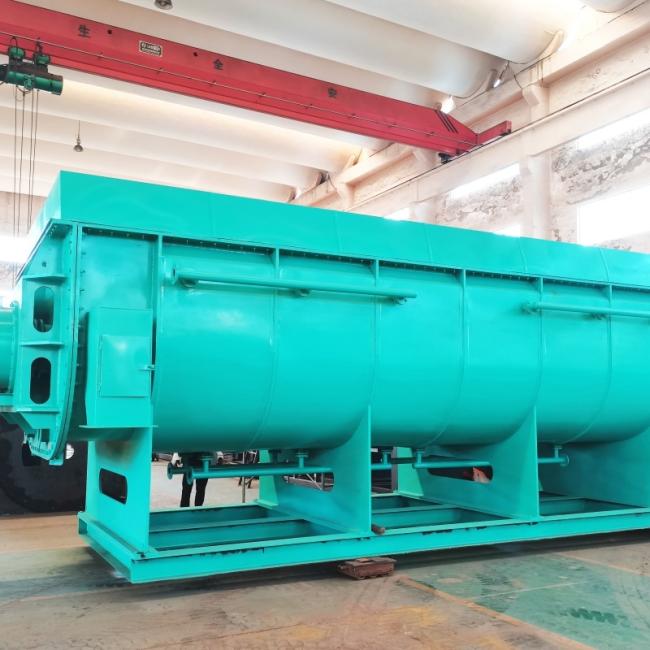
Fish Powder Hollow Paddle Dryer Customized SUS304 Hollow Blade Dryer
Fish Powder Customized Hollow Paddle Dryer
I. Basic Overview
The paddle dryer is a horizontal, indirect heat-conduction, low-speed agitated continuous drying equipment. It utilizes three heat transfer surfaces—hollow shaft, wedge-shaped hollow paddles, and jacketed shell—to provide heating without requiring large volumes of hot air. It is the mainstream energy-efficient drying equipment for treating sludge, filter cakes, and viscous paste-like materials.
II. Main Structure
1. W-type Ω shell: equipped with a jacket through which heating medium flows to heat the cylinder wall; feed inlet and moisture exhaust port at the top, discharge outlet at the tail end; fully enclosed structure.
2. Hollow main shaft + wedge-shaped hollow blades: two parallel hollow shafts fitted with densely arranged wedge-shaped hollow blades; heating medium circulates inside both the shafts and blades, serving as both mixing elements and heating surfaces.
3. Drive system: motor + gearbox + gear synchronous drive, enabling dual-shaft counter-rotating low-speed operation (2–10 rpm).
4. Rotary joint: installed at the shaft end to transfer heat-conducting medium from stationary piping to the rotating hollow shaft.
5. Shaft-end seal, insulation layer, frame, and exhaust gas dust removal unit.
III. Working Principle
1. The heat medium (saturated steam, thermal oil, hot water / cooling water) enters the hollow shaft, hollow blades, and jacket of the shell via a rotary joint, transferring heat indirectly to the material through the metal walls (the heat medium does not come into direct contact with the material).
2. Wet material enters the chamber from one end, where dual-axis blades slowly agitate and push the material toward the discharge end.
3. As the wedge-shaped blades rotate, the material is continuously compressed, loosened, and tumbled, maintaining constant contact with the heated surfaces; moisture evaporates upon heating, and the resulting vapor is gently extracted through the top exhaust port.
4. Self-cleaning effect: the inclined surfaces of the blades generate relative friction with the material, while the two blades scrape against each other, automatically removing adhered material from the walls and ensuring continuous high-efficiency heat transfer.
5. Dried material exits through the discharge outlet at the tail end; by switching to cooling water, the unit can also function as a material cooler.

Get in Touch
Have questions about our products or want to discuss a custom order? Our team is ready to help you.