
Fine Particle Mineral Flotation Cell for Fine Ore Separation
The Fine Particle Mineral Flotation Cell is engineered for mineral processing applications requiring precise air dispersion, slurry circulation, and adaptable flotation circuit configurations for finely ground ores.
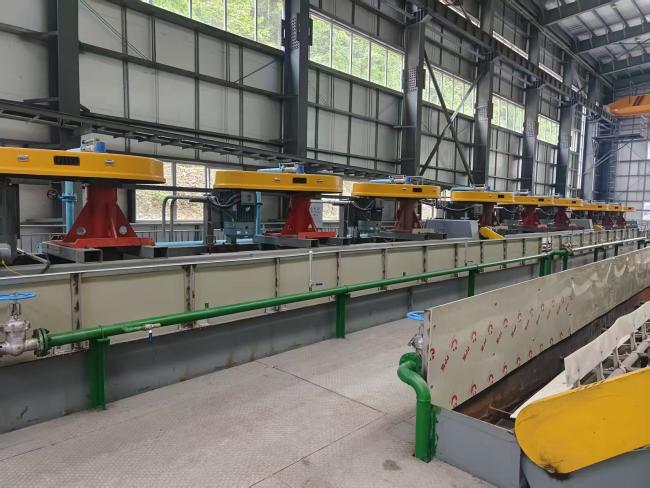
Cell volume and quantity can be selected based on particle size distribution, mineral liberation, slurry conditions, and required flotation stages. Available cell volumes from 1 m³ to 160 m³ support various processing capacities and flotation circuit configurations.
- Fine Particle Flotation: Optimized for finely ground mineral particles where froth flotation is applicable
- Flexible Cell Volume: Available from 1 m³ to 160 m³
- Multiple Flotation Stages: Configurable for roughing, cleaning, and scavenging operations
- Air-Slurry Contact: Advanced air dispersion and slurry circulation promote effective contact between mineral particles and bubbles
- Flexible Circuit Configuration: Cell size and quantity can be selected according to specific processing requirements
During flotation, air is dispersed into the conditioned slurry to form bubbles. Hydrophobic mineral particles attach to the bubbles and rise toward the froth layer, while other particles remain in the slurry.
For fine-particle applications, grinding, conditioning, aeration, and flotation time should be considered together when configuring the flotation circuit.
| Parameter | Specification |
|---|---|
| Equipment Type | Flotation Cell |
| Effective Volume | 1-160 m³ |
| Feed Particle Size | 0.3-0.01 mm |
| -0.074 mm Fraction | >50% |
| Air Volume | 0.05-1.4 m³/m²*min |
| Flotation Stage | Roughing / Cleaning / Scavenging |
Suitable for metallic and non-metallic mineral processing applications where finely ground particles are separated by froth flotation.
Actual equipment configuration should be determined according to mineral characteristics, particle size distribution, and flotation test results.
For flotation cell selection, the following information is recommended:
Ore Type * Processing Capacity * Feed Particle Size * Mineral Analysis * Required Flotation Stage * Flotation Test Data
This information helps determine the appropriate cell volume, quantity, and flotation circuit configuration.
- Is finer grinding always better for flotation?
No. Grinding should provide sufficient mineral liberation while maintaining a particle size suitable for the selected flotation process. Excessive grinding may produce very fine particles and change flotation behavior. - Can the flotation cell be used for roughing, cleaning and scavenging?
Yes. Different cell sizes and configurations can be selected according to the required flotation stage and process flowsheet.
Get in Touch
Have questions about our products or want to discuss a custom order? Our team is ready to help you.