
Double-Sided Aluminum Substrate PCB Thermal conductivity >2 W/mK, 1.65mm finished plate thickness, 1oz copper thickness, 2µm gold
Double-Sided Sandwich Aluminum Substrate PCB: Specifications and Insights
1. PCB Specifications
The Double-Sided Sandwich Aluminum Substrate PCB is a high-performance circuit board designed for applications requiring excellent heat dissipation and structural stability. Below are its detailed specifications:
| Specification | Details |
| Type | Double-Sided Sandwich Aluminum Substrate |
| Thermal Conductivity | >2 W/mK |
| Finished Board Thickness | 1.65mm ± 10% |
| Copper Thickness | 1oz (35μm) |
| Surface Finish | 2µm Immersion Gold Plating |
| Solder Mask | Green (Both Sides) |
| Dimensions | 68mm x 54mm = 1PCS |
This design incorporates aluminum as the core material for efficient heat dissipation and mechanical stability, making it suitable for high-power and high-thermal applications.
2. Extension
2.1 What is a Metal-Based Circuit Board?
A metal-based circuit board (MCPCB) is a type of printed circuit board that incorporates a metal core (usually aluminum, copper, or a metal alloy) instead of a traditional FR-4 substrate. The metal core is designed to improve heat dissipation from components such as LEDs, power devices, or high-frequency circuits, ensuring optimal performance and longevity.
Key features of metal-based circuit boards include:
- Enhanced thermal conductivity for managing heat dissipation efficiently.
- Superior mechanical durability compared to traditional PCBs.
- High reliability in harsh environments, making them suitable for automotive, industrial, and LED lighting applications.
2.2 What is the Difference Between a Double-Sided Sandwich Aluminum Substrate and a Double-Sided Single-Sided Aluminum Substrate?
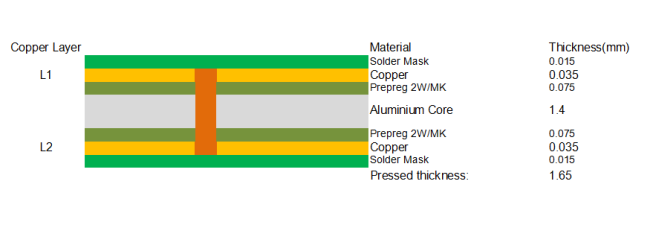
Double-Sided Sandwich Aluminum Substrate
Structural Features:
- The aluminum core is sandwiched in the middle of the PCB.
- Insulating layers (such as PP or PI) are placed on both sides of the aluminum core.
- A copper foil layer is pressed onto each insulating layer, creating two circuit layers.
- Heat is conducted through the aluminum core, which is in direct contact with both sides of the PCB.
Simplified Analogy:
Imagine a "sandwich cookie", where the aluminum core is the filling, and the two copper foil layers are the cookies.
Advantages:
- Efficient heat dissipation on both sides of the PCB.
- Enhanced thermal balance across the entire board.
- Suitable for applications with high power density or where both sides of the PCB generate heat.
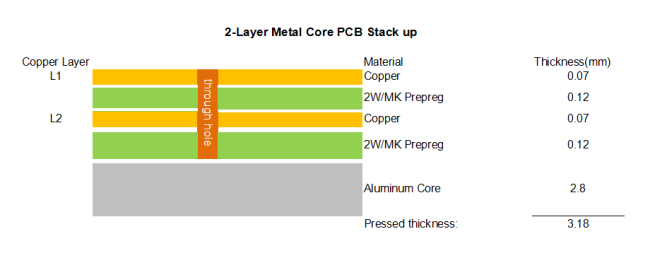
Double-Sided Single-Sided Aluminum Substrate
Structural Features:
- The aluminum core is placed only on one side of the PCB as a heat dissipation layer.
- The other side of the PCB uses standard insulating materials (e.g., FR-4).
- Two copper foil layers are present, but only one side is in contact with the aluminum core, allowing heat dissipation only on that side.
Simplified Analogy:
Think of it as a "double-layered board" where aluminum exists only on one side. The other side has no direct thermal conductivity to the aluminum.
Advantages:
- Lower cost compared to a sandwich structure.
- Suitable for applications where heat generation is concentrated on one side of the PCB.
Comparison Table: Double-Sided Sandwich vs. Single-Sided Aluminum Substrate
| Property | Double-Sided Sandwich Aluminum Substrate | Double-Sided Single-Sided Aluminum Substrate |
| Aluminum Core Placement | In the middle (sandwiched) | On one side only |
| Heat Dissipation | Both sides | One side only |
| Thermal Conductivity Balance | Excellent | Moderate |
| Cost | Higher cost | Lower cost |
| Applications | High-power, high-thermal environments | Cost-sensitive, single-sided heat dissipation |
Conclusion
The Double-Sided Sandwich Aluminum Substrate PCB is an advanced solution for applications demanding efficient heat dissipation and high thermal conductivity. Its sandwich structure with aluminum in the middle allows heat dissipation from both sides, making it ideal for high-power LEDs, power converters, automotive electronics, and industrial control systems.
While single-sided aluminum substrates are cost-effective and sufficient for certain applications, the sandwich aluminum substrate excels in high-performance scenarios, offering better thermal balance and reliability. Choosing the right PCB depends on the specific thermal and electrical requirements of your project!
Get in Touch
Have questions about our products or want to discuss a custom order? Our team is ready to help you.