
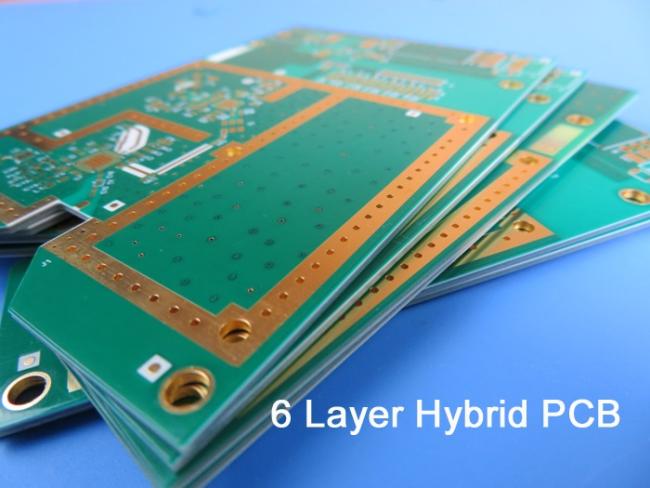
Hybrid PCB 6-layer 2.24mm Tg170 FR-4 and 20mil RO4003C Combined
Hybrid PCBs are characterized by the combination of different materials to achieve specific functionalities or performance characteristics. In the realm of electronics, Hybrid PCBs have emerged as a solution, where diverse requirements can be met by utilizing various materials in different sections of the board. For instance, improved signal integrity in high-frequency sections can be attained by employing specialized materials such as ceramic or Teflon, while standard FR-4 material can be used in other areas.
- The exceptional features and benefits of Hybrid PCBs, achieved through the combination of Tg170 FR-4 and 20mil RO4003C, include:
- Mixed-signal compatibility: Analog and digital signals can be effortlessly accommodated in Hybrid PCBs. Standard circuitry can rely on the reliable substrate provided by the FR-4 portion, while the RO4003C section ensures excellent high-frequency performance for RF/microwave signals.
- High-frequency performance: High-frequency applications benefit from the remarkable properties of the RO4003C material, which exhibits low dielectric loss and excellent signal integrity. This material facilitates efficient signal transmission while minimizing signal loss or distortion.
- Thermal management: The FR-4 material integrated into the Hybrid PCBs possesses good thermal conductivity, enabling effective heat dissipation from components. This feature is particularly advantageous for applications that require robust heat management.
- Design flexibility: Hybrid PCBs offer unparalleled design flexibility by allowing the integration of different technologies and materials. Designers can optimize the layout and material selection, tailoring them to the specific requirements of each PCB section.
- Cost optimization: Hybrid PCBs strike a balance between performance and cost. By selectively utilizing RO4003C in sections that demand high-frequency performance, overall costs can be optimized. The use of the more cost-effective FR-4 material in other areas enhances the economic feasibility of the Hybrid PCB compared to using high-frequency materials throughout the entire board.
- Compatibility: Both Tg170 FR-4 and RO4003C materials are compatible with standard PCB fabrication processes, ensuring ease of manufacturing and assembly.
The Hybrid PCB stackup consists of a 6-layer rigid PCB design, with the following construction details:
- Copper Layer 1: 35 μm
- RO4003C: 0.508 mm (20mil)
- Copper Layer 2: 35 μm
- Prepreg: 0.102 mm
- Copper Layer 3: 35 μm
- Tg170°C FR-4: 0.254 mm
- Copper Layer 4: 35 μm
- Prepreg: 0.102 mm
- Copper Layer 5: 35 μm
- Tg170°C FR-4: 0.508 mm
- Copper Layer 6: 35 μm
The construction of Hybrid PCBs adheres to precision standards, ensuring optimal performance. Key specifications include precise board dimensions, minimum trace/space requirements, appropriate hole sizes, and the use of high-quality finishes and masks. Each Hybrid PCB undergoes a comprehensive electrical test prior to shipment to ensure its quality.
Hybrid PCBs boast impressive statistics, including the number of components, pads, vias, and nets, which contribute to their versatility and functionality across various applications.
Hybrid PCBs are available worldwide, catering to the needs of industries such as telecommunications, defense, automotive, healthcare, industrial automation, and test and measurement.
In conclusion, Hybrid PCBs redefine the boundaries of performance and design flexibility through the fusion of Tg170 FR-4 and 20mil RO4003C. By leveraging the advantages of different materials, Hybrid PCBs offer mixed-signal compatibility, high-frequency performance, thermal management capabilities, design flexibility, cost optimization, and seamless compatibility. With Hybrid PCBs, designers can unlock the full potential of their electronic designs, ensuring superior performance and functionality across a wide array of applications.


Get in Touch
Have questions about our products or want to discuss a custom order? Our team is ready to help you.