
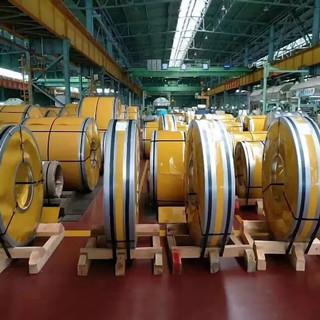
Baosteel Mill Edge 201 Stainless Steel Strips 2B NO.1 For Building
201 Stainless Stee Strips Stainless Steel 201 Strip For Building
201 Stainless Steel Strip Features:
The nickel in grade 201 is lower than 301 and is replaced with a manganese-nitrogen combination allowing this type to develop high yield and tensile strength in the annealed condition. Although the mechanical and corrosion properties are alike, its general uses do not cover the field of the comparative 300 series. 201 stainless steel strip is nonmagnetic when annealed yet slightly magnetic when cold-worked. Resistance to abrasion is favorable.
201 stainless steel strip is normally limited to nearly flat or shallow drawn products such as automotive trim, builder’s hardware comprised of window and door components, flatware, rapid transit cars and trailers.
201 Stainless Steel Strip Chemical Composition (%):
| Element | Minimum percentage | Maximum percentage |
| C | – | 0.15 |
| Si | – | 0.8 |
| Mn | – | 5.5-7.5 |
| P | – | 0.06 |
| S | – | 0.03 |
| Cr | 16 | 18 |
| Ni | 0.8 | 1.5 |
| Cu | 0.8 | 1.5 |
| N | 0.25 |
201 Stainless Steel Strip Mechanical Properties:
| Temper | Tensile Strength | Yield Strength | Elongation | Rockwell | ||
| KSi | MPa | KSi | MPa | in 2 inches % | ||
| 1/2 Hard | 150 | -1034 | 110 | -758 | 10 | C-32 |
| 1/4 Hard | 125 | -862 | 75 | -517 | 20 | C-25 |
| 3/4 Hard | 175 | -1207 | 135 | -931 | 7 | C-37 |
| Annealed | 95 | -655 | 45 | -310 | 40 | B-90 max. |
| Full Hard | 185 | -1276 | 140 | -965 | 5 | C-41 |
201 Stainless Steel Strip Advantages:
1. Corrosion resistance:
Stainless steel strips are resistant to acid, alkali, and salt attack and are generally used in high temperature applications.
2. High temperature oxidation resistance
Stainless steel strip also has high high temperature oxidation resistance, and the oxidation rate of stainless steel strip is also affected by the environment
3. Physical properties
The heat transfer coefficient of stainless steel strip is better than other metals with high thermal conductivity.
201 Stainless Steel Strip Information:
1-1: What is the difference between 201 and 201LN stainless steel strip?
201LN stainless steel was specifically designed for service at lower temperatures. The chemical composition varies slightly to accentuate mechanical properties like toughness and resistance to impact loading, which are critical factors at low temperatures.
Because 201LN stainless steel was specifically designed to provide austenite stability for service at low temperatures, it is often used for applications like pressure vessels, cryogenic, structural, architectural, magnetic and heat resisting components. 201 stainless is more often seen in restaurant equipment, cooking utensils, sinks, automotive trim, and various architectural applications.
1-2: What is austenitic steel?
Austenitic stainless steel is one of the five classes of stainless steels. The other classes of stainless steel are: ferritic, martensitic, duplex and precipitation hardened. These classes are determined by their crystalline structures.
1-3: How do you anneal this grade stainless steel?
It is recommended to anneal 201 stainless at 1,850 – 1,950°F (1,010 – 1,066°C). Then, water quench or rapidly air cool.

Get in Touch
Have questions about our products or want to discuss a custom order? Our team is ready to help you.