
ASTM A179 Extruded Finned Tube With Al1100 Fins For Power Plants & Refineries
ASTM A179 Extruded Finned Tube With Al1100 Fins For Power Plants & Refineries
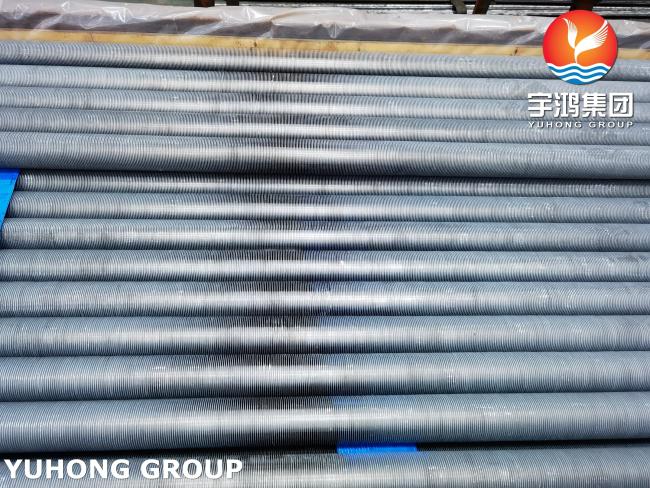
Carbon Steel ASTM A179 Extruded Finned Tube with Al1100 Fins is a specialized heat exchanger component used in various industrial applications. Here's a detailed breakdown:
1. Base Tube Material: ASTM A179 Carbon Steel
ASTM A179 is a standard specification for seamless cold-drawn low-carbon steel tubes, commonly used in heat exchangers and condensers.
(1). Chemical Composition (Weight %)
| Element | Composition (Max %) |
| Carbon (C) | 0.06–0.18 |
| Manganese (Mn) | 0.27–0.63 |
| Phosphorus (P) | 0.035 max |
| Sulfur (S) | 0.035 max |
| Silicon (Si) | 0.10–0.35* |
| Iron (Fe) | Balance |
Notes:
Low carbon content improves weldability and reduces brittleness.
Silicon enhances strength and oxidation resistance.
No significant alloying elements (e.g., chromium, molybdenum), making it unsuitable for high-corrosion environments without coatings.
(2). Mechanical Properties
| Property | Value (Typical) |
| Tensile Strength | 325 MPa (47,000 psi) min |
| Yield Strength | 180 MPa (26,000 psi) min |
| Elongation (in 2") | 35% min |
| Hardness (Rockwell B) | ~72 HRB max |
| Thermal Conductivity | ~51.9 W/m·K (at 20°C) |
Notes:
Cold-drawn process enhances strength and surface finish.
High ductility (35%+ elongation) allows for bending/flaring without cracking.
Low hardness makes it easy to machine or form
(3). Key ASTM A179 Standards
Manufacturing Process: Seamless, cold-drawn.
Size Range: Typically 3/16" to 3" OD, wall thicknesses from 0.015" to 0.165".
Heat Treatment: Usually supplied in the annealed or stress-relieved condition.
(4). Why These Properties Matter for Finned Tubes
- Weldability (Low C%): Ensures compatibility with fin attachment processes.
- Thermal Conductivity: Efficient heat transfer in exchangers.
- Ductility: Resists deformation during fin extrusion or tube expansion
2. Fin Material: Al1100 Aluminum
Al1100 is a commercially pure aluminum (99% minimum Al), known for:
- Excellent thermal conductivity
- Lightweight and corrosion-resistant (forms a protective oxide layer)
- Soft and malleable, making it easy to extrude
3. Manufacturing Process: Extruded Fins
(1). The fins are mechanically bonded to the carbon steel tube using an extrusion process:
A groove is cut into the steel tube.
An aluminum sleeve is placed over the tube.
The assembly is passed through a machine that extrudes (pushes out) the aluminum into fins while creating a tight mechanical bond.
(2). Advantages of Extruded Fins:
- Stronger bond compared to wound or welded fins
- Better heat transfer efficiency
- Resistant to thermal cycling and vibration
4. Key Features & Benefits:
- High Heat Transfer Efficiency: Aluminum fins enhance heat dissipation.
- Corrosion Resistance: Al1100 fins protect against oxidation in harsh environments.
- Lightweight & Durable: Aluminum fins reduce weight while maintaining strength.
- Cost-Effective: More affordable than all-stainless-steel or copper alternatives.
Primary Applications of ASTM A179 Extruded Finned Tube with Al1100 Fins:
The ASTM A179 Extruded Finned Tube with Al1100 Fins is a high-performance heat transfer component widely used in industries where efficient thermal exchange is critical. Below are its key applications, advantages, and industry-specific uses:
A. Heat Exchangers & Condensers
- Shell-and-Tube Heat Exchangers: Enhances heat transfer between fluids (e.g., water, oil, steam) and air/gases.
- Evaporators/Condensers: Used in refrigeration, power plants, and chemical processing.
- Air-Cooled Heat Exchangers (ACHEs): Ideal for oil refineries and gas processing where water cooling is impractical.
B. HVAC & Refrigeration
- Chiller Systems: Improves efficiency in commercial/industrial cooling.
- Heat Recovery Systems: Captures waste heat from exhaust gases or industrial processes.
C. Power Generation
- Boiler Economizers: Recovers heat from flue gases to preheat feedwater.
- Steam Turbine Condensers: Converts exhaust steam back into water efficiently.
D. Petrochemical & Oil Refining
- Process Heaters/Coolers: Manages temperatures in distillation columns and reactors.
- LNG (Liquefied Natural Gas) Plants: Cools gases during liquefaction.
E. Industrial Machinery
- Diesel Engine Intercoolers: Reduces intake air temperature for better combustion.
- Hydraulic Oil Coolers: Maintains optimal oil viscosity in heavy machinery.
Get in Touch
Have questions about our products or want to discuss a custom order? Our team is ready to help you.