
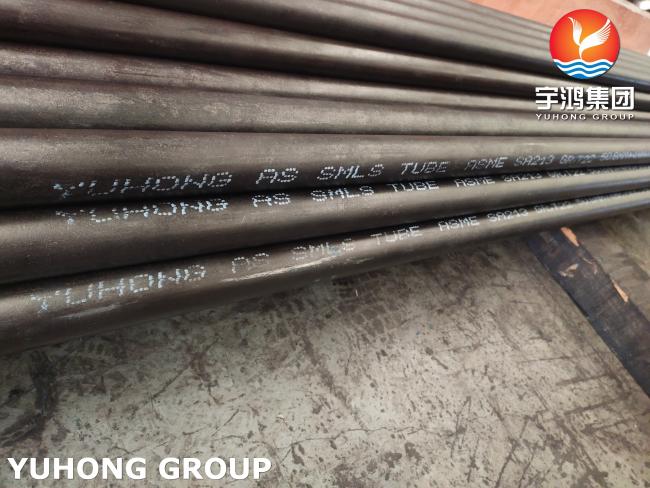
ASTM A213 T22 Low Alloy Steel Seamless Tube For Fired Heaters In Oil Gas Industry
ASTM A213 T22 Low-alloy Steel Seamless Tube For Fired Heaters in Oil&Gas Industry
The ASTM A213 T22 Alloy Steel Seamless Tube is a high-temperature, corrosion-resistant tube primarily used in power plants, boilers, and heat exchangers. Here's a detailed breakdown of its properties, applications, and standards:
1. Material Composition (Chemical Properties)
ASTM A213 T22 is a low-alloy steel with chromium and molybdenum for enhanced strength and oxidation resistance.
| Element | Composition (% Weight) | Role |
| Chromium (Cr) | 1.90 – 2.60 | High-temp oxidation & corrosion resistance |
| Molybdenum (Mo) | 0.87 – 1.13 | Creep strength, high-temp stability |
| Carbon (C) | 0.05 – 0.15 | Strength and hardness |
| Manganese (Mn) | 0.30 – 0.60 | Improves toughness and hardenability |
| Silicon (Si) | 0.50 max | Deoxidizer, enhances strength |
| Phosphorus (P) | 0.025 max | Impurity control |
| Sulfur (S) | 0.025 max | Impurity control |
| Iron (Fe) | Balance | Base material |
Key Notes:
T22 is also known as Grade 22 or 2.25Cr-1Mo steel (per ASME and ASTM standards).
Seamless construction ensures better pressure integrity than welded tubes.
2. Mechanical Properties
| Property | Value | Remarks |
| Tensile Strength | ≥ 415 MPa (60 ksi) | Minimum requirement |
| Yield Strength (0.2% offset) | ≥ 205 MPa (30 ksi) | Minimum requirement |
| Elongation (% in 50 mm) | ≥ 30% | Ductility indicator |
| Hardness (Brinell) | ≤ 163 HB | Typically in annealed condition |
High-Temp Performance:
Operating Temp: Up to 593°C (1100°F) for long-term service (e.g., boilers).
Creep Resistance: Excellent due to Cr-Mo alloying.
Oxidation Resistance: Forms a protective Cr₂O₃ layer at high temps.
3. Why Choose ASTM A213 T22?
✅ Cost-Effective: Cheaper than stainless steels (e.g., 304H, 347H) but offers good high-temp performance.
✅ Proven Reliability: Widely used in power plants for decades.
✅ Weldability: Easier to weld than higher-alloy steels (requires pre/post-weld heat treatment).
4. Comparison with Similar Grades
| Grade | Cr Content | Mo Content | Max Temp | Key Difference |
| T22 (2.25Cr-1Mo) | 2.25% | 1% | 593°C | Balanced cost/performance |
| T5 (5Cr-0.5Mo) | 5% | 0.5% | 650°C | Better oxidation resistance |
| T9 (9Cr-1Mo) | 9% | 1% | 650°C | Superior creep strength |
| T91 (9Cr-1Mo-V-Nb) | 9% | 1% + V/Nb | 700°C | Advanced creep resistance |
5. Fabrication & Heat Treatment
Hot/Cold Working: Can be formed but requires annealing after severe deformation.
Welding:
Preheat: 200–300°C (392–572°F) to avoid cracking.
Post-Weld Heat Treatment (PWHT): 675–760°C (1247–1400°F) to relieve stresses.
Annealing: Typically at 730–760°C (1350–1400°F) for optimal ductility.
6. Standards & Certifications
ASTM A213: Covers seamless ferritic/austenitic steel tubes for boilers and heat exchangers.
ASME SA213: Identical to ASTM A213 but for ASME Code compliance (e.g., pressure vessels).
Other Related Standards:
ASTM A335 P22: For seamless pipes (similar composition but larger diameters).
EN 10216-2 10CrMo9-10: European equivalent.
ASTM A213 T22 seamless tubes are workhorses in high-temperature, moderate-corrosion environments, especially in power and petrochemical industries. They balance cost, strength, and durability but may require upgrades (e.g., T9, T91) for more aggressive conditions.
The ASTM A213 T22 seamless tube is a chromium-molybdenum (2.25Cr-1Mo) alloy steel tube designed for high-temperature and high-pressure applications, particularly in power plants, refineries, and petrochemical industries. Below are its key applications, advantages, and operational environments:
1. Power Generation (Boilers & Steam Systems)
a. Boiler Tubes
- Superheaters & Reheaters:
- Handles high-pressure steam (up to 593°C / 1100°F) in coal-fired and gas-fired power plants.
- Resists oxidation and creep deformation under cyclic thermal stress.
- Water Walls & Economizers:
- Used in the furnace section of boilers where temperatures are lower but pressure is extreme.
b. Steam Piping
- Transports high-energy steam from boilers to turbines.
- Prefered over carbon steel due to superior creep resistance at elevated temps.
2. Oil & Gas Industry
a. Refinery Heat Exchangers
- Resists sulfur corrosion in crude oil refining processes (e.g., hydrocrackers, cokers).
- Handles H₂S-containing environments better than carbon steel.
b. Fired Heaters
- Tubes exposed to direct flame impingement (e.g., in refinery furnaces).
- Cr-Mo alloy provides scale resistance at high temps.
3. Petrochemical & Chemical Processing
- Catalytic Reformer Units:
- Withstands hydrogen-rich environments at high temps (~500°C).
- Ethylene Crackers:
- Used in convection sections where temps are moderate but corrosion is a concern
4. General Industrial Heat Exchangers
- Shell-and-tube heat exchangers for processes requiring moderate corrosion resistance and high strength.
- Common in paper mills, fertilizer plants, and LNG facilities.
Get in Touch
Have questions about our products or want to discuss a custom order? Our team is ready to help you.