
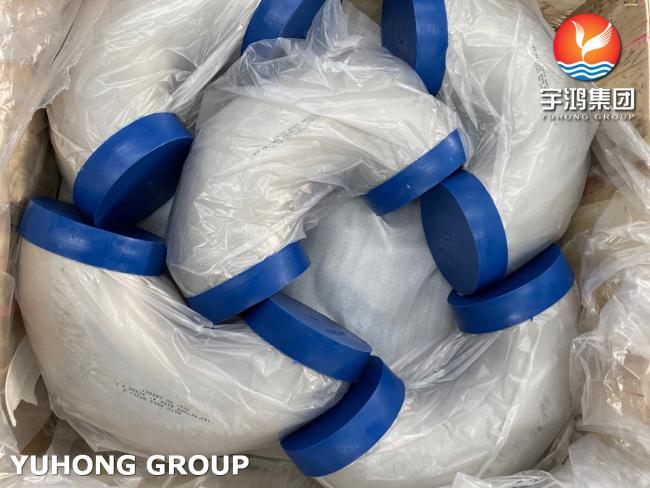
ASTM A403 WP304L-S Stainless Steel 180 Degree Return Bend For Tube Bundles
ASTM A403 WP304L-S Stainless Steel 180 Degree Return Bend For Tube Bundles
180 degree return bend is a pre-fabricated, high-quality stainless steel pipe fitting shaped like a tight "U" that changes the direction of flow in a piping system by 180 degrees. It's designed for use in high-pressure and high-temperature systems, commonly found in chemical plants, refineries, and power generation.
Here are some detailed breakdowns of A403 WP304L-S 180 Degree Return Bend:
1. Material: ASTM A403 WP304L-S
(1) Chemical Composition:
| Element | Weight % (Minimum) | Weight % (Maximum) |
| Carbon (C) | - | 0.030 |
| Manganese (Mn) | - | 2.00 |
| Phosphorus (P) | - | 0.045 |
| Sulfur (S) | - | 0.030 |
| Silicon (Si) | - | 0.75 |
| Chromium (Cr) | 18.00 | 20.00 |
| Nickel (Ni) | 8.00 | 12.00 |
| Nitrogen (N) | - | 0.10 |
| Iron (Fe) | Balance | Balance |
(2) Mechanical Properties
The mechanical properties define how the material performs under load. These are required minimums from test coupons.
| Property | Requirement |
| Tensile Strength | ≥ 70 ksi (≥ 485 MPa) |
| Yield Strength (0.2% Offset) | ≥ 25 ksi (≥ 170 MPa) |
| Elongation in 2 Inches | ≥ 35% |
(3) The advantages of using ASTM A403 WP304L for a 180-degree return bend are significant :
- Superior Weldability and Corrosion Resistance at Welds
- Excellent Corrosion Resistance
- High Ductility and Formability
- Mechanical Strength and Pressure IntegrityCost-Effectiveness and Availability
2. Advantages (Benefits from the Features) of 180 Deg Return Bend
- Superior Structural Integrity & Reliability
- Compact Design and Space Savings
- Reduced Pressure Drop and Improved Flow
- Resistance to Erosion, Corrosion, and Fatigue
- Economic and Installation Efficiency
- Predictable Performance and Dimensional Consistency
The application of A403 WP304L-S 180 Degree Return Bend:
1. Heat Exchangers and Shell & Tube Units
This is one of the most classic applications. Return bends are used to fabricate the "tube bundles" or "hairpins" inside heat exchangers.
2. Heating and Cooling Coils
Similar to heat exchangers, these are coils used in tanks, vessels, or furnaces to either heat or cool a substance.
- Examples:
- Immersion Coils: submerged in a tank to heat its contents (e.g., in a chemical processing tank).
- Cryogenic Coils: for cooling applications (304L performs well at low temperatures).
3. Complex Piping Systems with Space Constraints
In tight pipe racks or complex plant layouts, a 180-degree return bend is often the most efficient way to reverse the flow direction when space is too limited to use two 90-degree elbows with a straight pipe in between.
4. Pig Launcher/Receiver Systems
In pipelines that use "pigs" for cleaning or inspection, the piping assemblies for launching and receiving the pig often require a very compact flow path to divert the pig into a trap. Return bends can be part of this specialized valving.
5. Industrial Process Piping
Any process that requires a flow reversal can use this fitting. This is common in:
- Chemical and Petrochemical Plants: Handling corrosive acids, solvents, and other process streams
- Oil & Gas Refineries: For refining processes where corrosion resistance is key.
- Pharmaceutical and Food & Beverage Industries: Where hygiene, cleanability, and corrosion resistance (from cleaning agents and product) are mandatory. 304L is very common here.
- Power Generation: In boiler feedwater systems, cooling systems, and other auxiliary lines.
Get in Touch
Have questions about our products or want to discuss a custom order? Our team is ready to help you.