
ASTM A333 Gr.6 Carbon Steel Low Finned Tube For Low-Temperature Environments
ASTM A333 Gr.6 Carbon Steel Low Finned Tube For Low-Temperature Environments
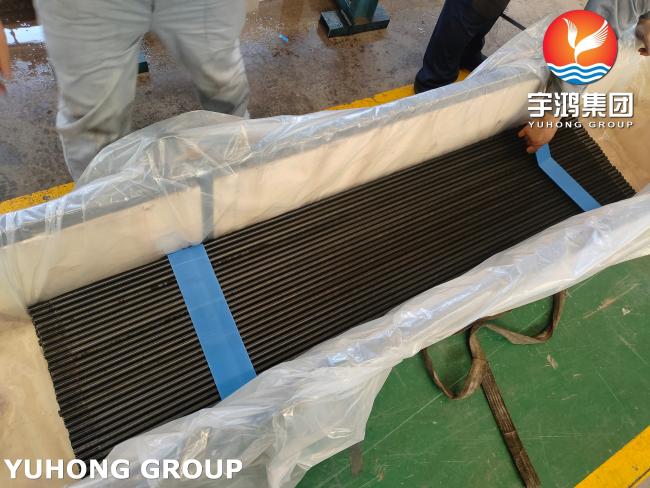
An ASTM A333 GR.6 Low Finned Tube is a specialized carbon steel tube designed for heat transfer in low-temperature environments. Its key feature is an external surface with integral, machined fins that dramatically increase its surface area, making heat exchange much more efficient than a plain (smooth) tube. The "Low Temperature" grade ensures it remains tough and resistant to brittle fracture even in sub-zero conditions.
Here are some detailed breakdowns:
1. Base Tube: ASTM A333 GR.6
(1). ASTM A333 Grade 6: Chemical Composition
The composition is primarily a carbon-manganese steel with controlled silicon content, designed for good low-temperature toughness.
| Element | Composition (%) |
| Carbon (C) | 0.30 max |
| Manganese (Mn) | 0.29 - 1.06 |
| Phosphorus (P) | 0.025 max |
| Sulfur (S) | 0.025 max |
| Silicon (Si) | 0.10 min † |
Note on Silicon (Si): The specification requires a minimum of 0.10% Silicon for killed steel (which A333 Gr.6 typically is). The maximum limit is often governed by the supplementary requirement for notch toughness.
(2). ASTM A333 Grade 6: Mechanical Properties
These properties ensure the strength and, most critically, the toughness at low temperatures.
| Property | Value |
| Tensile Strength, min. | 415 MPa (60,000 psi) |
| Yield Strength, min. | 240 MPa (35,000 psi) |
| Elongation, min. | • For longitudinal strips: 25% in 2 in. (50 mm) • For transverse strips: 1.25 * (Calculated value from standard) |
| Hardness, max. | Not specified in the base standard, but typically ~ 170 HBW. |
| Key Charpy V-Notch Impact Test | |
| Test Temperature | -45°C (-50°F) |
| Minimum Avg. for 3 Specimens | 18 J (13 ft·lbf) |
| Minimum for One Specimen | 14 J (10 ft·lbf) |
Key Takeaways from the Data:
- Low Carbon & Controlled Manganese: This combination provides good weldability and strength while promoting fine-grained microstructure, which is essential for toughness.
- Low Impurities: Strict limits on Phosphorus and Sulfur minimize segregation and improve notch toughness.
- Mandatory Impact Testing: The core of the A333 specification. The material must demonstrate it can absorb significant energy at -45°C (-50°F) without brittle fracture, making it suitable for low-temperature and cryogenic service.
2. Low Finned Tube
This is the key differentiator from a standard pipe. A low finned tube is created by mechanically machining a pattern of fins onto the outer surface of a plain tube.
Fin Profile: "Low" refers to the fin height being relatively short compared to the tube's wall thickness. They are typically integral (made from the tube's own material, not attached) and have a trapezoidal shape.
Purpose: The sole reason for the fins is to increase the effective outside surface area. This is crucial because the heat transfer coefficient on the outside of a tube (e.g., from gas or air) is often much lower than on the inside (from a liquid like water).
How it Works:
- Inside the tube: A fluid with high heat transfer capacity (like water or a process liquid) flows.
- Outside the tube: A fluid with low heat transfer capacity (like air, flue gas, or a refrigerant vapor) flows across the finned exterior.
The fins break up the boundary layer of the outside fluid and provide a much larger area for heat to flow from the tube wall to the outside fluid (or vice versa).
3. Key Characteristics and Advantages
- High Efficiency: Can increase heat transfer capacity by 5 to 7 times compared to a plain tube of the same base length and diameter.
- Compact Design: Allows for the design of smaller, more compact heat exchangers for the same duty, saving space and cost.
- Material Integrity: The fins are integral (machined from the parent tube), so there is no risk of them loosening or falling off due to thermal cycling, unlike wrapped or welded fins
- Low-Temperature Toughness: The A333 Gr.6 material ensures the tube will not become brittle and fail in cryogenic or low-temperature services.
The primary application of ASTM A333 GR.6 Low finned tube is in shell and tube heat exchangers where the process requires efficient heat transfer with a fluid that has a low heat transfer coefficient, and the operating environment is at low temperatures.
Here is a detailed breakdown of the specific applications and the why behind them:
Primary Application Areas
1. Oil, Gas, and Petrochemical Industry
This is the most common application area for these tubes.
- Gas Processing Plants (Natural Gas):
- Application: Used in gas coolers, dehydrator reboiler coolers, and refrigerant evaporators/condensers.
- LNG (Liquefied Natural Gas) Plants:
- Application: In pre-cooling stages and various sub-cooling heat exchangers.
2. Refrigeration and Cryogenic Plants
Application: Used as the heat transfer tube in evaporators and condensers for large-scale industrial refrigeration systems (e.g., in chemical plants, food processing, or cold storage facilities) and in plants producing/using liquid nitrogen, oxygen, or argon.
3. Power Generation
Application: In surface condensers and lube oil coolers, especially in colder climates or where the cooling medium is air.
4. Chemical and Process Industries
Application: In various coolers, chillers, and condensers for processes involving gases like hydrogen, carbon dioxide, or ethylene.
Get in Touch
Have questions about our products or want to discuss a custom order? Our team is ready to help you.