
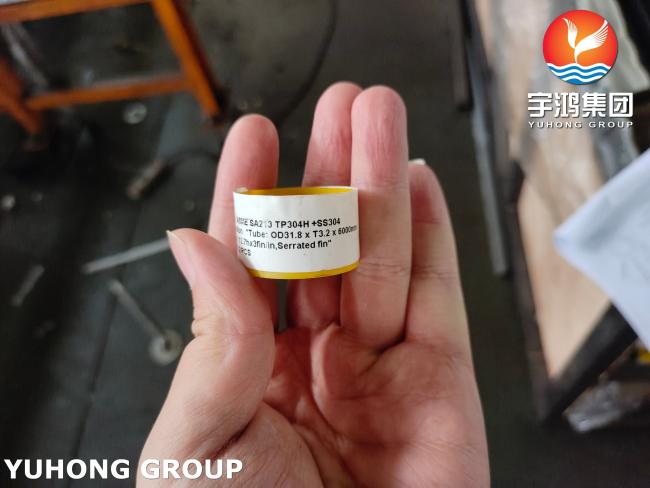
ASME SA213 TP304H Serrated Finned Tube with SS304 Fins For HRSGs and Boilers
ASME SA213 TP304H Serrated Finned Tube with SS304 Fins For HRSGs and Boilers
An ASME SA213 TP304H Serrated Finned Tube with SS304 Fins is a premium, high-efficiency component critical for the performance and reliability of modern industrial boilers and heat recovery systems.
Here are some detailed breakdowns:
1. Base Tube: ASME SA213 TP304H seamless tubes
(1). Chemical Composition (Weight %)
The composition is defined in the ASME SA-213 specification. The following are the required percentages, presented as either a maximum or a controlled range.
| Element | Composition Requirement (%) | Notes & Importance |
| Carbon (C) | 0.04 - 0.10 | This is the key difference from TP304. The controlled minimum carbon is essential for high-temperature creep strength. |
| Manganese (Mn) | 2.00 max | Aids in hot workability and strength. |
| Phosphorus (P) | 0.045 max | An impurity that reduces toughness and must be controlled. |
| Sulfur (S) | 0.030 max | An impurity that can cause brittleness at high temperatures; must be minimized. |
| Silicon (Si) | 0.75 max | Increases strength and oxidation resistance. |
| Chromium (Cr) | 18.00 - 20.00 | Provides oxidation and corrosion resistance by forming a protective oxide layer. |
| Nickel (Ni) | 8.00 - 11.00 | Stabilizes the austenitic crystal structure, providing ductility and toughness. |
| Nitrogen (N) | 0.10 max | Can increase strength, but is controlled to prevent embrittlement. |
The defining feature of the "H" grade is its controlled carbon content (0.04-0.10%), which is crucial for maintaining strength at elevated temperatures.
(2). Mechanical Properties (at Room Temperature)
These properties are for the material in the solution-annealed (softened) condition, as required by the standard.
| Property | Requirement | Test Standard |
| Tensile Strength | ≥ 515 MPa (75,000 psi) | ASTM A370 |
| Yield Strength (0.2% Offset) | ≥ 205 MPa (30,000 psi) | ASTM A370 |
| Elongation in 2 inches (50.8 mm) | ≥ 35% | ASTM A370 |
2. Finned Tube Type: Serrated Finned Tube
Serrated Fins: These are not smooth, continuous fins. They are cut at intervals to create a serrated or segmented pattern.
Advantages:
- Disrupted Boundary Layer: The serrations disrupt the stagnant boundary layer of gas on the fin surface, significantly enhancing turbulence and heat transfer efficiency.
- Reduced Weight: They use less material than solid fins for a similar height.
- Prevents Fin Overheating: In very high-temperature gas streams, serrations can help reduce the risk of the fin tips overheating and oxidizing excessively.
3. Fins Material: SS304 Fins
This specifies the material of the fins.
SS304: This is standard 304 Stainless Steel (without the "H" grade requirement). It offers excellent resistance to oxidation and corrosion from the flue gases. Since the fins are not pressure-retaining parts, they do not need the stringent high-temperature strength (creep) properties of the "H" grade tube. Using SS304 provides a good balance of performance, cost, and manufacturability.
4. How it made?
This tube is manufactured by a process called high-frequency welding (HFW). A strip of SS304 is fed into a machine that wraps it helically around the SA213 TP304H base tube. As it is wound, a high-frequency electrical current is applied, which heats and fuses the fin root to the tube wall, creating a strong, metallurgical bond with high thermal conductivity.
5. Key Advantages Summary
- High-Temperature Strength: The SA213 TP304H base tube can withstand high internal pressure and temperature (creep).
- Excellent Heat Transfer: The serrated fin design maximizes heat extraction from hot gases.
- Oxidation & Corrosion Resistance: Both the tube and fin materials resist scaling and degradation from flue gases.
- Long Service Life: The robust construction and material selection ensure reliability in demanding, continuous operations.
Primary Application: Boiler Superheaters and Reheaters
This is the most classic and critical use case, typically found in:
- Coal-fired, Biomass, and Waste-to-Energy Power Plants
- Large Industrial Boilers
Other Key Applications
1. Heat Recovery Steam Generators (HRSGs)
Used In: Combined cycle power plants.
Function: Captures waste heat from the exhaust of a gas turbine (which is still very hot, ~500-600°C / ~930-1100°F).
2. Process Heaters & Furnaces
Used In: Oil refineries, petrochemical, and chemical plants.
Function: Heats process fluids (e.g., hydrocarbons) to specific reaction temperatures.
3. Waste Incineration Boilers
Function: Generates steam from the heat produced by burning municipal or industrial waste.
4. Economizers
Function: Pre-heats the boiler feedwater using the leftover heat from the flue gas before it exits the stack.
Get in Touch
Have questions about our products or want to discuss a custom order? Our team is ready to help you.