
ASTM A335 P9 Studded Tube With 11-13Cr Stud Fins For Gas Turbine Power Plants
ASTM A335 P9 Studded Tube With 11-13Cr Stud Fins For Gas Turbine Power Plants
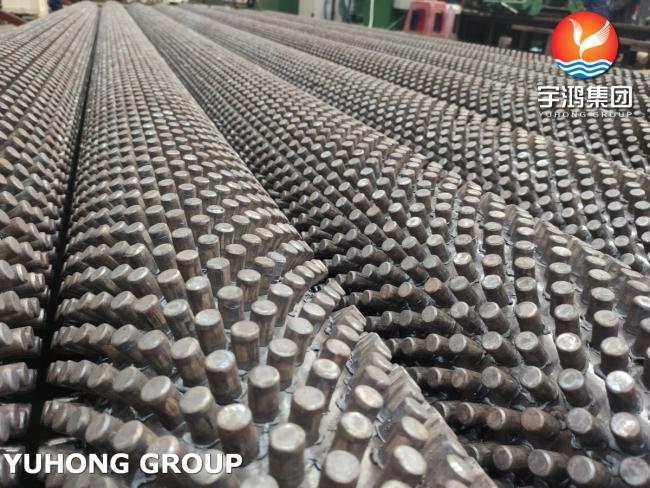
The ASTM A335 P9 Studded Tube with 11-13Cr Stud Fins is a high-grade, engineered component that optimizes heat transfer and longevity in aggressive industrial environments. The P9 tube provides the pressure integrity, while the higher-chromium studs ensure the extended surface survives the harsh external conditions, making it a cost-effective and reliable solution for critical heat exchange duties.
Here are the component breakdowns:
1. Base Tube-ASTM A335 P9 seamless tube
(1). ASTM A335 P9: Chemical Composition
| Element | Composition (%) |
| Carbon (C) | 0.15 max |
| Manganese (Mn) | 0.30 - 0.60 |
| Phosphorus (P) | 0.025 max |
| Sulfur (S) | 0.025 max |
| Silicon (Si) | 0.50 - 1.00 |
| Chromium (Cr) | 8.00 - 10.00 |
| Molybdenum (Mo) | 0.90 - 1.10 |
Notes:
Single values are maximum unless shown as a range.
Balance is Iron (Fe) and residual elements.
(2). ASTM A335 P9: Mechanical Properties (Room Temperature)
| Property | Requirement | Test Standard |
| Tensile Strength | ≥ 415 MPa (60,000 psi) | ASTM A370 |
| Yield Strength | ≥ 205 MPa (30,000 psi) | ASTM A370 |
| Elongation (in 50 mm / 2 in.) | ≥ 30% | ASTM A370 |
Heat Treatment Requirement:
All A335 P9 pipe is supplied in the fully annealed or normalized and tempered condition to ensure proper microstructure and high-temperature performance.
2. Studded / Stud Fins
Form: These are short, cylindrical rods (studs) that are resistance welded onto the tube's outer surface in a precise pattern (often staggered).
Function: They act as extended surfaces (fins), disrupting the flow of hot gas and pulling heat into the tube wall more effectively compared with a bare tube.
3. 11-13Cr Stud Material
This is the critical, high-performance feature. The studs themselves are made from a stainless steel containing 11% to 13% Chromium.
The studs are directly exposed to the most severe environment—the hot, often corrosive, flue gas. They need superior oxidation and corrosion resistance compared to the P9 base tube.
The 11-13% Cr content forms a more stable and protective chromium oxide layer at very high temperatures.
This prevents the studs from rapidly oxidizing (scaling), corroding, or "burning off," which would lead to a catastrophic loss of heat transfer efficiency.
Common grades for these studs include types like 409, 410, or 405 stainless steel.
4. Key Characteristics and Advantages
- High Heat Transfer Efficiency: The studded design can increase the effective heat-absorbing surface area by 6 to 10 times compared to a bare tube.Durability in Harsh Environments: The combination of a strong, creep-resistant base tube (P9) with highly oxidation-resistant studs (11-13Cr) makes it durable in abrasive and corrosive flue gas.
- Reduced Equipment Size: By achieving higher efficiency per tube, the overall size of the heat exchanger (e.g., boiler, HRSG) can be smaller and more cost-effective.
- Erosion Resistance: The studded pattern can help protect the base tube from direct fly ash erosion in coal-fired boilers.
Primary Applications & Environments
1. Heat Recovery Steam Generators (HRSGs) in Combined Cycle Power Plants
Function: The tube is exposed to exhaust from a gas turbine (typically 500°C - 600°C / 930°F - 1110°F). The studded surface maximizes heat pickup to generate saturated steam, which is then sent to the superheater.
2. Waste Heat Boilers (WHBs) in Process Industries
Industries: Petrochemical, Refining, Sulfur Recovery (Claus plants), Chemical, and Metallurgical.
Function: Captures heat from process furnace or reactor exhaust to generate steam for plant use or electricity.
Why Used Here? Flue gases can contain corrosive elements like sulfur compounds, vanadium, or alkalis. The 11-13Cr stud material provides much better corrosion resistance than carbon or low-alloy steel studs, extending tube bundle life in these chemically complex streams.
3. Fossil Fuel Power Plant Boilers
Specific Areas:
Furnace Division Walls: Walls that separate different sections of the boiler furnace.
Furnace Rear Pass / Convection Zones: Areas where gas temperatures are high but below the radiant furnace zone
Function: Acts as an evaporator surface to absorb convective heat.
4. Fluidized Bed Boilers (CFB & BFB Boilers)
Location: In-bed evaporator tubes or walls immersed in the fluidized bed.
Function: The tubes absorb heat directly from the intensely mixed, high-temperature bed of solid particles (coal, sorbent, ash).
Get in Touch
Have questions about our products or want to discuss a custom order? Our team is ready to help you.