
ASTM A335 P22 Studded Tube With 11Cr Stud Fins For Furnace Walls and Roofs
ASTM A335 P22 Studded Tube With 11Cr Stud Fins For Furnace Walls and Roofs
An ASTM A335 P22 Studded Tube with 11Cr Stud Fins is a high-performance engineered component designed for extreme service. It consists of:
- A pressure-bearing tube made of chrome-molybdenum alloy steel (P22) for high-temperature strength
- Studs or fins welded to its exterior, made of 11% chromium steel for superior corrosion and oxidation resistance.
- Its primary function is to securely anchor a refractory lining and maximize heat transfer in aggressive, high-temperature industrial environments like process heaters and boilers, ensuring long service life and reliability.
1. Base Tube: ASTM A335 P22 seamless pipes
(1). Chemical Composition
| Element | Composition (%) - Product Analysis (Heat analysis is slightly different) |
| Carbon (C) | 0.05 - 0.15 |
| Manganese (Mn) | 0.30 - 0.60 |
| Phosphorus (P) | 0.025 max |
| Sulfur (S) | 0.025 max |
| Silicon (Si) | 0.50 max |
| Chromium (Cr) | 2.00 - 2.50 |
| Molybdenum (Mo) | 0.87 - 1.13 |
(2). Mechanical Properties
These are the minimum requirements for the finished seamless pipe in the normalized and tempered heat-treated condition.
| Property | Value (Minimum) | Notes / Test Standard |
| Tensile Strength | 415 MPa (60,000 psi) | |
| Yield Strength (0.2% offset) | 205 MPa (30,000 psi) | |
| Elongation in 2 inches (50.8 mm) | See formula below | For walls ≤ 0.75 in: 30% min For walls > 0.75 in: 28% min |
| Elongation (Alternative Formula) | Longitudinal: El% = 625000 x A⁰·² / UTS⁰·⁹ Transverse: El% = 310000 x A⁰·² / UTS⁰·⁹ |
Where: A = cross-sectional area (in²), UTS = tensile strength (psi). Governs when it gives a higher minimum than the fixed percentage. |
| Hardness | Typically ≤ 197 Brinell HBW | Often specified to ensure weldability and ductility. |
2. Studded Tube (The Design)
This describes the physical form.
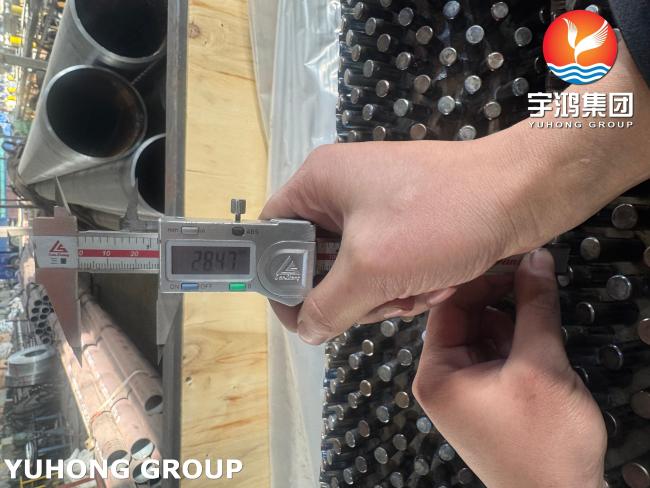
Instead of being a smooth pipe, the outer surface has studs (small, cylindrical pins) welded on in a regular pattern.
The purpose of these studs is to act as an anchor or reinforcement for a lining or coating, significantly increasing the surface area for heat transfer.
3. 11Cr Stud Fins (The Critical Feature)
This is the most specialized part of the specification.
11Cr: Stands for 11% Chromium. This is a martensitic stainless steel alloy (like Grade 410, but often a proprietary variant).
Stud Fins: shaped more like short, robust fins or pins.
Why 11Cr? The base tube (P22) is chosen for its high-temperature strength in the tube metal temperature range. However, the studs/fins themselves are exposed to an even harsher environment—the hot flue gas or firebox atmosphere, which can be highly corrosive due to sulfur, vanadium, and other combustion by-products.
- P22 studs would oxidize (scale) and corrode too quickly in this environment, leading to failure.
- 11% Chromium steel provides vastly superior corrosion resistance and oxidation resistance at high temperatures compared to P22. It forms a stable, protective chromium oxide layer.
- The Combination: By welding 11Cr studs onto a P22 tube, engineers get the best of both worlds: the cost-effective, strong base tube (P22) for pressure integrity, and highly corrosion-resistant studs (11Cr) to survive the aggressive external atmosphere.
Primary Applications
1. Petrochemical & Refinery Process Heaters (Fired Heaters)
This is the most common application.
Location: The radiant section/firebox walls and roof of heaters like:
- Crude Oil Heaters
- Vacuum Heaters
- Reformer Heaters (Hydrogen production)
- Coker Heaters
- Cracking Heaters
Role: They form the waterwall or steam-generating wall of the firebox. The studded/refractory lining:
Protects the tube from direct flame impingement and peak radiant heat, keeping the tube metal temperature within P22's safe limit.
Absorbs and transfers enormous amounts of heat to generate high-pressure steam or superheat process fluids.
Withstands the corrosive atmosphere from burning refinery fuel gas/oil, which contains sulfur and other contaminants.
2. Ethylene Cracking Furnaces
Location: The radiant coil section walls (the "firebox").
Role: These tubes form the walls surrounding the reaction coils where ethane or naphtha is cracked into ethylene at extreme temperatures (1500°F+ / 815°C+). They protect the structure and recover waste heat to produce steam, a critical utility for the plant.
3. Power Generation - Waste Heat Recovery (HRSG) & Specialty Boilers
Location: In Heat Recovery Steam Generators (HRSGs) following gas turbines in refineries or chemical plants, especially when firing supplemental (duct) burners.
Role: Used in the evaporator sections exposed to the hottest flue gas, particularly when the fuel may have corrosive elements.
Circulating Fluidized Bed (CFB) Boilers: For walls in areas subject to high erosion and moderate corrosion, the studded refractory lining provides excellent protection.
4. Carbon Black & Syngas Production Units
Location: Reactor walls in processes involving the pyrolysis or partial oxidation of hydrocarbons.
Role: These environments are exceptionally harsh, with high temperatures and potentially reducing atmospheres. The 11Cr studs and refractory lining are essential for longevity.
Get in Touch
Have questions about our products or want to discuss a custom order? Our team is ready to help you.