
ASTM A269 TP316L Stainless Steel Corrugated Tube For Oil & Gas Refineries
ASTM A269 TP316L Stainless Steel Corrugated Tube For Oil & Gas Refineries
In essence, an ASTM A269 TP316L Stainless Steel Corrugated Tube is a high-performance, flexible metal tube made from a superior low-carbon stainless steel alloy. Its compliance with ASTM A269 ensures material quality and traceability, while its corrugated form provides essential flexibility for piping systems that must handle movement, vibration, and thermal changes in corrosive or demanding environments.
1. Base Tube: ASTM A269 TP316L seamless tubes
(1) Chemical Composition (Weight %)
The composition ensures corrosion resistance, weldability, and austenitic structure stability.
| Element | Minimum (%) | Maximum (%) | Key Role |
| Carbon (C) | - | 0.030 | The "L" (Low Carbon) grade. Kept very low to prevent sensitization (chromium carbide precipitation) during welding, preserving corrosion resistance in the heat-affected zone. |
| Manganese (Mn) | - | 2.00 | Austenite stabilizer, aids hot workability. |
| Phosphorus (P) | - | 0.045 | Impurity, kept low for toughness. |
| Sulfur (S) | - | 0.030 | Impurity, affects machinability if too high/low. |
| Silicon (Si) | - | 0.75 | Deoxidizer during steelmaking. |
| Chromium (Cr) | 16.0 | 18.0 | Primary element for corrosion resistance. Forms the passive, protective chromium oxide layer on the surface. |
| Nickel (Ni) | 10.0 | 14.0 | Austenite stabilizer, provides ductility, toughness, and enhances resistance to certain acids. |
| Molybdenum (Mo) | 2.00 | 3.00 | The key differentiator from 304/304L. Dramatically increases resistance to pitting and crevice corrosion, especially in chloride-containing environments. |
| Nitrogen (N) | - | 0.10 | Strengthens austenite; controlled level. |
| Iron (Fe) | Balance | Balance | Base metal. |
Note: The standard may allow for slightly different ranges for certain elements if other supplementary requirements are specified.
(2). Mechanical Properties
These are the minimum required properties for the finished, annealed tubing.
| Property | Requirement (Minimum) | Notes / Test Standard |
| Tensile Strength | 70 ksi (485 MPa) | The force per unit area required to break the material. |
| Yield Strength (0.2% Offset) | 25 ksi (170 MPa) | The stress at which the material begins to deform plastically (permanently). A key design parameter for pressure-containing components. |
| Elongation in 2 inches (50.8 mm) | 35% | A measure of ductility. The percentage the material can stretch before fracture. Essential for formability (including corrugation) and indicating good toughness. |
| Hardness (Rockwell B) | 90 HRB | Maximum allowable hardness for annealed condition. Ensures the material is soft enough for further fabrication and indicates proper annealing. |
| Hydrostatic Test Pressure | Required | Each tube must withstand a hydrostatic test pressure (or non-destructive electric test) as specified by the standard to ensure leak-tight integrity without rupture. |
| Flaring Test / Flattening Test | Required | Specific tests (depending on tube dimensions) to demonstrate ductility and soundness of the weld (if welded tubing is used). |
2. Fin Type: Corrugated Finned Tube
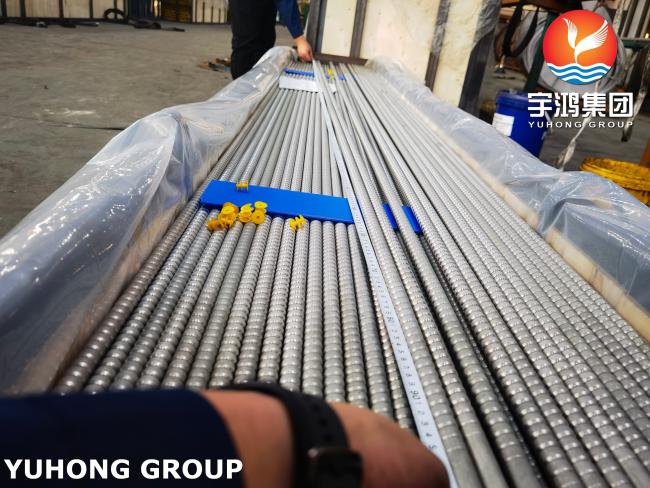
This describes the physical form. Unlike straight, smooth-walled tubing, a corrugated tube has a flexible, bellows-like structure made up of a series of alternating convex and concave corrugations .
It is a new type of high efficiency heat exchange tube instead of the row tube. It has the advantages of strong corrosion resistance and longer service life.
3. Key Characteristics & Advantages
- Flexibility & Movement: The primary purpose of the corrugation is to provide flexibility. It can absorb thermal expansion/contraction, compensate for misalignment, and relieve stress on connections.
- Corrosion Resistance (Excellent): Thanks to the TP316L grade, it offers excellent resistance to a wide range of chemicals, acids, and chlorides. The low carbon content makes it ideal for welded assemblies where the heat-affected zone must retain corrosion resistance.
- Pressure Tightness: When assembled with end fittings (ferrules, nuts), it forms a leak-tight conduit for fluids or gases.
- Vibration Damping: The flexible structure can absorb and dampen vibrations from pumps, compressors, or engines.
- Durability & Strength: Stainless steel provides high tensile strength and fatigue resistance, allowing the tube to withstand repeated flexing cycles.
- Temperature Resistance: Suitable for a broad range of temperatures, from cryogenic levels up to several hundred degrees Celsius (exact limits depend on pressure and media).
4. Typical Applications
This specific combination of standard, grade, and form makes it a premium component in critical, corrosion-prone, or hygienic applications:
- Instrumentation & Process Control: For connecting pressure gauges, transmitters, and valves in chemical plants, refineries, and offshore platforms (often called "impulse lines" or "gauge lines").
- Semiconductor Manufacturing: In ultra-high-purity gas and chemical delivery systems where corrosion and particle generation must be avoided.
- Pharmaceutical & Biotech: In process piping for purified water, WFI (Water for Injection), and clean steam, where hygiene and corrosion resistance are paramount.
- Food & Beverage: For sanitary processing lines requiring cleanability and resistance to cleaning agents.
- Heat Exchangers & HVAC: As flexible connectors for chillers, boilers, and pumps.
- Laboratory & Analytical Equipment: For flexible connections in sensitive instruments.
Get in Touch
Have questions about our products or want to discuss a custom order? Our team is ready to help you.