
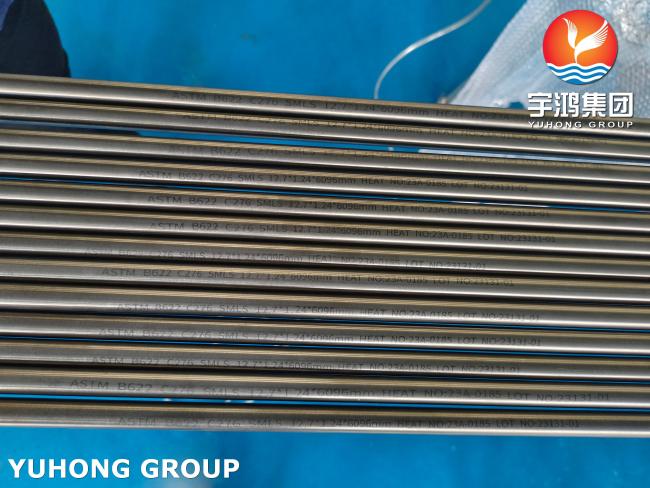
ASTM B622 Hastelloy C276 / UNS N10276 Nickel Alloy Steel Seamless Tube Heat Exchanger Tube
ASTM B622 Hastelloy C276 Tube UNS N10276 Nickel Alloy Steel Seamless Heat Exchanger Tube
Why C276 for Heat Exchangers?
This material is selected when standard stainless steels (304/316) or even higher grades like Alloy 625 or 825 fail. It offers:
-
Uniform Corrosion: Resistant to a wide range of aggressive chemicals, including sulfuric acid, hydrochloric acid, wet chlorine, formic and acetic acids.
-
Pitting & Crevice Corrosion: High Pitting Resistance Equivalent Number (PREN) ensures survival in chloride-laden environments (seawater cooling, brine, flue gas desulfurization).
-
Stress Corrosion Cracking (SCC): Highly resistant to chloride-induced SCC, which is a common failure mode in 300-series stainless steel heat exchangers.
-
Fabrication: It is readily cold worked (bent, U-bent, rolled) and welded.
Equivalent Grade of ASTM B622 Hastelloy C276 / UNS N10276 Nickel Alloy Steel Seamless Heat Exchanger Tube
| STANDARD | UNS | WNR. | AFNOR | EN | JIS | OR | GOST |
| Hastelloy C276 | N10276 | 2.4819 | - | NiMo16Cr15W | NW 0276 | ЭП760 | ХН65МВУ |
Chemical Composition % of ASTM B622 Hastelloy C276 / UNS N10276 Nickel Alloy Steel Seamless Heat Exchanger Tube
| Hastelloy C276 | Ni | C | Mo | Mn | Si | Fe | P | S | Co | Cr |
| Balance | 0.010 max | 15.00 – 17.00 | 1.00 max | 0.08 max | 4.00 – 7.00 | 0.04 max | 0.03 max | 2.5 max | 14.50 – 16.50 |
Mechanical Properties of ASTM B622 Hastelloy C276 / UNS N10276 Nickel Alloy Steel Seamless Heat Exchanger Tube
| Density | Melting Point | Yield Strength (0.2%Offset) | Tensile Strength | Elongation |
| 8.89 g/cm3 | 1370 °C (2500 °F) | Psi – 52,000 , MPa – 355 | Psi – 1,15,000 , MPa – 790 | 40 % |
Critical Testing (Beyond ASTM B622)
For heat exchanger service, buyers often add:
-
Positive Material Identification (PMI) – 100% of tubes to verify alloy composition.
-
Eddy current testing (ET) – Mandatory in many specifications (e.g., TEMA “R” class) to detect through‑wall defects.
-
Flattening & flange tests – To verify ductility for tube expansion.
-
Intergranular corrosion test (ASTM G28 Method A) – Confirms the low‑carbon stabilization is adequate, especially if the tubing will be exposed to sensitizing temperatures during welding.
Application:
-
Flue Gas Desulfurization (FGD): Reheaters and quench nozzles in coal-fired power plants.
-
Chemical Processing: Handling sulfuric acid, hydrochloric acid, and phosphoric acid.
-
Pharmaceutical: High-purity environments where contamination cannot be tolerated.
-
Offshore Oil & Gas: Seawater heat exchangers, particularly in topside facilities where chloride corrosion is extreme.
-
Waste Treatment: Evaporators and crystallizers.
Get in Touch
Have questions about our products or want to discuss a custom order? Our team is ready to help you.