
3-25 mbar Weather Resistant Biogas Balloon Storage Customizable For Wastewater Treatment
In the quest for sustainable wastewater management, biogas balloons are emerging as a game-changing technology. These flexible, cost-effective storage systems not only capture methane from organic waste but also address critical challenges in wastewater treatment plants—energy recovery, greenhouse gas reduction, and operational efficiency.
Wastewater treatment plants generate substantial amounts of biogas (60-70% methane) during anaerobic digestion of sludge. However, traditional storage methods like steel gas holders often fail due to:
- Corrosion risks from hydrogen sulfide (H₂S) in biogas
- Pressure fluctuations causing gas leaks
- High maintenance costs (up to $15,000/year for large tanks)
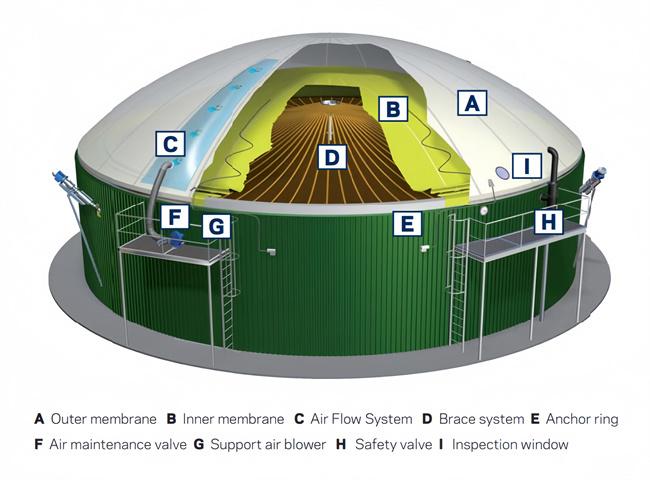
The biogas balloon for wastewater treatment solves these issues with a dual-membrane design:
- Inner Gas Layer: Stores biogas at 3-25 mbar pressure.
- Air Cushion Layer: Automatically adjusts to maintain structural integrity.
- UV-Resistant Outer Cover: Withstands harsh weather for 20+ years.
| Feature | Biogas Balloon | Steel Gas Holder |
|---|---|---|
| Installation Time | 3-5 days | 6-8 weeks |
| H₂S Resistance | Yes (no metal corrosion) | No (requires coating) |
| Pressure Management | Fully automatic | Manual valve adjustments |
| Lifespan | 15-20 years | 25-30 years |
| Cost per m³ Storage | USD20-USD30 | USD80-USD120 |
Table 1: Biogas balloon vs. steel gas holder for wastewater applications.
- Remove 90-95% of H₂S using biological scrubbers (<100 ppm residual).
- Maintain digestate temperature at 35-37°C for stable gas production.
- IoT sensors track gas volume, pressure, and methane content in real time (A PLC system needs to be selected and configured).
- Alerts trigger when CH₄ drops below 55% or pressure exceeds 30 mbar.
- Option 1: Direct combustion in CHP units (35-45% electrical efficiency).
- Option 2: Upgrade to biomethane (95% purity) for grid injection.
- Challenge: Frequent gas leaks in aging steel tanks caused 12% annual methane loss.
- Solution: Installed 2,000 m³ biogas balloon with integrated H₂S scrubber.
- Results:
- Energy Savings: 1.2 GWh/year generated for onsite use.
- Emission Reduction: 4,800 tons CO₂eq/year eliminated.
- ROI: Achieved in 2.3 years via energy sales and carbon credits.
- Modular Stackable Units: Scale storage capacity vertically to save space.
- AI-Powered Predictive Maintenance: Algorithms forecast membrane wear 6 months in advance.
A: Yes! Their elasticity allows 10-20% volume expansion during peak biogas production.
A: Use non-abrasive robotic cleaners during annual maintenance shutdowns.
A: Specify salt-resistant polymers (e.g., EPDM rubber) during procurement.
A: Economical for plants processing ≥10 tons sludge/day (≈500 m³ biogas/day).
The biogas balloon for wastewater treatment is more than a storage device—it's a strategic asset for circular economy goals. By converting waste sludge into clean energy, plants can slash operational costs by 20-40% while meeting stringent emission regulations. As technologies advance, these systems will become indispensable in creating climate-resilient wastewater infrastructure.
- 1 m³ biogas ≈ 6 kWh thermal energy
- Global biogas market in wastewater to hit $12.7B by 2030 (CAGR 6.8%)
- EPA estimates 60% of US wastewater biogas is currently flared—a $300M recoverable loss
Get in Touch
Have questions about our products or want to discuss a custom order? Our team is ready to help you.