
Condensation Cure Liquid Silicone Rubber For Gypsum And Concrete Mold Making
Condensation Cure Liquid Silicone Rubber For Gypsum And Concrete Mold Making
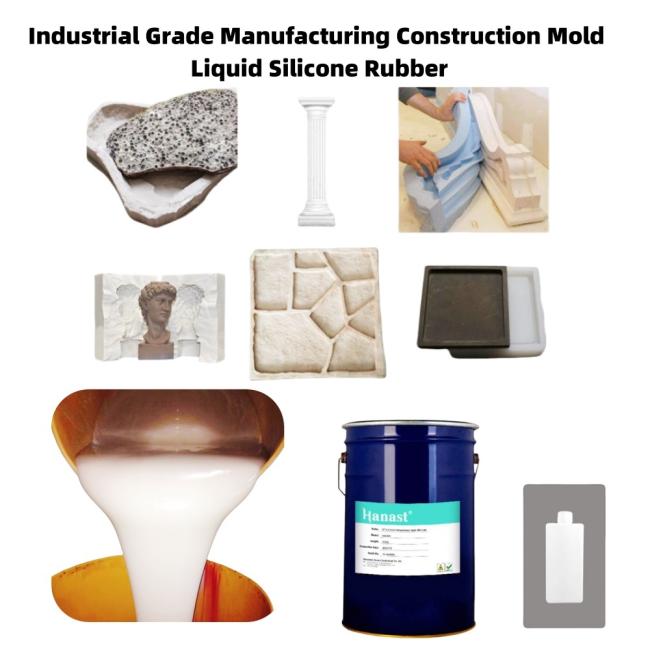
RTV-2 tin-cured liquid silicone rubber (LSR) delivers exceptional performance in producing high-durability molds for concrete, plaster, and silicone-based architectural components. Engineered for precision and resilience, it is the optimal choice for fabricating decorative elements such as patterned wall tiles, ornate Roman columns, and intricate relief panels.
Key Properties of Tin-Cured LSR
1. Room Temperature Fast Curing, Easy & Stable Operation
This is an RTV-2 two-component condensation cure silicone rubber. It consists of part A and part B, with a mixing ratio of 100:2~3 by weight. It cures fully at room temperature without heating, offering an operation time of 30–40 minutes. You can also adjust the curing speed by modifying the catalyst addition (1.5%–3%) according to the ambient temperature. Even without a vacuum machine, bubbles can escape naturally by extending the standing time, making it ideal for factories, workshops, and new users for batch mold making.
2. High Tear Strength & Excellent Toughness, Resists Cracking After Multiple Uses
It features outstanding tear resistance and tensile properties. After curing, the material remains highly elastic and tough, with no cracking, deformation, or brittleness even after repeated use. It supports dozens of demolding cycles, delivering a much longer service life than ordinary silicone. Perfect for molds for concrete, resin, plaster, cultural stone, and other hard materials, it ensures smooth demolding without damaging fine details, significantly reducing mold-making costs.
3. Ultra-Low Shrinkage & High Detail Reproduction, Captures Fine Textures Precisely
With a linear shrinkage rate of ≤0.3%, the cured silicone maintains excellent dimensional stability without deformation. It perfectly reproduces intricate patterns, reliefs, sharp edges, and complex structures with zero distortion, making it ideal for sculptures, antique replicas, precision prototypes, crafts, decorative moldings, and other applications requiring high fidelity.
4. Excellent Temperature, Weather & Chemical Resistance, Suitable for a Wide Range of Applications
The standard formula offers a working temperature range of -50℃ to 200℃, and high-temperature resistant versions are available upon request. It also boasts superior aging resistance, acid and alkali resistance, water and moisture resistance, and remains free from chalking, cracking, or sticking when used outdoors for long periods. It is widely used for molds for concrete, resin crafts, plaster, candles, soap, candy art, cultural stone, and artificial stone.
5. Customizable Hardness & Performance, Tailored to Different Mold-Making Needs
- Shore A 5~10: Extra soft, ideal for human body simulation, insoles, and pads.
- Shore A 15~35: Best all-round performance, perfect for general-purpose molds for concrete, resin, and plaster.
- Shore A 40+: Extra hard, suitable for jewelry casting, high-hardness filling, and leather embossing.
Applications in Architectural Mold Making
| Segment | Use Cases | Performance Benefit |
| Mass Production | Concrete pavers, modular wall systems | High tear resistance for 1,000+ casts |
| Custom Design | Heritage restoration molds, 3D facade panels | Captures 50μm surface textures accurately |
| Landscaping | Artificial boulders, fountain basins | UV stability for 5+ years outdoor use |
Comparison with Alternative Materials
- vs. Platinum LSR:
- Pros:Cost-effective; superior air release for bubble-free molds.
- Cons:Lower thermal stability; continuous exposure to >200°C can degrade the tin catalyst.
- vs. Polyurethane:
- Pros: 3× longer service life; superior chemical resistance to wet concrete.
- Cons: ~20% slower cure time; requires mold release agents when used with PU master models.
Get in Touch
Have questions about our products or want to discuss a custom order? Our team is ready to help you.