
Food Starch Sugar Release Glucose Pullulanase Enzyme
Food Use Liquid Glucoamylase and Pullulanase
HGA-101PC For Starch Sugar Release Glucose
Higher conversion rate from starch to glucose.
This compound enzyme product has been specially designed for the production of starch sugar.
DESCRIPTION
Food Use Liquid Glucoamylase and Pullulanase HGA-101PC For Starch Sugar Release Glucose
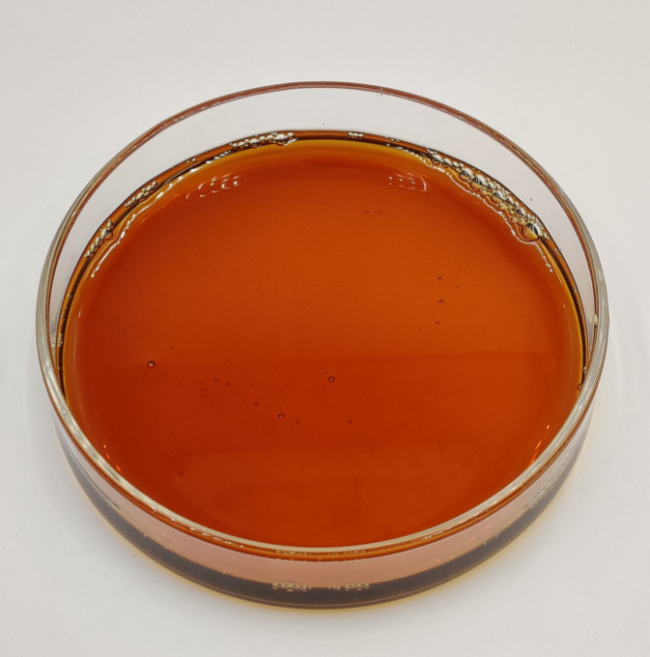
HGA-101PC is a Glucoamylase / Pullulanase blended enzyme. It contains robust Glucoamylase and starch debranching enzyme - Pullulanase. The Glucoamylase is produced from controlled fermentation of selected strains of Aspergillus niger , whilst the Pullulanase is produced from robust strains of Bacillus licheniformis. Glucoamylase can hydrolyze alpha-1,4 glucosidic linkages from the non-reduction end of starches to release glucose, whilst Pullulanase can specifically cleave the alpha-1, 6 glycosidic bond of the branching point of amylopectin, and cut out the entire branch structure to form amylose. Thus HGA-101PC has a higher conversion rate from starch to sugar.
This compound enzyme product has been specially designed for the production of starch sugar.
| Glucoamylase Activity: | 100,000U/ml (minimum) |
| Pullulanase Activity: | 1,400BU/ml (minimum) |
| Appearance: | Yellow brown liquid |
| Product pH: | 3.0 to 5.0 |
| Specific Gravity: | 1.10 to 1.25 g/ml |
Effect of pH
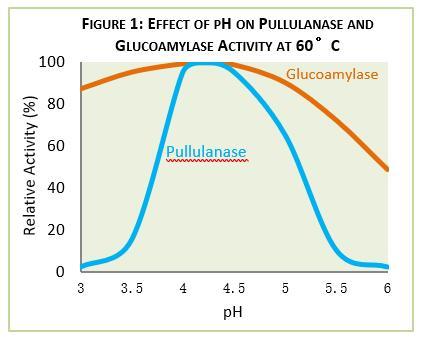
HGA-101PC can work at pH range from 3.5 to 5.0. For maximum activity, the optimal pH range is 4.0 to 4.5, with an optimum pH at 4.2-4.5 (See Figure 1).
Effect of Temperature
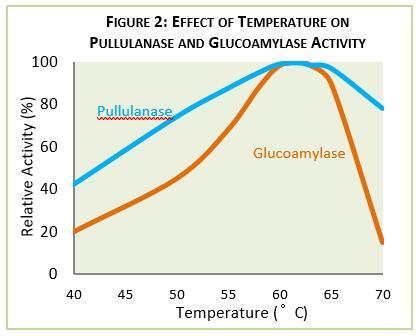
Effective temperature range for HGA-101PC is 55 to 65°C, normal temperature range is 58 to 65°C , with an optimum temperature at 60°C. HGA-101PC can be inactivated at temperatures above 65°C. Normally, this product will be completely inactivated if the saccharified liquid is boiled at 80°C for 5 minutes (See Figure 2).
| Effect of pH | Effect of Temperature |
 |
 |
BENEFITS FOR STARCH SUGAR INDUSTRY
Food Use Liquid Glucoamylase and Pullulanase HGA-101PC For Starch Sugar Release Glucose
Use of HGA-101PC ensures the following benefits for starch sugar industry:
| √ | Greater conversion rate from starch to glucose |
| √ |
Maximized utilization of raw materials |
| √ |
Stable activity ensures stable dosage rate, no need to adjust dosage for each batch |
| √ |
Suitable for the production of glucose with DX≥97% |
| √ |
Capable to work with higher concentration substrate |
USAGE GUIDELINES
Food Use Liquid Glucoamylase and Pullulanase HGA-101PC For Starch Sugar Release Glucose
Add this product into liquefied starches of substrates such as corn, wheat, barley, tapioca, rice, potatoes, etc. can convert the starches into glucose.
Recommended optimal temperature for industrial operations is 59 to 62°C, pH 4.1 to 4.5.
First, adjust pH; then add this product. Dosage rate depends on the type of raw materials and actual processing conditions. It is recommended to conduct several trials to determine the optimal dosage rate. A generally recommended dosage rate for HGA-101PC is 0.30 to 0.5kg / TDS. The saccharification should be kept for 32 to 48 hours depending on its actual processing requirements.
PACKAGING, STORAGE AND SHELF-LIFE
Food Use Liquid Glucoamylase and Pullulanase HGA-101PC For Starch Sugar Release Glucose
- Standard packaging is 25kg, 30kg food-grade HDPE drums or 1125 kg IBC totes.
- Customized packaging is available upon request.
- Typical shelf-life is six months if it is stored below 25°C in its original packaging, sealed and unopened, protected from sunlight.
- Its shelf-life will be eighteen months if this product is stored properly at 0∼10°C.
- HGA-101PC has been formulated for optimal stability. Prolonged storage and/or adverse conditions such as higher temperature may lead to a higher dosage requirement, therefore should be avoided.
SAFE HANDLING OF ENZYMES
Food Use Liquid Glucoamylase and Pullulanase HGA-101PC For Starch Sugar Release Glucose
Inhalation of enzyme dust and mists should be avoided. In case of contact with skin or eyes, promptly rinse with water for at least 15 minutes. For detailed handling information, please refer to the Safety Data Sheet.
Get in Touch
Have questions about our products or want to discuss a custom order? Our team is ready to help you.